I am watching 27 movies over the next two months that I otherwise would not have watched. All movies from my watchlist I was not planning on watching. I will post a little review for each one.
Starting with # (Day 1)
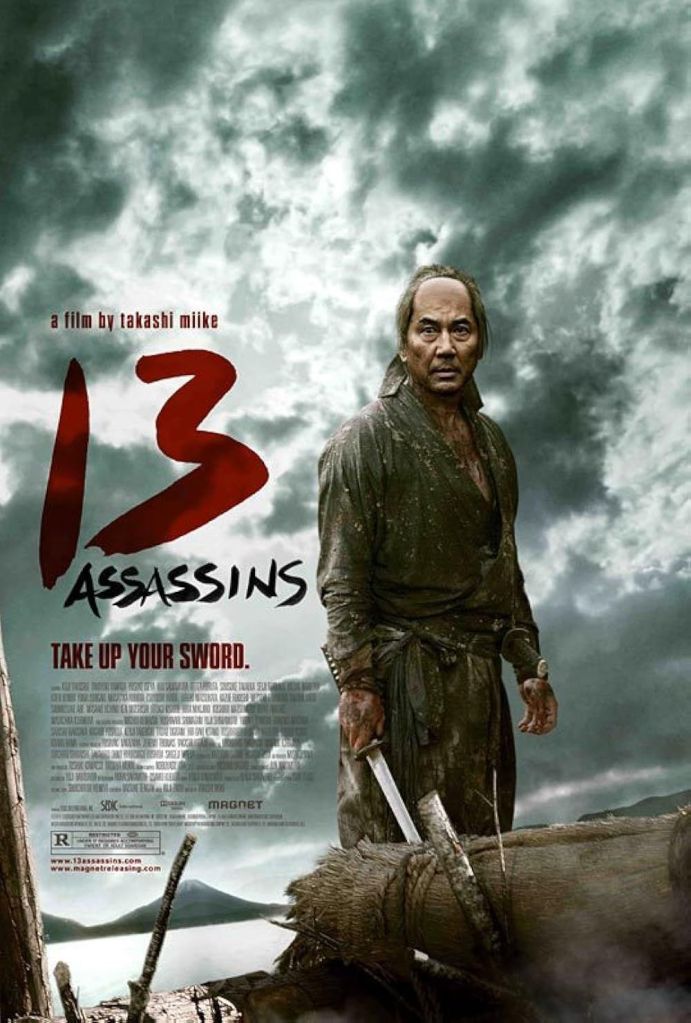
13 Assassins (Takashi Miike, 2010)
You could call this one of the best Dungeons and Dragons movies ever made. It is in no way based on the tabletop RPG, but it has that feel. Set at the end of an extended era of peace in Japan (likely the Edo period from 1603 to 1868), all samurai are trained for combat but no one has actually ever fought in a battle. A samurai master becomes disillusioned by a tyrannical lord and commits ritual suicide, seemingly feeling there was nothing else he could do to take the lord down. This does the trick. A bunch of samurai/Ronin are brought together to take down this supremely evil antagonist.
This isn’t an overly visceral movie. It’s not about spectacle or violence, though it is violent. It has some special effects that look incredibly cheap for 2010, but that doesn’t bother me. It is “telling a story” about samurai mindset and ethos in a specific time and place. It is extremely well written, every scene is masterful and drips with character. I had to keep my phone as a study guide to understand everything going on, but it didn’t detract from the experience. I look forward to watching the movie again straight through after reading a list of all the characters. To look for little details I might have missed. If I saw this when I was 12 years old, it would have been the best movie ever.
An incredibly ambitious piece of low budget filmmaking.
The idea here is a good one: what if Alzheimer’s disease was something you could catch?
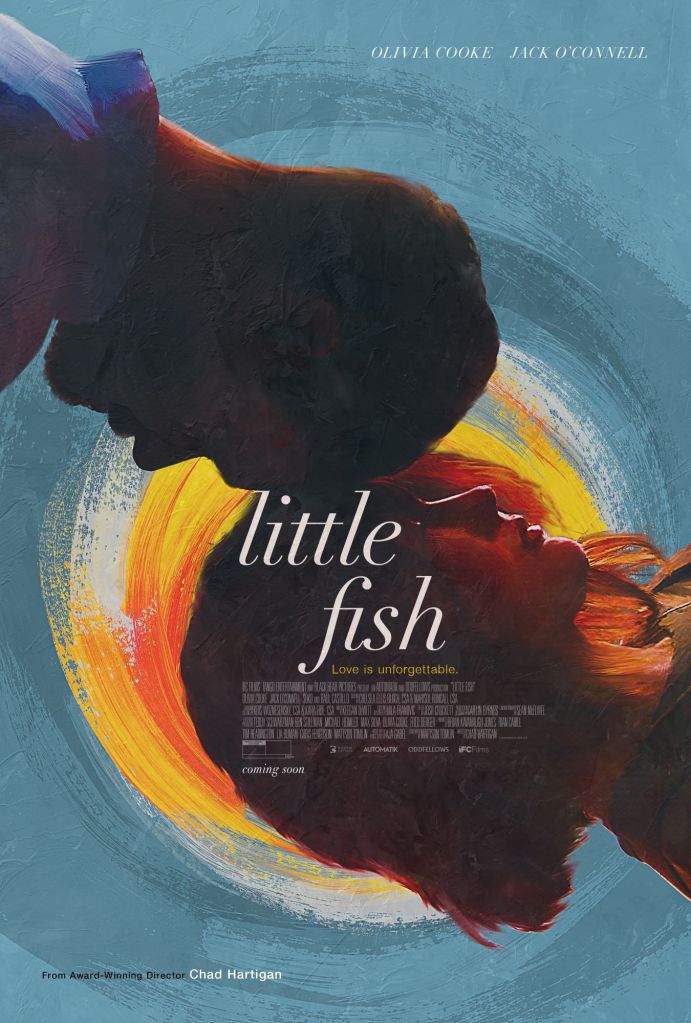
Now, imagine giving that premise to Terence Malick to write and direct and you will have a basic idea of what Little Fish is like.
The story follows Emma (Olivia Cooke) as she grapples with the Alzheimer’s-like disease that is erasing the memory of her husband, Jude (Jack O’Connell). The disease can either affect you all at once or it can affect you gradually. Jude’s loss is very gradual.
The script relies on Emma’s narration, both to explain what is happening in the plot and what is happening to her emotionally. I am reminded of Days of Heaven‘s voice-over narration. It isn’t the greatest idea in a movie to have most of the plot just flatly told to you instead of shown visually, but here it works. I usually hate voice-overs, but when it seems purposeful in many ways, I dig it. Because we hear her narration, we understand everything: what each idea means to her, why it means to her to choose the specific details she is recalling, what her emotions have been like during this process.
Badlands is associated with extreme world-building. PT Anderson held it up as a pinnacle of filmmaking because it “used pictures on the walls.” What he seemed to mean was that they found pictures that looked like Sissy Spacek’s family from childhood and put them on a wall. Just to have in the background for a few seconds. Either they asked Sissy to bring in pictures of herself or someone spent time finding photos that could work. In the days before online photo libraries that could be searched with a few keywords, this was almost unheard of.
There are little touches like that in Little Fish. Giant murals are chosen for quick shots. Mysterious paintings that just display a word on the entire side of a building. Did they scout out the location themselves? Or did they commission the painting? Either way, it would have required over a hundred hours of work for a shot that lasts only a few seconds.
In the world of Little Fish, every little word counts. There is one scene where Emma and Jude stand looking at a collage of pictures of details from their lives with their names taped to them. Dogs, friends, locations.
Literal pictures on walls.
Tattoos are also used to keep memories of importance alive, but again, the plot doesn’t dwell on this. It doesn’t affect the plot in the way such a device was used in, say, Memento.
For a low-budget film, it’s nice to see care put into the little details.
I feel like the team (the writer, the director, the producer, et al.) worked their hardest in a mad fit of effort to come up with ways to maximize the resources they had. At one point, a car crashes into another car in a scene that in no way affects the plot. It is just a way to add punctuation to the emotional changing world.
Little bits of effort make an impact. Noticing these moments that seem superfluous made me wonder, “why would they do this? What meaning does this bring?”
In a different scene, the camera follows the characters through a nice area in the city when, in the background, someone has crudely spray-painted the words “Iris come home” on the wall outside. The shot only lasts six seconds and the camera doesn’t focus on the wall. That moment is so subtle and adds an extra layer of meaning.
Who is Iris? What is her story? Did she paint it herself? Why would the community leave it?
Is the thought of Iris never making it home too heartbreaking to remove the graffiti?
Perhaps the biggest problem this movie had critically: if there is a contagious epidemic going on, why does no one wear masks? It was kind of unfortunate this came out when it did, as it was made in a pre-Covid world and came out post. There actually is one scene where scientists made everyone wear masks. However, there is a moment where a main character takes off the mask out of confusion and no one seems to care. This, to me, spoke volumes. The scientists were making people wear the masks as a technicality, but it seems like everyone has figured out that the disease is not airborne. That is my reading of the world as it is portrayed.
The movie is about memory loss, but in a way that embraces quiet melancholy. The movie recalls, specifically Eternal Sunshine of the Spotless Mind, in a way that has the characters protective of their love for each other instead of actively trying to remove such memories. Trying to hold on to memories or trying to remove them. Either way, I appreciate the depth of thought that went into this: both movies are told nonlinearly in a method that cherry-picks the important moments. This relationship feels very lived in.
Overall, this is a quiet movie that explores how Alzheimer’s affects people struggling to keep hold of themselves and the people they love. And it asks the age-old question: is it better to lose a loved one or lose the memories of the person you loved?
Best of all is the final line. Poetic and meaningful, it conveys a real message. When remembering the love of your life, even the most important emotions fade into the background when you remember him.
This is a collection of interviews and stories from dog owners and admirers about the dogs in their communities or the pets that have changed their lives. The mood of the film aligns with its title — this is all very, very sad. Sad stories, sad people, and sad circumstances that brought dogs into their lives.
The music is relentlessly somber, a constant collage of string instruments playing sustained whole notes, reminiscent of Philip Glass composing his version of Adagio for Strings by Samuel Barber. Interestingly, the actual composer is a former child actor, one of the Little Rascals from the 1990s movie — an odd detail.
About 80% of the film is not in English. It’s a beautifully filmed, albeit somewhat amateur, travelogue that captures glimpses of how dogs are perceived in various cultures. Some of the countries featured include Chile, Peru, Uganda, Pakistan, Romania, Vietnam, and Scotland. I had to look this up, as the segments aren’t separated by headings or on-screen text.
The film might have been aiming for the tone of Kedi, the 2016 documentary about Istanbul’s street cats. In that film, we see how cats bring meaning to people’s lives, often serving as community mascots. They’re respected and cared for, but no one person takes sole responsibility for them.
The opening story, set in Santiago, Chile, echoes this concept. It features a dog named Dr. Coffee who lives a dual life. Everyone in the neighborhood knows him and will often ask, “Have you seen Coffee today?” He moves freely, vanishing and reappearing days later. Eventually, one resident learns that the hospital nearby knows him by a different name — he has a room there and stays for days at a time. Coffee isn’t like a typical dog; he doesn’t crave pets and affection. His version of companionship is simply sitting quietly with kind people.
In Uganda, survivors of violent trauma are given dogs as a form of emotional support. One woman names her dog PTSD to reflect the emotional weight she’s working through. The belief is that a dog provides unconditional love, free from hate or judgment. The group dog-training sessions, where dozens of new dog owners learn how to care for their companions, are striking in their simplicity and warmth.
In Pakistan, a self-described tomboy finds a dog on the street with a paralyzed leg, covered in maggots, and left to die. Despite many people telling her to give the dog away once he recovered, she refused. Some people in Pakistan believe that having a dog in the house will prevent God from accepting you into heaven. She rejects that belief, instead seeing the dog’s presence in her life as part of God’s plan. Her story is one of quiet defiance and compassion.
Not all the stories are tragic. In Chile, a therapy dog named Patron brings joy to residents of a retirement home. During an exercise session, Patron is told to “find the yellow ball,” which he does effortlessly. The residents marvel at his ability to distinguish colors. One participant remarks, “If a dog comes up and hugs you, then it is a hugging dog, and you can hug it.” This gentle wisdom encapsulates the joy dogs bring — they accept us for who we are.
However, the film doesn’t shy away from difficult realities. In Vietnam, the dog meat trade is addressed. A restaurant owner recounts how his father introduced him to the practice as a child. While he acknowledges that dog meat consumption has declined, he continues to serve it as long as there is demand. This segment is sobering, forcing viewers to confront how cultural norms shape our perceptions of animals. It made me wonder about the conditions of dog meat farms and, by extension, the treatment of all farm animals. Should I view them all as dogs? It’s a thought that lingered with me.
While the film’s tone leans toward the morose, it remains gentle in its approach. Dog lovers will appreciate the celebration of the bond between humans and animals, as long as they’re prepared for the emotional weight of the stories. Ultimately, We Don’t Deserve Dogs serves as a poignant reminder of the kindness and joy that dogs bring to our lives.
“Carrot Rope” was rather odd, even by Pavement-standards. The closing song on Pavement’s final album, Terror Twilight, seems to be an ode to the penis, and, on a cursory listen, it seems to be about making sexual advances to a child. This begs the question: Why? Why on Earth would you want to go out on such an uncomfortable image?
Do Pavement lyrics need to make sense? Let’s break it down, shall we?
Lyrics
SPIRAL: I want to say SM: It’s my second hand wonder A thing that recovers the doubt SPIRAL: Slim door MARK: Like a rainstorm, you’ve got to do What you want and say it
This overlapping chaos always thrills me. Two (or more) singers fighting for attention. It has the air of a Spiral Stairs song that Stephen Malkmus couldn’t help but comment on. For the track to have three lead singers seems destined for disaster, but somehow, the melodies sing. It’s a fascinating mess.
“It’s my second hand wonder, a thing that recovers the doubt.”
Malkmus seems to jump in, out of only curiosity. “I don’t mean to bump into your song, but maybe I can elevate this in some way. ‘Cause I’m not really sure about this. Is it too simple maybe?”
Then Mark chimes in: “This seems like a rainstorm, melodically.” If something sounds like a good idea, why not throw it onto the pile? The song seems alive. One line in, I find myself wondering — are all of the lyrics going to be this dense?
SM: It’s of my design assembled at the cut SPIRAL: Slim door SM: It’s all right to shake, to fight, to feel MARK: You go down, down, down, down
The tug of war goes on. Malkmus asserts his role as the track’s architect, insisting that this tangled web of ideas is his design. The song is stitched together “at the cut” — a phrase that could evoke film or audio tape editing.
The band takes turns adding cool sounds. Spiral shuts a door, Mark takes steps down, and Malkmus proclaims that what moves you can’t be bad. That’s Malkmus’s entire lyrical philosophy in a nutshell.
SM: Harness your hopes to the folks With the liquor with the ropes Red, red ropes, periscopes They’ve got everything you will ever need Stored under the chair
Was this a callback to “Harness Your Hopes” — an outtake from Brighten the Corners? When “Carrot Rope” came out, most listeners wouldn’t have even heard that B-side. Maybe the phrase lingered in Malkmus’s head, a leftover on the cutting room floor.
A harness controls and restrains. Maybe he’s saying, “We’re all trying to make something great here, but we have to keep it contained.” Or maybe “the folks with the liquor and the ropes” are the fans, the ones who decide what a song ultimately means.
And “stored under the chair”? It could be either forgotten ideas or just literal junk. We decide, I guess. I personally stash things under my patio furniture. Maybe that’s what he’s talking about — those weird little details we all carry.
Simmer, simmer, simmer down Simmer, simmer, simmer down Don’t waste your precious breath Explaining that you are worthwhile
The music slows, as if trying to soothe us. And the message? You are worthwhile. But why waste time explaining it to somebody else? Seeking validation from others is futile.
Simmer, simmer, simmer down Simmer, simmer, simmer down Be patient and I’ll let you see my Carrot rope, feed my thrill I got beat by weather
Calm down, and I’ll let you see my penis. But don’t worry — it’s flaccid. Rock stars have a long history of singing about their genitalia, but Pavement makes it sound so incredibly… ordinary.
Then there’s the wicket keeper — a cricket term. The wicket keeper stands behind the stumps, ready to catch the ball. If the keeper is down, the game is compromised and no one can win. The sustained minor chord that ends the section is pure “Game over, man.”
SM: Hey little boy, would you like to know What’s in my pocket or not It’s no ploy, it’s no gimmick It’s the chance of a lifetime to see Something that’s never seen by mere mortals
SPIRAL: Except me MARK: And myself
And now the song spirals into overt creep territory. Malkmus adopts the voice of a pervert, though what he offers to show the boy is… his carrot rope. It’s an absurdly non-sexual euphemism. “Hey, want to see what a grown man’s penis looks like?” Ok. Unsettling. But maybe not dangerously so?
Spiral and Mark chime in as if additional voices in Stephen’s head. “No one has ever seen my penis, but me and only me.” It’s like something out of The Jerk — “And that’s all I need. And that’s ALL I need.” The song becomes a parody of rock-star bravado.
A little, little Christian lie A little, little Christian lie Debating if it’s time To drop the bomb on you, my dear
But what if this isn’t just parody? What if the song masks something deeper? The “Christian lie” could point to internalized homophobia — the struggle of someone trying to suppress their desires. He might be married, fighting to maintain a facade.
A little, little Christian lie A little, little Christian lie Let’s get down to brass tacks and start it
And now, we strip away the nonsense. “Brass tacks” means getting to the essentials. Maybe the song’s narrator is finally done pretending. He’s ready to confront what’s real. If this is a man with internalized homophobia, maybe this transition considers it is time to explore his sexuality in a healthy way (around other adults).
It’s time to get me off of the ground The wicket keeper is down The wicket keeper is down And he gets me off of the ground
And just like that, we’re back to cricket. The image shifts. “The wicket keeper is down”, but he is just helping someone get off the field. My guess is he probably isn’t coming back. This was nice, but it was probably time. “Fun while it lasted.”
The idea of helping each other, even at the expense of winning, is a strangely sweet sentiment for Pavement’s career closer.
Final Thoughts
Looking at the lyrics as a whole, the song’s vocal interplay feels like a deliberate comment on the “let’s just say it because it sounds cool” tradition. Pavement, ever meta, critiques on what is happening.
After years of making music through compromise and collaboration, Malkmus was likely rgo on his own. “Carrot Rope” feels like him wrestling with that — knowing it’s time to step away but still tangled in the joy and frustration of the band dynamic.
And after all that? I’m left with this: this is my third favorite Pavement song.*
Lyrical content: A Rating: 5/5
*Not that it matters, but number one and two are “Cut Your Hair” and “Harness Your Hopes.
A swirling buzzsaw boast song that forgets to actually boast about anything.
The second single from BRAT — literally every critic’s #1 (or #2) album of the year — was brought up by a friend as something different, but fantastically so. Yet neither of us had any idea what the lyrics meant. So, let’s break them down.
“I went my own way and I made it I’m your favorite reference, baby Call me Gabbriette, you’re so inspired.”
The opening is a boast, but one laced with irony. Gabbriette refers to Gabbriette Bechtel, a model and influencer who was part of the band Nasty Cherry. In Netflix’s short-lived reality series I’m With the Band: Nasty Cherry, Charli XCX wasn’t a member — she was the creator, producer, and mentor.
No, this isn’t Neneh Cherry of “Buffalo Stance” fame. You’ve probably never heard of Nasty Cherry. They have around 60,000 Spotify listeners, three EPs, and a handful of singles. The reality show fizzled after six episodes, and despite the band naming their second EP Season 2, there was no actual second season. The third EP, fittingly titled The Movie, brought the project to a close.
Charli seems in on the joke. The line “You’re so inspired” mocks the idea that anyone would overhype her more obscure accomplishments. It’s a sly jab at fans who try to impress her by knowing everything. “Call me Gabbriette” isn’t a boast of greatness — it’s a reminder that even her minor failures are apparently iconic.
“I’m tectonic, moves, I make ’em Shock you like defibrillators No style? I can’t relate I’ll always be the one.”
Charli leans into grand, nerdy imagery. Tectonic plates cause earthquakes when they shift — a term that pops up in music when artists want to sound powerful. Pairing that with defibrillators (devices used to shock a heart back to life) adds to the drama.
This whole section is a playful exaggeration. She’s no heavyweight rapper; this is indie-pop braggadocio, cartoonishly exaggerated. “I’m so powerful I’ll knock the earth off its axis and bring you back to life with a single beat.”
“Drop down, yeah Put the camera flash on So stylish Baby tee is all gone.”
“Drop down” is striking a pose — a model’s move. And while a baby tee was once the peak of Y2K fashion, it’s now a symbol of immaturity. Charli isn’t playing cute anymore; she’s ditching the trends. This shift from “baby tee” to “icon” is all part of her fashion evolution.
“Yeah, 360 When you’re in the mirror, do you like what you see? When you’re in the mirror, you’re just looking at me I’m everywhere, I’m so Julia.”
A 360 spin — posing from every angle — is the ultimate model flex. But Charli isn’t a supermodel. She’s taking on the persona of her famous friends, like Julia Fox, the actress and model best known for Uncut Gems and brief relationship with Kanye West.
Julia isn’t exactly Cindy Crawford or Heidi Klum; she’s more in the Chloë Sevigny or Alexa Chung category — an “It Girl” whose fame is driven as much by her personality as her career. Charli isn’t trying to be a traditional star; she’s part of the same effortlessly cool orbit.
“When you’re in the party b-b-bumpin’ that beat 666 with a princess streak I’m everywhere, I’m so Julia.”
The “666” lyric is Charli playing into her devil-may-care image, contrasted with a princess streak — a little girly indulgence. It’s punkish, unserious, and dripping with irony.
And then there’s the line:
“That city sewer slut’s the vibe.”
It’s as grotesque as it is deliberate. The sewer slut aesthetic — gritty, trashy, and hyper-stylized — is a fashion statement. Charli’s adopting the exaggerated grunge of downtown club kids. It’s not real filth; it’s curated filth.
A.G. Cook and the Boast Track Subversion
“Legacy is undebated You gon’ jump if A.G. made it If you love it, if you hate it I don’t fing care what you think.”
A.G. Cook is Charli’s longtime collaborator and a pioneer of hyperpop. The “jump” she refers to is both literal and metaphorical — his chaotic production inspires movement, even from reluctant listeners.
There’s a tradition of boast tracks in pop and hip-hop — songs dripping with excess and confidence. Charli’s version twists the trope. Unlike the diamonds and champagne of Ariana Grande’s “7 Rings” or the opulent flexes of Cardi B’s “Money”, Charli brags about her obscure reality show, her niche producer friend, and a DIY fashion sense.
Even compared to Biggie’s “Juicy”, where the late rapper celebrated middle-class comforts like a Super Nintendo, Charli’s boasts are gleefully unserious. No private jets or penthouses here — just selfies, baby tees, and the thrill of making a scene.
Final Thoughts
The production of “360” is gloriously chaotic. Charli’s voice punches through buzzing synths and clapping percussion, her monotone delivery serving as a rhythmic anchor. She’s not trying to croon a beautiful melody — she’s demanding your attention.
The video adds to the absurdity. There’s Charli pouring red wine while wobbling on a vibration plate (an exercise device of questionable effectiveness). She straddles a hospital bed-ridden man, poses with outdated computers, and walks through a crumbling restaurant as waiters smash chairs for her dramatic entrance. It’s a farce, but a glamorous one.
That “360” made it to pop radio at all is astonishing. It’s not a hit in the traditional sense, but it’s infectious. And for all its bizarre references and self-deprecating boasts, it’s proof that Charli’s pop sensibility remains undeniable.
Remember those days in your second car? Good times.
“Diet Pepsi” might be the best somewhat-popular song of 2024 that you still don’t know. In a year where many young women have made the jump from casual artists to superstars (Charli XCX, Sabrina Carpenter, Chappell Roan), it’s nice to see the underdog baton being passed to the next wave.
Analysis of the Lyrics
My boy’s a winner, he loves the game My lips reflect off his cross-gold chain. I like the way he’s telling me My ass looks good in these ripped blue jeans
A quickly painted picture of a girl fawning over her alpha-male boyfriend. He likes glitz and glamour, but I don’t get the sense that she requires that in a guy. She appreciates that it’s his style—and that she can accessorize him, too.
A cursory listen makes the word “ass” really stand out. It’s rather shocking, actually. The song has a Taylor Swift-esque pop sound, but Swift would never objectify her body this overtly—or if she did, she wouldn’t sing about enjoying that some guy did it. This is a girly girl who enjoys the attention and validation.
My cheeks are red like cherries in the spring Body’s a work of art you’d die to see Untouched, XO Young lust, let’s—(ah)
Firstly, cherries don’t ripen until May or June. Cherry trees do bloom in the spring, but their flowers are white or pink, not red. So, she’s not a botanist. But I like that there’s a line about cherries in a song called “Diet Pepsi.” Along with the bubbly production and understated, sped-up vocal delivery (which we’ll get to later), a sense of sugary coldness is conveyed here.
I don’t buy that Addison is singing about a girl who has never had sex. She and this guy have likely been together for a while, but when it’s time to have sex, she likes to role-play as if it’s her first time. There are less fulfilling sexual fantasies.
When we drive in your car, I’m your baby (so sweet) Losing all my innocence in the back seat Say you love, say you love, say you love me (love me) Losing all my innocence in the back seat
Addison defines herself as an accessory to her boyfriend’s lifestyle. She doesn’t feel like she matters less to him than his jewelry or his car—it’s just that everything fits together perfectly.
“Losing all my innocence in the backseat.” This song isn’t for young girls losing their virginity. It’s for women in their late thirties and up, evoking memories of making out in the backseat of a car with the stereo playing. Do you remember the first time you made out with a guy in his car? That.
Most notable about the chorus is the way “losing all my innocence” is pitch-shifted, giving her voice a Chipmunk-like quality. Coupled with reverb and a high-pass filter that thins out the vocal, the song has a dreamlike, ethereal quality.
I always find significant pitch shifting interesting—how did she even write this melody? She likely didn’t originally conceive it at that pitch; it was probably a production decision that elevates the song’s uniqueness. My guess is that she wrote the melody an octave lower, and then a producer suggested raising it artificially. She may have recorded that line with the track slowed down so she could naturally hit those notes before speeding it back up. The result is a pristine, glass-like effect that stands out from anything on the radio right now.
Break all the rules ’til we get caught Fog up the windows in the parking lot Summer love (ah, ah), sexy Sitting on his lap, sippin’ Diet Pepsi
She and her guy create their own little world in his car. Normal rules don’t apply. When I was in high school, there always seemed to be that one couple who could get away with making out in the school parking lot. The reaction wasn’t “PDA? Gross.” It was more like, “They must be so in love.”
“Diet Pepsi” feels meticulously crafted to evoke nostalgia—a longing for a relationship where your first time feels just as special as your first-ever experience. I doubt Addison Rae is reflecting on her actual first time; that was probably mundane or awkward. What she’s doing is crafting an idealized memory: a moment where everything feels perfect. “Losing all my innocence” could just as easily be read as roleplay, which is why she emphasizes it so insistently.
I enjoy that the song is called “Diet Pepsi” and that it’s just a throwaway detail in the second verse. When I think of Diet Pepsi, I picture a glass bottle freshly pulled out of an ice-filled cooler. On a summer night where the windows are fogging up from body heat, what could be more refreshing? (I just don’t know where they’re getting a Diet Pepsi in a random parking lot. Did they bring a cooler?)
Some songs that use noticeable pitch shifting (at least half a pitch or more) include “Oblivion” by Grimes, “Feels Like We Only Go Backwards” by Tame Impala, and “When I’m Sixty-Four” and “Strawberry Fiekds Forever” by The Beatles. The reason this section sounds so much like Grimes (my favorite modern recording artist) is that it achieves that same high-pitched, dreamlike vocal effect without her voice going into head voice. It retains its fullness while sitting at an almost impossibly high register.
I write my name with lipstick on your chest I leave a mark so you know I’m the best
This line is funny. Is she actually pulling out a tube of lipstick and writing “Addison Rae” on his torso? She’s obviously just kissing him all over with his shirt off, leaving little marks so that if anyone sees him shirtless before he showers, they’ll know he was with her. “Writing her name with lipstick” is a playful euphemism.
As the song nears its conclusion, the production takes a twist. There’s a break, but a few beats later, the music comes back with a key shift. However, it’s not a standard key change—it sounds like the entire track has been slowed down, enhancing the song’s hazy, surreal atmosphere.
How does she perform this song live? She does not appear to actually sing the line “losing all my innocence in the backseat.” She sings the first half and then dances around and smiles for the second part. I’m still a bit perplexed by the exact recording techniques used in the song. That line was definitely recorded while the music was slowed down (before being sped back up). But it could also be, “When I’m Sixty-Four”-style, that the entire track was originally sped up for the first 80% of the song. To then shift the pitch speed in the form of a key change feels like a fresh, novel approach.
As far as I know, this is the only pop hit that uses this trick so dramatically. For the last chorus to sound like it’s coming from a cassette tape played at a different speed is subtly innovative. It’s rare for a pop song to intentionally call attention to the artificiality of its own vocal processing.
The song seems revolutionary in its own quiet way.
Amyl and The Sniffers are probably the best pure punk band making new music right now. They are known for their live performances. I have never seen them play, but I can imagine their unique vibe making for a memorable, energetic show.
The band released their third LP, Cartoon Darkness, in 2024, and it is great—a mix of early/second-generation punk, like Minor Threat and Dead Kennedys, blended with arena-ready hard rock, like AC/DC. The song “Tiny Bikini” stood out to me for its big riffs and playful lyrics. It is my favorite song on the album. Someone said, “Why don’t you write a review for it?”
So here we are. Doing a deep dive on a two-minute fifteen second song about wearing a bikini. I am fascinated by the thought. Will analyzing every line reveal hidden layers of meaning?
The Music
With this one, what stood out most was the music, so let’s start here. The song kicks off with a syncopation-less, anthem-like headbanger riff that calls to mind Beavis and Butt-Head bands AC/DC and Judas Priest.
Thematically, the song appears to evoke “Sharp Dressed Man by ZZ Top and “Money for Nothing” by Dire Straits. A cursory listen gives a sense of glamour and excess.
The “Ooohs” that start each line in the verses sound like two girls being impressed by something beautiful, like a dress at a red carpet gala or a precious piece of jewelry. The hook riff is pure “Money for Nothing”, which seems to be saying, “This song is about living cool—like a rock star.”
The Lyrics
But what do the lyrics mean? I had no idea, and I was afraid that analyzing them would reveal nothing and make me like the song less. But here we go.
“Oooh, you like it when I stay up late Is there anywhere in this world a dream can’t take me?”
This premise is actually quite funny. I didn’t realize this song was about vocalist Amy Taylor falling asleep and talking to a dream version of herself. She has stayed up late, likely performing until 3 a.m. at a punk show, and she’s very likely to have vivid dreams—being sleep-deprived and full of stimulation from being around a lot of people all night. So far, so good.
“Ooh, I know it’s technically my space But I’m the only one here in a bikini”
What a funny premise. She’s having a lucid dream where she should be able to do anything she wants—you’d think she’d be the one in control. Maybe she could imagine everyone else in their underwear. No such luck. “But I’m the only one in a bikini.” Ah, cruel irony.
“Ooh, I just wanna wear my bikini Ah, I just wanna wear my shorts”
Hilarious. Now that she’s here, at a crowded after-party wearing just a bikini top and suggestive shorts, she’s going to make the most of it. It’s not that she wants everyone to stare at her—she just doesn’t care. Being proud of your girl parts can make you feel confident. Societal norms and good etiquette be damned.
“Eh, there’s too many snags at the party Eh, so I’m just gonna walk”
I get the sense that the party she was at earlier in the night felt too stuck-up and pretentious. There’s a sense of self-awareness—like she wishes she had done this in reality when it really would have counted. Instead, she’s going to enjoy the freling in this very good dream.
“Ooh, you think the world is not man enough? So I’m gonna inject some of this cunt”
Ahh, so there’s another layer going on here. These punk rock after-parties are full of hyper-masculine dudes trying to out-bro each other. So, while she’s showing off her breasts and feminine wiles, she isn’t doing it in a playful, sexy way. She’s doing it to be just as cool as everyone else—except she’s the only one doing something in-your-face and definitive.
“Ooh, if I didn’t show up in something spicy The cold world would feel even more icy”
It’s not just that the party is full of dudes who are too pretentious for school—she feels like no one was having any fun at all. That isn’t Amy’s style. She might not want to be the one objectified and exposed, but she’s willing to take one for the team to make everyone else have a good time.
I initially thought the point of the song was casual narcissism upon a casual listen, but I still rather liked it. It had a playful punk attitude and vibe. Knowing the full details not only made the song make sense, but it also made me actually laugh out loud.
Peehaps more than anything, this song is a tongue in cheeky homage to the rebellious swagger of The Shangri-Las, pride in being the feminine role in a scene filled with gruff uber-masculinity. “I’m just gonna wear my bikini” has its place for the girls who go to these punk shows and feel like the stranded 10 percent.
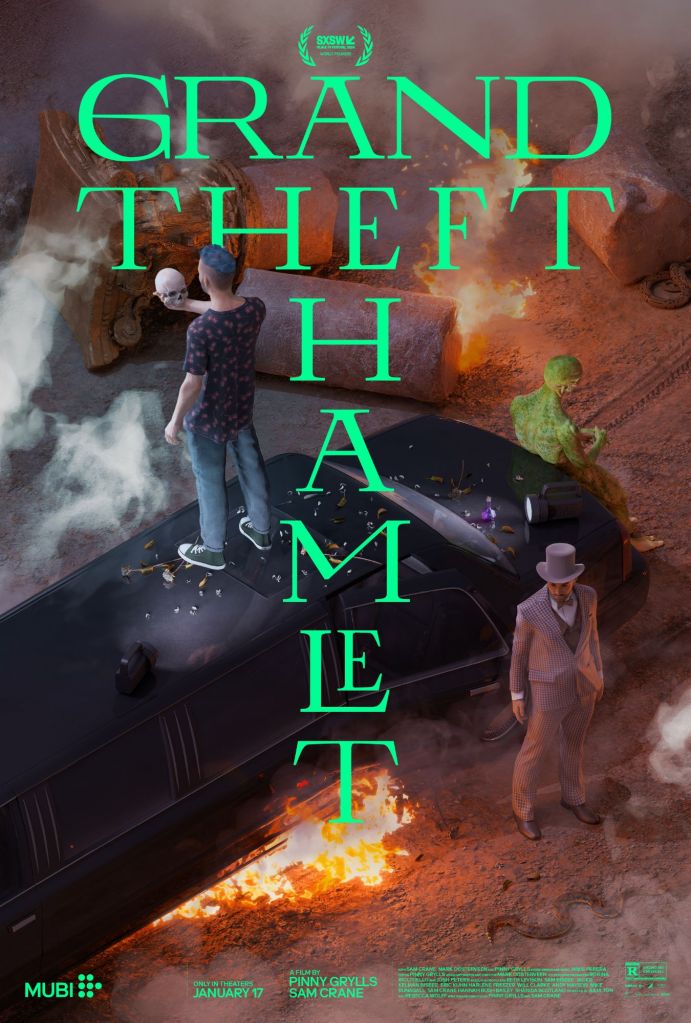
Hmm. This is just the making of Grand Theft Hamlet.
So, what is Grand Theft Hamlet? It’s a performance of Hamlet staged within Grand Theft Auto Online. Here is what that looks like:
Grand theft auto trailer.
But what exactly is GTA Online?
It’s an “open-world, action-adventure, multiplayer” sandbox game. That might sound like World of Warcraft mixed with Grand Theft Auto, but not really. GTA Online is actually part of Grand Theft Auto V, rather than a separate MMO. Only 30 players can be in the same session at a time—far fewer than the thousands in WoW.
But is GTA Online any good? That’s what I’ve been trying to figure out. The game had a mixed critical reception when it launched on PS3, likely due to server issues and bugs. Even after a PS4-era re-release, reviews remained similar. GTA V as a whole is beloved—often considered one of the best games of its generation—but I’m not sure how much of that acclaim extends to its online component.
One thing’s for sure: GTA Online is popular. Over 20 million people still play it every month, even today. Considering GTA V has sold 205 million copies, that means about 10% of people who bought a game originally released 12 years ago still log in regularly. That’s remarkable longevity. It might not be my thing, but it must have done something right.
So how was the performance of Hamlet?
No idea. Out of Grand Theft Hamlet’s 90-minute runtime, only about 10 minutes are dedicated to the performance itself. No full scene is shown. I was hyped to see Shakespeare—I even prepped by familiarizing myself with the themes, characters, and plot. But I didn’t need to. The full performance isn’t available online. And if the filmmakers didn’t want to show it, I have to assume it wasn’t very good.
As a documentary, Grand Theft Hamlet is a fascinating making-of feature. But it’s more like a DVD bonus than a full-fledged film. The project was marketed as a complete in-game performance of Hamlet, but the documentary isn’t that—it’s about the attempt to make it happen.
Was GTA Online the right place for this?
Probably not.
The idea started when two out-of-work Shakespearean actors, stuck at home during the COVID-19 lockdown, discovered a massive outdoor theater while exploring GTA Online. They wondered, Could we stage a play here? They tried performing lines, announcing their impromptu show to any players nearby. Before they could start, another player in the audience shot them, looted their corpses, and left.
Not a great start.
But they persisted, bringing in a documentary filmmaker to capture their attempt to perform Hamlet in full.
At first, I thought GTA Online was a large enough MMO that thousands of players could gather to watch, but with only 30 per session, that wasn’t the case. Even then, the idea of Hamlet performed in the chaos of GTA—grenades going off, cars ramming the stage, audience members shooting each other—sounded like a trainwreck I needed to see.
It wasn’t quite that, but it was still a trainwreck. They struggled to recruit actors, often getting killed mid-rehearsal. Every time they died, they respawned at their home base and had to drive all the way back—assuming their car didn’t explode on the way.
I appreciate that GTA Online sparked the idea: Let’s perform a play in an online world. But they put zero effort into considering other platforms. VRChat, Rec Room, Neos VR, Second Life, Minecraft, Roblox, Mozilla Hubs—all arguably better suited for virtual theater. But because they got the idea while playing GTA Online, that’s what they used.
As a gimmick for a documentary, it’s clever. The contrast between GTA’s violence and Shakespeare’s high art is intriguing. But if the goal was to explore whether online theater works, the film needed to dig deeper. I’d love to see a documentary that actually tested different platforms to see which one best supports digital performance.
“I’ve been sitting at home. Alone.”
More than anything, Grand Theft Hamlet is about pandemic-era isolation and how people filled that time. Unless you worked in an essential field, you were probably stuck at home, wondering how to stay productive. (Charli XCX: Alone Together tackles a similar theme—though in that case, the result was How I’m Feeling Now, one of her best albums.)
Many people got pulled into video game routines. One actor even asks his wife, “Do you think I spend too much time playing this game?” She says, “Yeah, a little bit.” His friend stays up late rehearsing, while he spends all night “buying planes” in GTA Online. He even misses his wife’s birthday. She tells him she has to log into the game just to spend time with him.
At one point, he says, “I want to give you a hug.” She replies, “You can in real life. I live in the same house as you.”
While Grand Theft Hamlet has more to say about video game addiction than Shakespeare, it’s still worth a watch. If you’re interested in how video games are changing the way people connect and create, this documentary offers a glimpse of what’s starting to be possible—while also highlighting the many limitations.
Final Thoughts
The idea of performing Hamlet in a video game is interesting, but this documentary sells the concept of a great film rather than being one itself. That said, it got me thinking. Online theater is still underexplored. I’d love to see a documentary that takes a methodical, America’s Test Kitchen approach—experimenting with different platforms to see how Shakespeare (or any play) translates into a digital environment.
If their Hamlet is unavailable, maybe it just didn’t work. But I’d love to see someone try again—this time, with a game that actually supports the concept.
Let’s be clear from the start: this song is about Donald Trump—or at least a powerful, Trump-like executive or political figure. It opens with the line, “Donnie dug a hole,” immediately evoking the phrase “Drill, baby, drill!” from Trump’s rallies. But more broadly, it paints a picture of someone powerful who keeps digging their own grave, constantly making a mess of things.
Then comes, “Momma turns to dust. She was on the train tracks waitin’ for the blood to rush.” His mother, full of ambition for her son, was waiting for him to become a great man. But she died before seeing how it all played out.
The perspective then shifts to Donnie himself: “And you told me I was stayin’ strong When all I’ve done is play along And they put it on, they put it on me.”
This feels like a confession—Mama, I tried to be the man you thought I would be, but I never wanted this.
Then comes the pivotal line: “Maybe you’re not the person who caught the football.”
The imagery here is striking: a football player runs into the end zone, convinced he has scored the winning touchdown. He celebrates as if he’s the star of the game—only to look at the scoreboard and realize his team has lost. What happened?
This perfectly conveys misplaced confidence—someone who believes they’re destined for greatness, only to face the reality that they weren’t the right person for the job. It’s reminiscent of politicians who prematurely celebrate election victories.
Hillary Clinton’s 2016 campaign famously planned an election-night celebration at the Javits Center in New York, complete with confetti cannons meant to simulate breaking a glass ceiling. Many Bernie Sanders supporters believed he was the rightful nominee, and when Clinton lost, it only fueled their frustration.
Trump had his own moment of misplaced victory. On election night in 2020, he declared himself the winner before the results were in. When he ultimately lost, he refused to accept it—leading to the events of January 6th, when a mob stormed the U.S. Capitol, forcing members of Congress to flee.
Both Hillary’s balloon drop and the chaos of January 6th would pair beautifully with “Football”—a politician at a bar, drink in hand, watching these moments unfold on TV.
The second verse shifts focus to Mary, seemingly a stand-in for conservative influencers or televangelists:
“Her faith was wearin’ thin like an old shoe sole.”
The song describes Mary’s faith exactly the same as Donnie’s old, withered face. It conveys someone who is struggling to seem overwhelmingly confident in their beliefs but ultimately is just putting on a show. “She would even f___ the preacher if he paid enough.”
She is so determined to profit from faith that she’s willing to compromise its core principles.
Then comes a moment of intimacy, or perhaps an alliance: “And his ring is off and his button down And he tore it off and she tore around.”
This isn’t necessarily literal. It suggests a politician forming a mutually beneficial relationship with a powerful religious figure—two people bound together by influence rather than love.
“Put a bullet in and pull it on three. Don’t pull it on me.”
This line speaks to the ruthless nature of power—finding scapegoats and sacrificial lambs to stay on top. No one wants to be the one taking the fall.
Despite the weight of the lyrics, the music itself is surprisingly delicate. A Norah Jones-like piano line cascades in gentle triplets over a steady 4/4 drumbeat, creating a sense of fragile beauty. The lead melody—played on a lap steel guitar with heavy reverb and a volume pedal—feels ethereal, each note swelling into existence rather than being plucked outright. It’s the perfect soundtrack for staring out a coffee shop window on a gray, rainy morning.
It’s a striking contrast—lush, haunting instrumentation paired with biting political commentary. The song’s subtle steel drum accents and whispered vocal overdubs (“leave, don’t leave”) add to its dreamlike, weightless atmosphere. Yet at its core, it remains grounded in its message: arrogance, misplaced faith, and the sobering realization that power isn’t always what it seems.
If this idea could be distilled into a postcard, it would fly off the shelves. The song lingers, both sonically and thematically, long after it ends.
Releasable, but not otherwise a cause for celebration.
“Oh my God. They’re making a re-quel.” “A what?” “Or a Legacy-quel. Fans aren’t quite sure on the terminology.”
That’s not a good sign. If the trend you’re referencing doesn’t even have a proper name, you might not want to hinge your entire script on it.
So let’s investigate this legacy-quel idea. If I understand it based on Scream (2022), it’s when a movie shares the same name as the original, looks like a remake, but is actually a sequel. It takes place in the same world, continuing the story while trying to pass the torch to new characters. The film presents this as a major trend worth parodying. But… is it?
At the time of this movie’s production, there was really only one clear case: David Gordon Green’s Halloween (2018). For some reason, they just called it Halloween, instead of adding a number or subtitle, making it confusing for audiences. But even that wasn’t entirely new—Halloween H20 had already tried to ignore past sequels and return to the original’s vibe. The franchise then spiraled into chaos with Halloween: Resurrection (widely considered the worst entry), Rob Zombie’s divisive remakes, and finally, a nine-year dormancy before the 2018 reboot.
So, was Halloween (2018) really the start of a trend? At the time Scream (2022) was being written, two more so-called “legacy-quels” were in development: Candyman and The Texas Chainsaw Massacre. But those movies weren’t even out yet. Scream treats legacy-quels like they’re an established Hollywood phenomenon, but this feels premature—more like the filmmakers heard the term floating around and rushed to cash in.
And even among recent sequels that revive old franchises, most don’t just reuse the original title. Ghostbusters: Afterlife, Blade Runner 2049, Star Wars: The Force Awakens—all of these continued the story but at least had unique names. The only recent example I can find of a sequel taking the exact same name as the original is Ted, the TV series. And even that could have just been called Ted: The TV Show—but I guess that sounded too much like CSI: Crime Scene Investigation – The Board Game.
The worst offender is Scream itself. Naming Scream 5 just Scream is obnoxious. It forces fans to refer to it as Scream (2022)—which I hate typing—just to differentiate it from the 1996 classic. If Hollywood insists on doing this, at least give us a color-coded logo system, like Peter Gabriel and Weezer do with their self-titled albums.
So how’s the movie?
It’s fine. It seems aware that modern horror has evolved past the slasher formula, but instead of fully embracing that, it just points it out. The characters openly discuss how “elevated horror” (The Babadook, It Follows, Hereditary) is what people actually watch now. That’s another bad sign. If your own script admits the genre has moved on, why are we here?
The script overall is hammy and half-baked. The vibe is: “We noticed this trend, so we rushed this out the door. We didn’t put much effort in, because this won’t be relevant anyway.” Reviews have been generous, probably because they brought back as many surviving original characters as possible. Scream (1996) had the benefit of satirizing a slasher trend that was still relevant enough to participate in. Scream (2022) tries to satirize a trend that barely exists.
As for the returning cast, the energy feels like: “I’m too old for this. But what else am I doing? This is the script? Really? I’ll only need to be there for a week? Good enough, let’s go.”
The movie strains with its meta-humor and callbacks. “Do you know what happens to the expert?” You mean Jamie Kennedy? He survives the first movie. So, “Do you know what happens to you?” “Yeah. I’ll survive… for a while at least.” The self-awareness borders on lazy winking.
There are a couple of cute modern touches: kids watching YouTube breakdowns of bad sequels, using phone tracking apps to monitor a partner’s location. These ideas feel relevant but barely impact the plot. They were probably brainstormed in the writers’ room and then forgotten.
The Most Unrealistic Scream Movie Yet?
For a franchise built on exaggerated horror tropes, this might be the most unrealistic Scream yet. Where are the returning characters’ partners and kids? Wouldn’t they have obligations keeping them from abruptly chasing down a serial killer? Also, how does Scream (2022) manage to reference the exact dialogue from the original’s opening scene? Spoiler: everyone present in that scene was dead. Even if they made a movie (Stab) based on those events, how would they have an exact transcript?
The ending is… fine. It doesn’t make much sense, but it has the pulpy, page-turning quality of an airport thriller. There are enough twists that I didn’t outright reject the movie.
But Scream (2022) definitely misjudged the legacy-quel concept, or at least overestimated its importance. It’s trying to make a trend happen that doesn’t really exist.
Final Verdict
The sixth installment is supposedly “just as good” as this one. I might watch it.

 Avidavr: Media Reviews