An incredibly ambitious piece of low budget filmmaking.
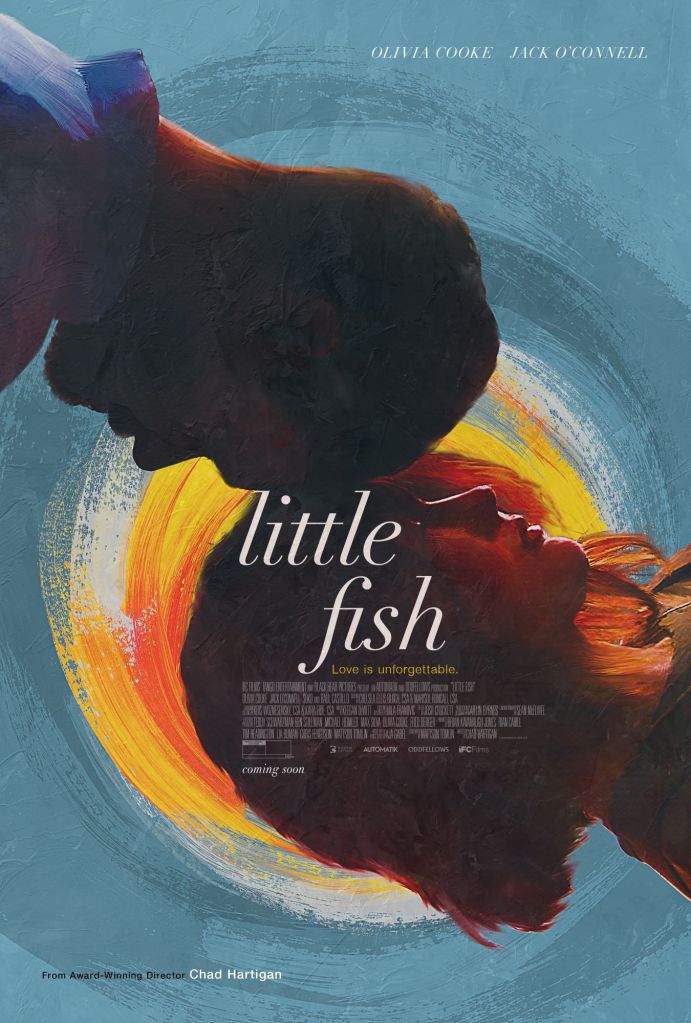
The idea here is a good one: what if Alzheimer’s disease was something you could catch?
Now, imagine giving that premise to Terence Malick to write and direct and you will have a basic idea of what Little Fish is like.
The story follows Emma (Olivia Cooke) as she grapples with the Alzheimer’s-like disease that is erasing the memory of her husband, Jude (Jack O’Connell). The disease can either affect you all at once or it can affect you gradually. Jude’s loss is very gradual.
The script relies on Emma’s narration, both to explain what is happening in the plot and what is happening to her emotionally. I am reminded of Days of Heaven‘s voice-over narration. It isn’t the greatest idea in a movie to have most of the plot just flatly told to you instead of shown visually, but here it works. I usually hate voice-overs, but when it seems purposeful in many ways, I dig it. Because we hear her narration, we understand everything: what each idea means to her, why it means to her to choose the specific details she is recalling, what her emotions have been like during this process.
Badlands is associated with extreme world-building. PT Anderson held it up as a pinnacle of filmmaking because it “used pictures on the walls.” What he seemed to mean was that they found pictures that looked like Sissy Spacek’s family from childhood and put them on a wall. Just to have in the background for a few seconds. Either they asked Sissy to bring in pictures of herself or someone spent time finding photos that could work. In the days before online photo libraries that could be searched with a few keywords, this was almost unheard of.
There are little touches like that in Little Fish. Giant murals are chosen for quick shots. Mysterious paintings that just display a word on the entire side of a building. Did they scout out the location themselves? Or did they commission the painting? Either way, it would have required over a hundred hours of work for a shot that lasts only a few seconds.
In the world of Little Fish, every little word counts. There is one scene where Emma and Jude stand looking at a collage of pictures of details from their lives with their names taped to them. Dogs, friends, locations.
Literal pictures on walls.
Tattoos are also used to keep memories of importance alive, but again, the plot doesn’t dwell on this. It doesn’t affect the plot in the way such a device was used in, say, Memento.
For a low-budget film, it’s nice to see care put into the little details.
I feel like the team (the writer, the director, the producer, et al.) worked their hardest in a mad fit of effort to come up with ways to maximize the resources they had. At one point, a car crashes into another car in a scene that in no way affects the plot. It is just a way to add punctuation to the emotional changing world.
Little bits of effort make an impact. Noticing these moments that seem superfluous made me wonder, “why would they do this? What meaning does this bring?”
In a different scene, the camera follows the characters through a nice area in the city when, in the background, someone has crudely spray-painted the words “Iris come home” on the wall outside. The shot only lasts six seconds and the camera doesn’t focus on the wall. That moment is so subtle and adds an extra layer of meaning.
Who is Iris? What is her story? Did she paint it herself? Why would the community leave it?
Is the thought of Iris never making it home too heartbreaking to remove the graffiti?
Perhaps the biggest problem this movie had critically: if there is a contagious epidemic going on, why does no one wear masks? It was kind of unfortunate this came out when it did, as it was made in a pre-Covid world and came out post. There actually is one scene where scientists made everyone wear masks. However, there is a moment where a main character takes off the mask out of confusion and no one seems to care. This, to me, spoke volumes. The scientists were making people wear the masks as a technicality, but it seems like everyone has figured out that the disease is not airborne. That is my reading of the world as it is portrayed.
The movie is about memory loss, but in a way that embraces quiet melancholy. The movie recalls, specifically Eternal Sunshine of the Spotless Mind, in a way that has the characters protective of their love for each other instead of actively trying to remove such memories. Trying to hold on to memories or trying to remove them. Either way, I appreciate the depth of thought that went into this: both movies are told nonlinearly in a method that cherry-picks the important moments. This relationship feels very lived in.
Overall, this is a quiet movie that explores how Alzheimer’s affects people struggling to keep hold of themselves and the people they love. And it asks the age-old question: is it better to lose a loved one or lose the memories of the person you loved?
Best of all is the final line. Poetic and meaningful, it conveys a real message. When remembering the love of your life, even the most important emotions fade into the background when you remember him.
A great companion piece to Away From Her.
8.5/10.
 Avidavr: Media Reviews
Leave a comment