Author: Avidavr

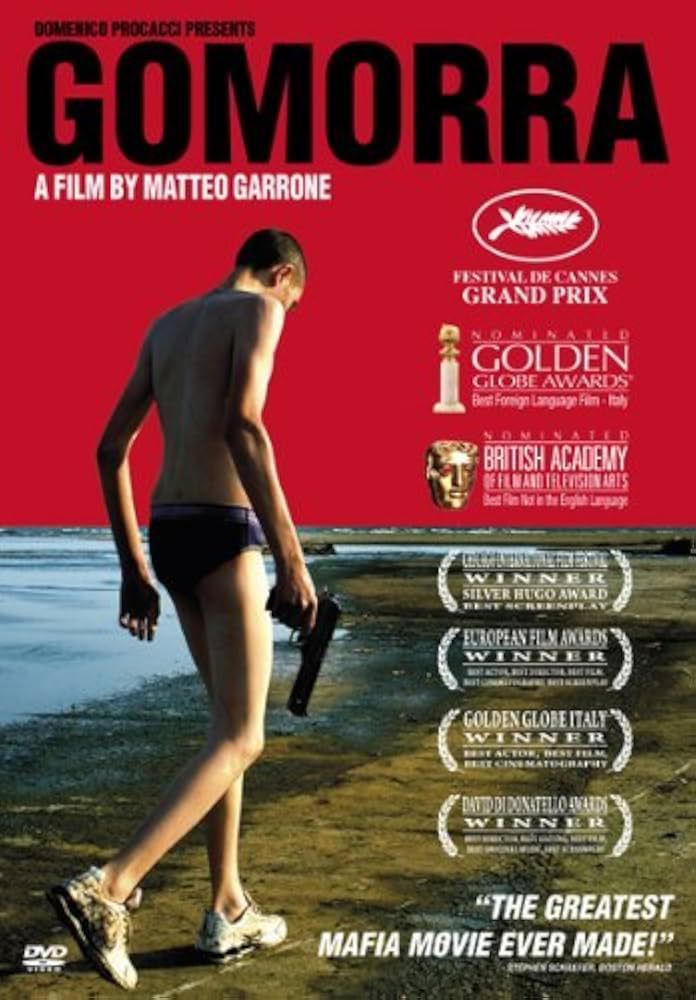
  • Gomorrah (2008)

    My 27 movie A-Z film-a-thon: Day 8

    This one felt real to me—the culture, the power dynamics, the hierarchy of command. I believe this is what the Mafia really is.

    There is no honor here. No sacred “Mafia code.” It all comes down to the bottom line: money, and no liability.

    The difference between life and death is arbitrary. Early on, a 15-year-old is asked why he’s shaking—is he scared? “No,” he says. The older man is pointing a gun at his head. “Are you scared?” “No.”

    Bang.

    He’s dead. For no reason other than being too afraid to admit he was afraid. The next kid wears a bulletproof vest and survives. Why? Luck. You have to guess right. What will offend the Camorra? What will charm and delight them? The difference is negligible. The consequences are massive.

    Director Matteo Garrone shows us the world of the Camorra through two central perspectives. The A story follows two kids raised in a world where the mob is king, trying to break into it. The B story centers on a high-end fashion tailor who makes no money because the syndicate exploits his skill. This second story is more compelling.

    The kids are idiots. I would’ve preferred to see what this system does to the smart ones—but I fully believe kids like this exist. And they’re doomed.

    Gomorra presents a world of crime that is consistently fascinating. Every scene feels like something I haven’t seen in a film before. For this type of movie, that’s miraculous. Beat for beat, it’s consistent in the psychology of its world-building. I’m not sure if Gomorra is a necessary film the way City of God was five years earlier—but it’s absolutely a purposeful one.

    8.5/10

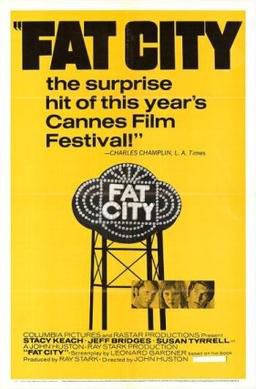
  • Fat City (1972)

    My 27 movie A-Z film-a-thon: day 7

    Most sports movies are about the 0.1% who achieve something extraordinary. Fat City is about the other 99+.

    I’ve never really understood the sports mindset. I get being a casual fan. I get enjoying physical activity and the social element. But I don’t get the fantasy footballers who desperately need Chuba Hubbard to rack up yards, or the guys betting their paychecks on the Knicks winning by 14. I especially don’t understand the middle-aged men still clinging to glory days on their high school wrestling team.

    That mindset is what Fat City explores. When deciding what to watch for the letter F-Fresh (2022) or Fat City-a friend said he got why I was leaning toward Fat City: “It’s gay.” I asked what he meant. He said the trailer was homoerotic. Queer-coded.

    I went in cold, knowing only the premise and that comment. And honestly, I think he was onto something. John Huston seems genuinely fascinated by men who are drawn to other men but can’t quite articulate or even understand that desire.

    “When I first saw you at the Y, I thought, ‘Now there’s a guy who is soft in the center.’ (beat) Never mind.”

    Jeff Bridges plays a boxer everyone gravitates to-not for his skill, but for his movie star looks. A coach lies in bed, unable to stop praising him: “He’s good looking. He’s white. People like to see a white boy fight.” His wife pretends to be asleep. It’s hard not to read something queer in a middle-aged man fixating on a 19-year-old at 1 a.m.

    Despite being quiet and subdued, the movie never feels dull. Every scene adds something. Each minute offers a new idea, another glimpse into the psychology of small-town people living in the past. There’s no wasted space here-just a deepening sense of melancholy.

    Fat City received a single Oscar nomination: Supporting Actress for Susan Tyrrell, playing a hot mess of a drunk who can’t decide whether to accept the steak Stacy Keach cooks for her. But it’s Keach who anchors the film. His performance is the story-his expressions, his reactions, the silent things his character carries.

    John Huston didn’t write this script, but his films always had an ear for natural, revealing dialogue. Fat City ranks among his very best in that regard.

    9/10.

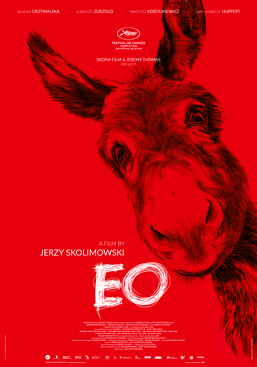
  • EO (2022)

    My 27 movie A-Z film-a-thon: Day 6

    The idea is to watch and review 27 movies I would likely not have gotten to anytime soon. I am trying to knockout some well reviewed movies I am curious, but not overly excited, about.

    My journey so far has been:

    _ 13 Assassins (Takashi Miike, 2010) – 9/10

    _All Dirt Roads Taste of Salt (Raven Jackson, 2023) – 7.5

    _Blow Out (Brian De Palma, 1981) – 8.5

    _Cold War (Pawel Pawlikosski, 2018) – 6.5

    _Darby O’Gill and the Little People (Robert Stevenson, 1959) – 9 

    This is one I had picked out from day 1. I was so sure I was going to like this. It seemed to be a little bizarre and bat crazy, usually my wheelhouse.

    EO (2022) Review

    For whatever reason, EO seems to drag on forever — which is odd, because it’s only 90 minutes long. I kept asking myself: Why is this so dull? It’s intriguingly filmed, but emotionally hollow.

    The plot veers from one extreme turn to another, often stretching believability. Time and again I found myself repeating, “This is unlikely.” If this were a film about magical realism or something genuinely inspirational, I might have adored it. The one compelling thread is that EO, having once been a circus performer, has the temperament and training to keep escaping trouble. He genuinely likes people — and that’s what keeps him alive.

    In that sense, EO reminded me most of The Pianist. Adrien Brody’s survival hinges on his exact combination of virtues, just as EO survives by possessing the right qualities at the right time. But whereas The Pianist builds its world with weight and consequence, EO feels more like a series of self-conscious flourishes.

    That brings me to the style. Why is there a red filter over so many scenes? Why does the film periodically burst into epilepsy-triggering strobe effects? Do donkeys only see in strobing reds? These choices come off more like art-house affectation than anything rooted in the film’s themes or perspective.

    I wanted EO to feel necessary or believable — ideally both. Instead, it offers implausible set pieces that don’t hold up under scrutiny. The football scene, where EO is brutally attacked by rival fans with metal poles, is particularly absurd. There’s no documented history of such animal abuse occurring after a loss, and the fans themselves don’t even seem that emotionally invested in the match to begin with. Then, late in the film, we get a cameo from Isabelle Huppert that leads to an unearned and out-of-nowhere incest subplot. It’s baffling.

    The idea of EO excited me. On paper, it sounds like a children’s film with heart — a donkey’s odyssey across a hostile world. But it lacks the soul, wonder, or even plausibility to make that concept land. It’s not touching. It’s not believable. It’s just a beautifully shot, meandering series of affectations.

    5/10

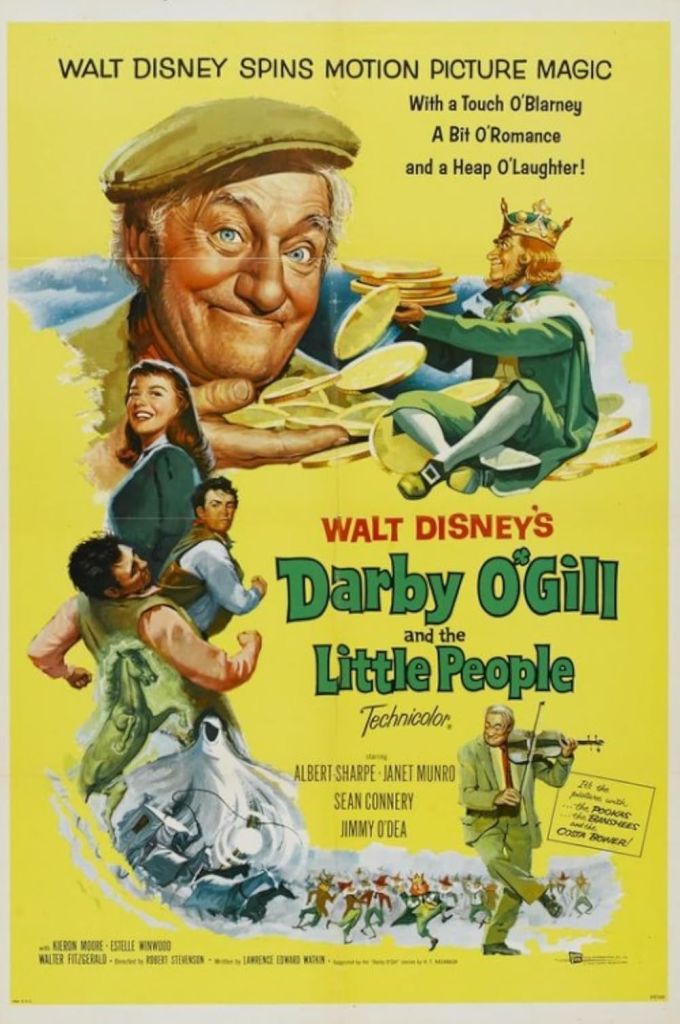
  • Darby O’Gill and the Little People (1959)

    My 27 movie A-Z film-a-thon: Day 5

    My 27 movie A-Z film marathon, day 5.

    I am watching a movie for each letter of the alphabet I otherwise probably wouldn’t get to (anytime soon).

    So far, my journey is this:

    13 Assassins (Takashi Miike, 2010) – 9/10

    All Dirt Roads Taste of Salt (Raven Jackson, 2023) – 7.5

    Blow Out (Brian De Palma, 1981) – 8.5

    Cold War (Pawel Pawlikosski, 2018) – 6.5

    The next one is one I was *hoping* I would enjoy, but didn’t think I actually would much. It’s the exact type of film this project was made for.

    Darby O’Gill and the Little People (1959) – Review

    I wish I had watched this on VHS instead of Disney+. The Disney+ version uses a widescreen 1.85 aspect ratio rather than the original 1.33 full frame—the image feels zoomed in, with the tops and bottoms noticeably cropped.

    Nevertheless, I’m glad I finally saw this little-known Disney classic. Why I don’t watch it every St. Patrick’s Day, I have no idea. It’s wall-to-wall Irish charm: Celtic music, drinking, leprechauns… It’s a slightly altered Beauty and the Beast, only it’s the father who must remain instead of the daughter.

    This movie ticks all the boxes for a holiday tradition: tall tales, improvised Irish pub songs, elaborate dance numbers, even a house cat chasing a leprechaun. It’s full of charm—the kind of film my grandma would’ve adored, smiling through the whole thing. It really is what so-called “classics” like White Christmas and The Sound of Music only aspire to be.

    My favorite part is the music. Every minute is soaked in the very best of the era—it’s joyful and varied. The plot keeps introducing new ideas to match the melodies and movement. I love this for all the same reasons I love Singin’ in the Rain and A Night at the Opera. This might be my third-favorite feel-good movie.

    9/10

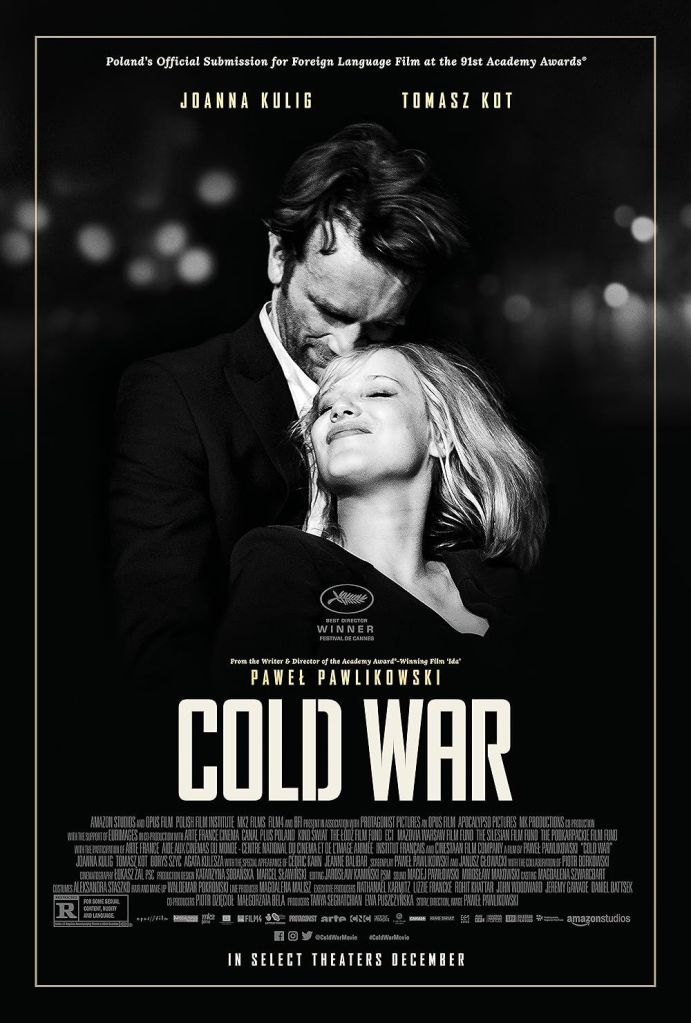
  • Cold War (2018)

    My 27 movie A-Z film-a-thon: Day 4

    Each day, I choose a movie that looked interesting but I was not planning on watching soon.So far, I have watched the following, with my rating.

    13 Assassins (Takashi Miike, 2010) – 9/10

    All Dirt Roads Are Made of Salt (Raven Jackson, 2023) – 7.5

    Blow Out (Brian De Palma, 1981) – 8.5

    Day 4: C

    I was deciding between Creed and Cold War, and wound up choosing the movie that seemed less like Blow Out. Cold War seemed different the rest of the movies previously, and I did not realize it got an Academy Award nomination for Best Director (Despite not Best Picture). I have thoughts about that, but maybe I will get to those 

    Cold War (2018) Review
     

    Wiktor comes to bed. His wife is awake, waiting for him.


    “Were you out whoring?”
    “I don’t have money for whores. I was with the woman of my life.”
    “Let me go to sleep then.”

    There are little bright moments that rise above the dull pretension of Cold War. The heart of the film isn’t bad. I was sold a story about a musician who uses his influence to help a young ingénue break out of the limits of Soviet-era Poland. In reality, he’s just a horny guy who sleeps with a girl who auditions for him. They sleep together almost immediately. He likes her enough to ask her to run away with him. She says no. And so begins their decades-long emotional standoff—a “cold war” of romantic indecision. That part of the movie works. It has some truth to it.

    But Cold War is strangely passionless. I believe Wiktor and Zula when they say they’re in love. The film, however, does little to show it. Even the music—arguably the one thing that could tie them together—feels pushed to the background. The Parisian scenes brush against interesting questions about art and politics, but don’t do anything with them. They come and go like set dressing.

    Despite the title, there’s not much “Cold War” in Cold War. I have strong feelings about Stalin and what it meant to live under his regime and the years that followed. This movie doesn’t share those feelings. It doesn’t seem to have any.

    Instead, the film plays like a kind of revisionist history. Everyone, everywhere, feels roughly the same. Only the music tastes change. Paris is full of snooty people; Poland is a land of sincerity. The message feels less about telling a historical story and more about making a nationalistic point: Poland was always great. A 20-year-old girl with just a high school education can be just as worldly and wise as any of those smug intellectuals in the West. I don’t really buy that.

    What’s more, every character feels modern, like they were written by and for people in 2018, not people shaped by the trauma, fear, or ideology of their time. This movie is made with characters who have more to say about now than about the Soviet era. I also can’t ignore the way it tries to frame Wiktor’s power over Zula as romantic. It wants us to root for a man sleeping with someone who looks up to him, and calls it love. That’s not just dated—it’s subtly two layers of gross.

    6.5/10

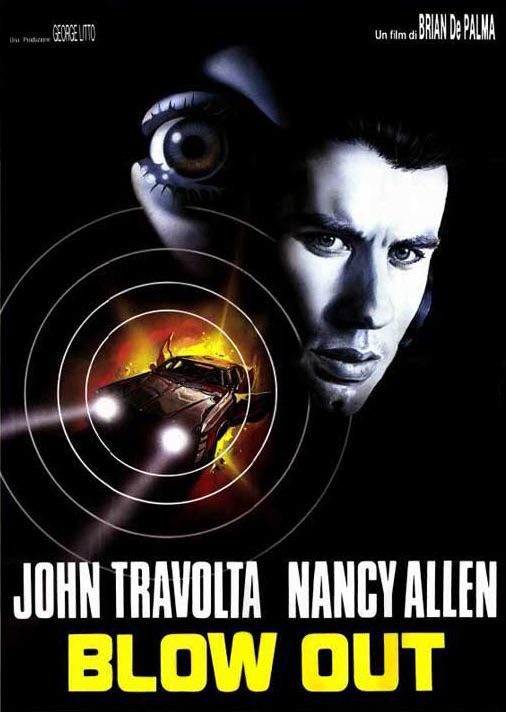
  • Blow Out (1981)

    My 27 movie A-Z film-a-thon: Day 3

    My 27 movie film-a-thon continues. What I have seen so far:

    13 Assassins (Takashi Miike, 2010) – 9/10

    All Dirt Roads Taste of Salt (Raven Jackson, 2023) – 7.5

    In fear that my film-a-thon was getting a bit sleepy, I changed gears and chose a “real classic” this time. A movie I rather discounted without seeing for too long. Maybe this is really good, I thought.

    As schlock, Blow Out may be the best B-movie ever made. It’s one of those “check your brain at the door” motion pictures. Nothing about it makes a lick of technical sense—you only need a rudimentary understanding of filmmaking to spot dozens of things that are objectively nonsensical.

    So why do I like it?

    Because this is trash. Questionably acted, extremely charming, beautifully filmed trash. It might as well wear a sash that says “TRASH” across its shoulder, like it’s competing in a beauty pageant. What’s not to love? It feels like it was storyboarded to perfection, but directed by someone who looked past the boards and saw the film that should exist. The camera glides through Philadelphia like no movie’s ever filmed a city before. The colors, the lighting—this thing pops.

    Blow Out is a little of this, a little of that. Mostly: Blow-Up, The Conversation, and Chinatown. But what sets it apart is that it isn’t pretentious. It refuses to pretend it’s above the pulp it’s soaked in. Jane Fonda and Julie Christie have both played prostitutes—but have they ever been stiffed $30 after providing oral sex in a phone booth? Here, the villain entices his target by pressing a $20 bill against the glass. She smiles. (“Maybe this night won’t be so bad after all?”) They couldn’t even make it a $50?

    Someone’s bound to be annoyed with me for seemingly dismissing this film’s artistry. But I don’t enjoy it ironically. I was disappointed at first—but by the end, I loved it. Because when a movie knows exactly what it is, and pushes that all the way to the edge? That’s the kind of movie that influences legends.

    8.5/10

  • All Dirt Roads Taste of Salt (2023)

    My 27 movie A-Z film-a-thon, day 2.

    I am watching a movie for each letter of the alphabet I would otherwise not get to for a while.
    So far I have watched:

    13 Assassins (Takashi Miike, 2010) – 9/10

    Days 2: A

    All Dirt Roads Taste of Salt (Raven Jackson, 2023)

    All Dirt Roads Taste of Salt (2023) is halfway in between Terrence Malick’s Tree of Life and David Gordon Green’s George Washington. The film quietly paints a portrait of a black family living in rural Mississippi over multiple decades, using beautiful cinematography and an incredible nature sound design. It creates a dreamlike atmosphere, like a collage of memories from childhood. There isn’t enough “there” there. The dialogue is way too minimal, and the actors seem overly blocked, always trapped inside invisible walls.

    I can’t stress how beautiful this looks, though. For the last half hour, I continuously thought every shot was going to be the final image of the movie. Any would have made a perfect ending. The movie resonates and lingers.

    The title is curious. It recalls one’s reaction to always tasting unpaved road when you travel down one, tires kicking debris in the air. But…salt? Wouldn’t dirt roads taste like…dirt? The director has talked about it, and I’m not satisfied. She said it is a metaphor. “Roads” are metaphorical roads. Also, geophagy (eating clay dirt) is common among poor families in the south, but the family does not seem to be overly poor. Also, why would she be eating the dirt from a dirty road? That would be the dirtiest dirt?

    A movie like this is only as good as its weakest component. It is very impressive for many reasons, but it is also rather vacuous in content and intent. Still, make sure to keep your eye on Raven Jackson. She made a polished, expensive feeling movie on likely almost no budget. I expect big things from her.

    7.5/10

  • 13 Assassins (2010)

    My 27 movie A-Z film-a-thon: day 1.

    I say take the kids. (Only sort of joking)

    I am watching 27 movies over the next two months that I otherwise would not have watched. All movies from my watchlist I was not planning on watching. I will post a little review for each one.

    Starting with # (Day 1)

    13 Assassins (Takashi Miike, 2010)

    You could call this one of the best Dungeons and Dragons movies ever made. It is in no way based on the tabletop RPG, but it has that feel. Set at the end of an extended era of peace in Japan (likely the Edo period from 1603 to 1868), all samurai are trained for combat but no one has actually ever fought in a battle. A samurai master becomes disillusioned by a tyrannical lord and commits ritual suicide, seemingly feeling there was nothing else he could do to take the lord down. This does the trick. A bunch of samurai/Ronin are brought together to take down this supremely evil antagonist.

    This isn’t an overly visceral movie. It’s not about spectacle or violence, though it is violent. It has some special effects that look incredibly cheap for 2010, but that doesn’t bother me. It is “telling a story” about samurai mindset and  ethos in a specific time and place. It is extremely well written, every scene is masterful and drips with character. I had to keep my phone as a study guide to understand everything going on, but it didn’t detract from the experience. I look forward to watching the movie again straight through after reading a list of all the characters. To look for little details I might have missed. If I saw this when I was 12 years old, it would have been the best movie ever.

    9/10

  • Little Fish (2021)

    An incredibly ambitious piece of low budget filmmaking.

    The idea here is a good one: what if Alzheimer’s disease was something you could catch?

    Now, imagine giving that premise to Terence Malick to write and direct and you will have a basic idea of what Little Fish is like.

    The story follows Emma (Olivia Cooke) as she grapples with the Alzheimer’s-like disease that is erasing the memory of her husband, Jude (Jack O’Connell). The disease can either affect you all at once or it can affect you gradually. Jude’s loss is very gradual.

    The script relies on Emma’s narration, both to explain what is happening in the plot and what is happening to her emotionally. I am reminded of Days of Heaven‘s voice-over narration. It isn’t the greatest idea in a movie to have most of the plot just flatly told to you instead of shown visually, but here it works. I usually hate voice-overs, but when it seems purposeful in many ways, I dig it. Because we hear her narration, we understand everything: what each idea means to her, why it means to her to choose the specific details she is recalling, what her emotions have been like during this process.

    Badlands is associated with extreme world-building. PT Anderson held it up as a pinnacle of filmmaking because it “used pictures on the walls.” What he seemed to mean was that they found pictures that looked like Sissy Spacek’s family from childhood and put them on a wall. Just to have in the background for a few seconds. Either they asked Sissy to bring in pictures of herself or someone spent time finding photos that could work. In the days before online photo libraries that could be searched with a few keywords, this was almost unheard of.

    There are little touches like that in Little Fish. Giant murals are chosen for quick shots. Mysterious paintings that just display a word on the entire side of a building. Did they scout out the location themselves? Or did they commission the painting? Either way, it would have required over a hundred hours of work for a shot that lasts only a few seconds.

    In the world of Little Fish, every little word counts. There is one scene where Emma and Jude stand looking at a collage of pictures of details from their lives with their names taped to them. Dogs, friends, locations.

    Literal pictures on walls.

    Tattoos are also used to keep memories of importance alive, but again, the plot doesn’t dwell on this. It doesn’t affect the plot in the way such a device was used in, say, Memento.

    For a low-budget film, it’s nice to see care put into the little details.

    I feel like the team (the writer, the director, the producer, et al.) worked their hardest in a mad fit of effort to come up with ways to maximize the resources they had. At one point, a car crashes into another car in a scene that in no way affects the plot. It is just a way to add punctuation to the emotional changing world.

    Little bits of effort make an impact. Noticing these moments that seem superfluous made me wonder, “why would they do this? What meaning does this bring?”

    In a different scene, the camera follows the characters through a nice area in the city when, in the background, someone has crudely spray-painted the words “Iris come home” on the wall outside. The shot only lasts six seconds and the camera doesn’t focus on the wall. That moment is so subtle and adds an extra layer of meaning.

    Who is Iris? What is her story? Did she paint it herself? Why would the community leave it?

    Is the thought of Iris never making it home too heartbreaking to remove the graffiti?

    Perhaps the biggest problem this movie had critically: if there is a contagious epidemic going on, why does no one wear masks? It was kind of unfortunate this came out when it did, as it was made in a pre-Covid world and came out post. There actually is one scene where scientists made everyone wear masks. However, there is a moment where a main character takes off the mask out of confusion and no one seems to care. This, to me, spoke volumes. The scientists were making people wear the masks as a technicality, but it seems like everyone has figured out that the disease is not airborne. That is my reading of the world as it is portrayed.

    The movie is about memory loss, but in a way that embraces quiet melancholy. The movie recalls, specifically Eternal Sunshine of the Spotless Mind, in a way that has the characters protective of their love for each other instead of actively trying to remove such memories. Trying to hold on to memories or trying to remove them. Either way, I appreciate the depth of thought that went into this: both movies are told nonlinearly in a method that cherry-picks the important moments. This relationship feels very lived in.

    Overall, this is a quiet movie that explores how Alzheimer’s affects people struggling to keep hold of themselves and the people they love. And it asks the age-old question: is it better to lose a loved one or lose the memories of the person you loved?

    Best of all is the final line. Poetic and meaningful, it conveys a real message. When remembering the love of your life, even the most important emotions fade into the background when you remember him.

    A great companion piece to Away From Her.

    8.5/10.

  • We Don’t Deserve Dogs (2020)

    Mellon collies and the infinite sadness.

    This is a collection of interviews and stories from dog owners and admirers about the dogs in their communities or the pets that have changed their lives. The mood of the film aligns with its title — this is all very, very sad. Sad stories, sad people, and sad circumstances that brought dogs into their lives.

    The music is relentlessly somber, a constant collage of string instruments playing sustained whole notes, reminiscent of Philip Glass composing his version of Adagio for Strings by Samuel Barber. Interestingly, the actual composer is a former child actor, one of the Little Rascals from the 1990s movie — an odd detail.

    About 80% of the film is not in English. It’s a beautifully filmed, albeit somewhat amateur, travelogue that captures glimpses of how dogs are perceived in various cultures. Some of the countries featured include Chile, Peru, Uganda, Pakistan, Romania, Vietnam, and Scotland. I had to look this up, as the segments aren’t separated by headings or on-screen text.

    The film might have been aiming for the tone of Kedi, the 2016 documentary about Istanbul’s street cats. In that film, we see how cats bring meaning to people’s lives, often serving as community mascots. They’re respected and cared for, but no one person takes sole responsibility for them.

    The opening story, set in Santiago, Chile, echoes this concept. It features a dog named Dr. Coffee who lives a dual life. Everyone in the neighborhood knows him and will often ask, “Have you seen Coffee today?” He moves freely, vanishing and reappearing days later. Eventually, one resident learns that the hospital nearby knows him by a different name — he has a room there and stays for days at a time. Coffee isn’t like a typical dog; he doesn’t crave pets and affection. His version of companionship is simply sitting quietly with kind people.

    In Uganda, survivors of violent trauma are given dogs as a form of emotional support. One woman names her dog PTSD to reflect the emotional weight she’s working through. The belief is that a dog provides unconditional love, free from hate or judgment. The group dog-training sessions, where dozens of new dog owners learn how to care for their companions, are striking in their simplicity and warmth.

    In Pakistan, a self-described tomboy finds a dog on the street with a paralyzed leg, covered in maggots, and left to die. Despite many people telling her to give the dog away once he recovered, she refused. Some people in Pakistan believe that having a dog in the house will prevent God from accepting you into heaven. She rejects that belief, instead seeing the dog’s presence in her life as part of God’s plan. Her story is one of quiet defiance and compassion.

    Not all the stories are tragic. In Chile, a therapy dog named Patron brings joy to residents of a retirement home. During an exercise session, Patron is told to “find the yellow ball,” which he does effortlessly. The residents marvel at his ability to distinguish colors. One participant remarks, “If a dog comes up and hugs you, then it is a hugging dog, and you can hug it.” This gentle wisdom encapsulates the joy dogs bring — they accept us for who we are.

    However, the film doesn’t shy away from difficult realities. In Vietnam, the dog meat trade is addressed. A restaurant owner recounts how his father introduced him to the practice as a child. While he acknowledges that dog meat consumption has declined, he continues to serve it as long as there is demand. This segment is sobering, forcing viewers to confront how cultural norms shape our perceptions of animals. It made me wonder about the conditions of dog meat farms and, by extension, the treatment of all farm animals. Should I view them all as dogs? It’s a thought that lingered with me.

    While the film’s tone leans toward the morose, it remains gentle in its approach. Dog lovers will appreciate the celebration of the bond between humans and animals, as long as they’re prepared for the emotional weight of the stories. Ultimately, We Don’t Deserve Dogs serves as a poignant reminder of the kindness and joy that dogs bring to our lives.

    7.5/10