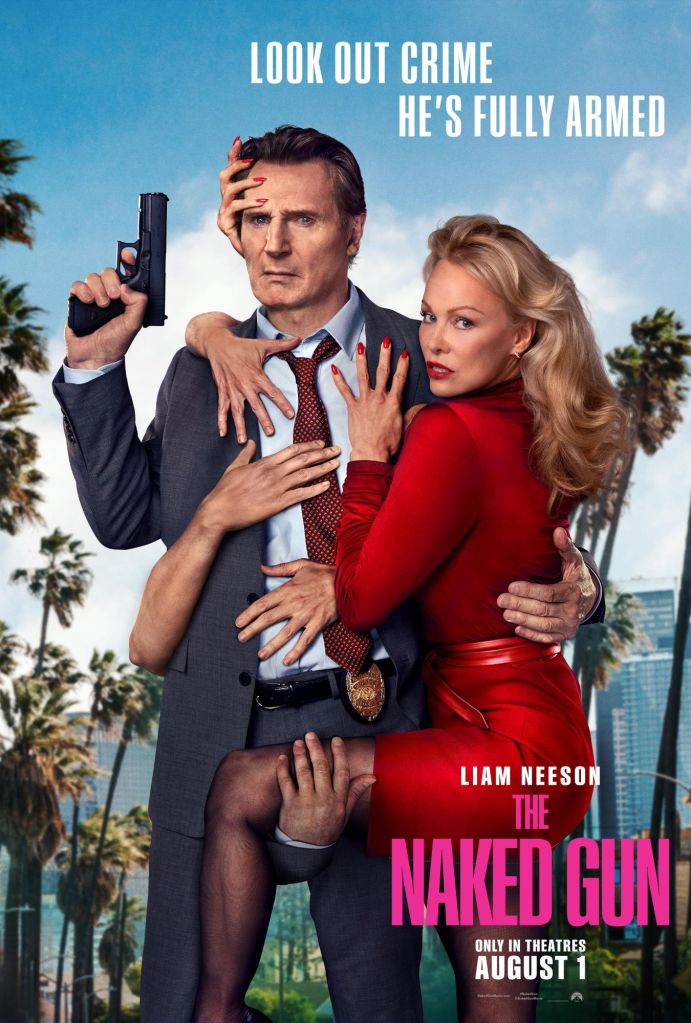
“I’m not your little girl. I’m Liam Neeson in a little girl mask. Want to dance?”
Cue Neeson enacting frontier justice — ripping off appendages and beating people with their own arms. (Paraphrasing.)
Who greenlit this movie? An outwardly funny comedy for adults, in 2025? I scrambled to list five other comedies from this decade that worked for me in this genre: Strays, No Hard Feelings, Bros, Champions, Bottoms. None set the world on fire — and that’s exactly the point.
This project’s roots stretch back to 2009, when Paramount toyed with a direct-to-TV fourth Naked Gun. Alan Spencer was hired to salvage what sounded like a doomed sequel, with Leslie Nielsen attached. The plan collapsed when Nielsen’s role was cut, then he passed away.
Later, Thomas Lennon and Robert Ben Garant (Night at the Museum) drafted a reboot with Ed Helms. David Zucker declined to join, saying the tone strayed too far. Zucker himself wrote a parody sequel (The Naked Gun 444 1/4: Nordberg Did It, later Naked: Impossible), a spoof of Mission: Impossible that briefly had traction before the industry moved on.
In 2021 Paramount turned to Seth MacFarlane, who’d long wanted Liam Neeson in the lead. With MacFarlane producing and Akiva Schaffer (The Lonely Island, Hot Rod) directing, the project finally clicked.
The result is an easy movie to root for, though it feels like a relic of another era. Neeson had dabbled in comedy before with MacFarlane’s A Million Ways to Die in the West, but his late-night “serious tough guy as a punchline” persona makes him a natural here. Pamela Anderson looks like stunt casting, but she’s got experience skewering her bombshell image — from the failed Barb Wire to the self-aware late-night press tour that followed.
The difference from the original trilogy is clear: The Naked Gun (1988) built out a full world of characters spun from a TV show. This 2025 version plays closer to late-night sketch comedy. Imagine Conan O’Brien’s Oscars monologue stretched into a feature. If you liked the 2025 Academy Awards, you’ll recognize the cadence.
My favorite gags are when the film leans into “Yes, and…” character absurdities. Drebin meets a femme fatale, Beth Davenport, who writes books about ordinary people solving crimes with uncannily correct hunches. The irony lands, especially with villains. And Neeson’s Drebin Jr. inherits his dad’s clumsiness — even worse behind the wheel. Yelling “Get out of the road!” at pedestrians on the sidewalk is a highlight, as is the inventive string of GPS-related disasters.
The downside? Too often the movie feels built around trailer moments rather than a story. Big gags land harder in a promo than in the film. That’s the MacFarlane effect: at his best (American Dad), he grounds characters in a world of competing rights and wrongs. Here, he doesn’t always extend the same care.
One low point: Drebin and Beth are spied on with heat-vision goggles. The movie nods to the trope’s worst offenders (Chris Cooper in American Beauty comes to mind), but doesn’t decide whether the characters should believe the ruse. It just hangs there.
Still, The Naked Gun (2025) is silly, sometimes too broad for its own good, but undeniably funny. The trailer may have been the silliest ever cut, but there’s enough in the full film to justify the revival. The original Naked Gun remains endlessly quotable and prescient; this one feels like a small miracle in 2025, even if it would’ve been ho-hum thirty years ago.
Zach Creggor’s latest taps into many of the most expected small town fears.
Early in the movie Arrival, the feeling of fear seemed very familiar. When Louise (Amy Adams) walks into her classroom to teach at her prestigious university, only a handful of students are present. Didn’t you hear? Alien spaceships are hovering over our largest cities. The human race might be done.
Sigh… everyone go home.
As Arrival was to 9/11, Weapons is to Columbine, or perhaps Sandy Hook. Early in the movie, there is a town hall meeting for all of the parents of the students who ran out the front door in the middle of the night into the darkness and haven’t been seen since. They were all from the same classroom, which drives the parents to dabble in conspiracy theories. Witchcraft?
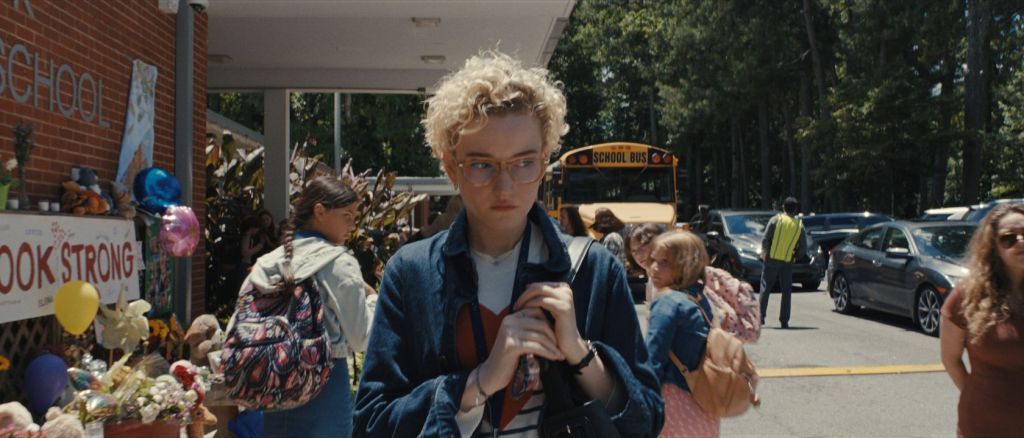
Julia Garner as Justine, one of the many lead characters that swap in and out in Weapons.
The principal invited the teacher of the classroom, which quickly becomes a notable mistake. “Why is she here?,” exclaims Archer (Josh Brolin), as he explains, rather ignorantly, why she is the only plausible explanation for what happened. If there is one thing I know about town hall meetings from TV shows (Parks and Recreation), it’s that they tend to groupthink themselves into the lowest common denominator.
The characters, who swap in and out as leads across a half-dozen overlapping stories, are rough clichés for this type of suburban town—which is probably the point. Everyone is drawn quickly and given a quirk or two, but there’s nothing to anyone that makes them feel like more than archetypes. This story could happen anywhere, we come to believe.
The villain here is likely to be referenced among horror movie buffs as one of the best of the twenty-first century so far. Does the occult really work like this? How does one acquire the capabilities of a level 16 wizard? Could no one roll a die and escape the cold grasp of a terrifying lich that seems to acquire whatever they want?
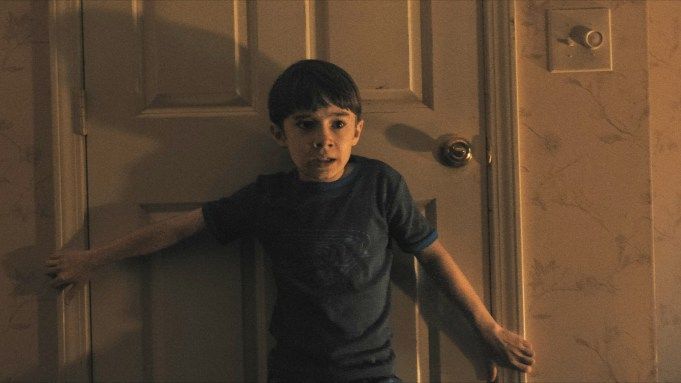
Cary Christopher as Alex. Terrified of terrifying?
The movie doesn’t quite make sense. The biggest problem is the ease with which Archer triangulates the exact location of the destination point that the kids ran to in the middle of the night. He knows the degree by counting the number of concrete slabs the kids ran over. The problem? All of the kids ran out the front door and then straight ahead. What is the likelihood of that? Every kid’s house pointing directly to the same center point? It’s as though everyone built their home so they could walk out the door and be inspired by the emperor’s glorious house on a hill. City planning doesn’t work that conveniently for amateur sleuths trying to solve an implausible mystery.
Nonetheless, Weapons is atmospheric and extremely satisfying. The split narrative works well, showing several different characters, flaws and all, in ways that overlap and converge unexpectedly. I thought of Doug Liman’s Go mixed with Sidney Lumet’s Before the Devil Knows You’re Dead. I hope that reads like high praise, because it is. Director Zach Cregger almost convinces us that this silly premise contains a story that needed to be told. I don’t believe the evils of the world work this way—but this movie made me feel like they could, and that’s what makes it linger.
An alt-country ode to those who celebrate by trying to get along.
The Title:
What is elderberry wine?
Elderberry wine is a bittersweet, earthy drink made from elderberries. If not made properly, it can taste slightly off—more like a medicinal tonic than a celebration drink. It has a lot of depth, but in a way that tastes like memory. It’s easy to imagine drinking it in a hobbit’s hovel. Its most famous use in cinema is in Arsenic and Old Lace, where two conniving old ladies lure men into their home and poison them with elderberry wine. The only other notable pop culture reference is Elton John’s 1973 song “Elderberry Wine.” It’s not a beverage that comes up often. I certainly had never heard of it before this.
—
The Lyrics:
Sweet song is a long con I drove you to the airport with the E-brake on Ain’t heard that voice in a long time Had to check back there to make sure you were alive
I imagine Karly driving a family member to the airport, but she really doesn’t want to. She’s driving as slowly as she possibly can—potentially even damaging her car—playing a love song so they’ll have something to remember her by. Even though they mean something to Karly, they’re sitting in the backseat. Quiet, possibly sleeping. A sibling, maybe? An ex-partner she hasn’t quite gotten over?
Angel hum of an electric car Reverses towards me Sometimes in my head I give up and flip the board completely
Her passenger is always pulling away from her—headed toward bigger things. They’re silent, perhaps sophisticated and modern, while Karly is old-school. She wants her engine to roar, her emotions on display. She views this relationship like a chess game—one she’s considered quitting in a spectacular way. She knows she won’t win, but she wants her loss to matter.
But everybody gets along just fine ‘Cause the champagne tastes like elderberry wine And the pink boiled eggs stay afloat in the brine ‘Cause even the best champagne still tastes like elderberry wine
Karly shifts focus. This song isn’t just about her relationship with the passenger—it’s about how people put on an air of pleasantness even when things are quietly breaking down. You might drink champagne to celebrate, but buy the cheap bottle because it tastes sweet and slightly wrong. Instead of crisp and bubbly, it tastes like fermented fruit juice that sat out too long. You remember the last time you drank it—not because it was good, but because it felt familiar.
Even the best champagne tastes like elderberry wine. It’s a metaphor for disappointment dressed as contentment. Everyone knows how to make do. They carry disappointments and keep going anyway.
—
You’ll cry at commercials At an unbolted leg scraping against the ground As the tilt-a-whirl goes around
Karly is back to singing about the same partner. He’s emotionally scattered—more moved by thirty-second commercials than by the woman sitting across from him. He sees art in everything. Karly counters with the most mundane image she can think of: a chair leg scraping the floor—and somehow, even that becomes poetic to him.
Roll one up say it’s mostly CBD Say I wanna have your baby ‘Cause I freckle and you tan I find comfort that angels don’t give a damn
This partner still isn’t fully present. Even the act of lighting a joint is undercut—he says it’s “mostly CBD.” There’s no high, no release. He wants to have a child, so he’s sort of in the relationship—at least until something better comes along. But Karly wants more. It’s exhausting to be with someone who’s always halfway gone. This is the person she gets to be with—and he’s never all the way there.
To want a child just to see whether their skin freckles or tans strikes Karly as absurd. If someone were watching your life from the outside, the detail that would matter least is the exact shade of your hypothetical child’s skin—especially between two people who know they aren’t meant to stay together.
And your eyes are the green of tornado sky
The first chorus included a tangible detail: pink boiled eggs floating in brine. That felt like rural atmosphere, something drawn from real life—a hallmark of alt-country. Think Lucinda Williams: “Cat wheels on a gravel road.”
But the second chorus replaces that homespun image with a comparison to tornado sky. Instead of seeing warmth in her partner’s eyes, Karly sees the sickly, ominous green that signals coming destruction. Out of all the things she could think of when she looks at him, this is what rises to the surface.
—
The Music:
The #1 thing to highlight is Karly Hartzman’s voice. On most Wednesday records, she sounds like someone who maybe took a few vocal lessons years ago, but who mostly goes to rock shows and screams along with every lyric.
For instance, watch a live clip of Wednesday performing “Bull Believer.” She yells the apex lyric—“Finish him”—again and again over a wave of shoegaze guitars. It’s a little like My Bloody Valentine, but Karly is delivering a full Mortal Kombat incantation at full volume. When you see her sing that live, you know her voice will be hoarse for days.
But “Elderberry Wine” is something else. Karly uses that hoarseness like texture, delivering a pretty, pure vocal with a distinctive edge. On Rat Saw God, her voice wasn’t bad, but it may have been what held the band back from wider appeal. “Chosen to Deserve” is a great song, but she sings it so softly and flatly that it has no dynamic range. Karly seemed to think that singing quietly and emphasizing the crack in her voice would give the song power. It worked in the way Mumblecore movies work: for every person who loves them, nineteen walk away annoyed.
But “Elderberry Wine” avoids that trap. Even die-hard country fans will likely find her voice perfect here. She controls the fragility, using cracks only for emphasis. In the chorus, she finally jumps up to a mezzo-forte and dials back down just in time for the titular line. She sings: “And the champagne tastes like elderberry—wi^ine.” And on the final line, she lets herself leap up into a high register: “El—derber—ry w^i—i—i…i ne.” That moment couldn’t be more beautiful. (Great work, Karly.)
As for the instrumentation—what usually turns me off in country music is the lead instrumentation, especially pedal steel. It often feels cloying or overplayed, like a session player trying to make sure his paycheck is audible. Even in loud country songs, pedal steel has the potential to be subtle and expressive. Xandy Chelmis is likely one of the very best. He always knows what to add and what to leave out, whether it’s screeching distortion in shoegaze or melancholy tenderness in this quiet country track.
MJ Lenderman had a great 2024, releasing Manning Fireworks and scoring a minor chart hit with Waxahatchee on “Right Back To It.” He’s poised to be a major alt-country star. As Wednesday’s secondary vocalist, MJ’s rising profile may have nudged the band into making a real, classic-sounding country song. “Elderberry Wine” sounds so classic, it feels new.
Wednesday knows their audience now. The music video is perfect. It opens with a man in his late 50s driving his Jeep to a bar, where he drinks, watches sports on TV, and plays cards with guys older than he is. The band knows their fans are often 15+ years older than them—people who’ve seen music evolve half a dozen times and just want to feel something familiar again.
—
Wednesday is a bit of an enigma. Their influences aren’t obvious, but they seem to pull from ‘70s country, Wowee Zowee-era Pavement, and Loveless-era My Bloody Valentine. I saw a YouTube comment under their cover of Gary Stewart’s “She’s Acting Single (I’m Drinking Doubles)” that said:
> “I remember this song. I never thought I’d hear a shoegaze version of it, but here we are.”
The world at large probably doesn’t want a band that’s only partly traditional country. When they scream through layers of guitar, they likely lose 90% of one audience. When they cater to old guys in bars, they lose the other 90%. But if you stick around for the entire set and never want it to end—you’ve probably just found your new favorite band.
Wednesday does too much. Their pieces don’t make obvious sense together. But what they do has never been done better.
Karly and MJ dated for years. I have a sneaking suspicion MJ is the passenger in “Elderberry Wine.” His biggest solo hit right now is “Wristwatch,” where he brags his watch is “a compass and a cell phone.” It’s one of the saddest brag songs I’ve ever heard, ending with the watch telling him when he’s “all alone.”
There’s clearly history behind the scenes. It’s a minor miracle the band kept MJ as a member, considering both his rising solo career and a relationship with Karly that clearly ended in disappointment. But the band went on and tried to celebrate anyway—to raise a toast when nothing tastes like it should, and still call it home.
Hmm. “Maybe this is the slice of pie that will make me happy…”
You probably don’t know any Puerto Rican artists, and you’ve almost definitely never seen a Puerto Rican movie. You probably don’t know any Puerto Rican music either. The only Puerto Rican cultural work you’re likely familiar with is West Side Story — and even that uses Puerto Rico mostly as a plot device. It flattens the culture into a stereotype: “colorful immigrants with knives.”
It’s not that Puerto Rico doesn’t have great culture — it absolutely does. The problem is that most Americans never hear about it. Colonial repression, racism, and political neglect have created obstacles that keep Puerto Rican voices out of the mainstream. And when Puerto Rican art speaks openly — often saying, “We hate what you’ve done to us” — the United States doesn’t want to hear it.
Puerto Rico has pioneered many different musical genres over the years, but few individual artists have broken through globally. Cuba has Buena Vista Social Club, a supergroup of folk and jazz musicians who came together to preserve their country’s musical legacy. Puerto Rico never had its Buena Vista.
Bad Bunny seems to be trying to change that. His newest album, DeBÍ TiRAR MáS FOToS, feels like an attempt to create a pastiche of Puerto Rican musical culture. In the lyrics of the lead single, he name-checks multiple Puerto Rican genres: salsa, merengue, bachata, and reggaetón. He seems to ask, “How does my music compare?” His album tries to honor his country’s musical history, while still making something new.
Bad Bunny’s 2025 NPR Tiny Desk Concert. Good stuff.
The album title, DeBÍ TiRAR MáS FOToS, literally means “I should have taken more photos.” It’s a fitting entry point for the album’s themes of memory, nostalgia, and regret.
Bad Bunny and Jimmy Fallon in San Juan, Puerto Rico.
I analyzed the lyrics of the lead single, “DtMF,” and here’s what I found:
Bad Bunny sings, with a call and response chant during the chorus::
Debí tirar más foto’ de cuando te tuve Debí darte más beso’ y abrazo’ las veces que pude Ey, ojalá que los mío’ nunca se muden Y si hoy me emborracho, pues, que me ayuden
Which translates to:
I should have taken more photos from when I had you. I should have given you more kisses and hugs whenever I could. Hey, I hope my family never moves away. And if I get drunk today, well, I hope they help me.
At first, it sounds like he’s mourning an ex-lover — someone who might even be dead. But the song becomes more interesting when you dig deeper. In the second verse, he mentions playing dominoes with his grandfather. His grandpa asks about the girl from the first verse, and Bad Bunny casually says he’s not with her anymore.
Zooming out, the meaning shifts: Bad Bunny is drunk, high, and hallucinating — imagining conversations with friends and family members who have either died or moved away. He’s not just pining for a lost love; he’s mourning a whole lost world. The ex-girlfriend probably isn’t dead — she just moved on long ago. The real loss is his grandfather. He isn’t playing dominoes with him now. He’s remembering playing dominoes years ago — or maybe he’s imagining it, wishing he could sit down with him one more time.
The album cover for DeBÍ TiRAR MáS FOToS.
The album cover of DeBÍ TiRAR MáS FOToS captures this feeling perfectly. It shows two cheap plastic lawn chairs under a few tropical trees — the exact kind of place where you might play dominoes with your grandfather. Since he doesn’t have any real photos of those moments, this empty scene is the closest he can come to capturing them now. The life has been stripped from the landscape, but the memory still lives through context and feeling.
It’s basically the equivalent of Jack’s shirt in Brokeback Mountain. Ennis doesn’t have any photos of Jack either, so he hangs up Jack’s shirt in his closet, preserving what little he can of a love he lost long ago.
A full breakdown of Kendrick’s Drake takedown track, 2024’s Record of the Year.
Estimated reading time: 16 minutes.
“Not Like Us” is the song of 2024. It dominated charts and won both Song and Record of the Year at the Grammys. Is served as Kendrick Lamar’s significant return to the center culture.
And yet, I didn’t really get it. I like the song, but I don’t feel like I fully understand it. I know he and Drake are in a feud consisting of rap battle-style diss tracks.
The only part I feel like I get is the verse where Kendrick says, “I hear you like ‘em young. You better not go to cell block one…trying to strike a chord and it’s probably A-minor—” I understand what that means, I think, but why? What is the story? Also, is he actually using an A minor chord?
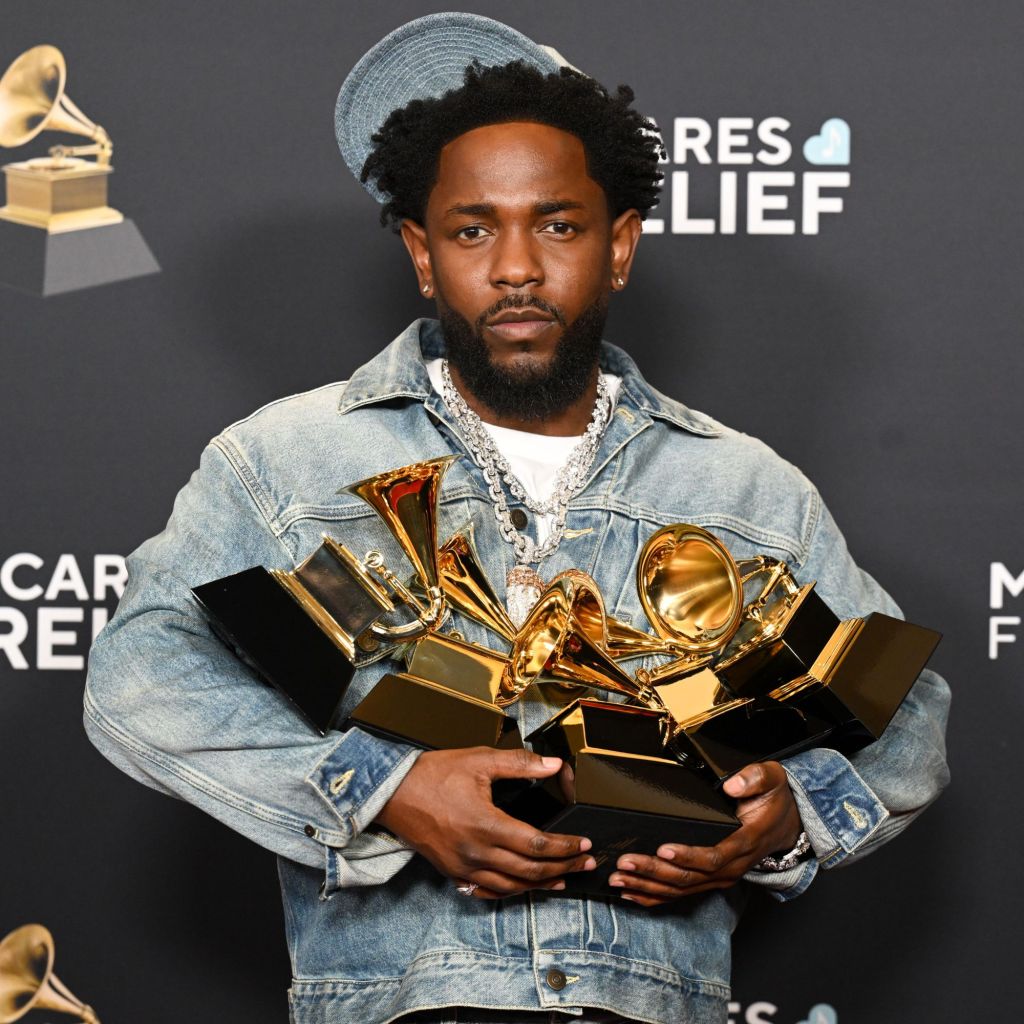
Kendrick at the 2025 Grammys.
My feeling right now: it’s fine. Catchy but repetitive. It grabs your attention, but it’s too jittery to “groove” to. I often feel that way about new hip hop songs, though. I need to go in depth with the lyrics, since the meaning makes or breaks this type of song.
Let’s go into a deep analysis-mode.
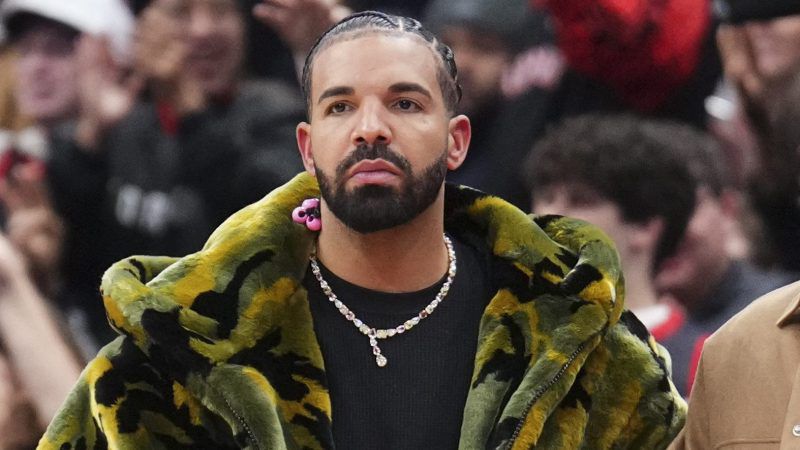
Drake at a Sacramento Kings game.
Lyrical analysis
Psst, I see dead people
Mustard on the beat, ho
Mustard is music producer DJ Mustard, Dijon McFarlane. Mostly he produces mainstream West Coast Hip Hop tracks. He has worked on full albums by hip hop artists YG and Ella Mai and many individual songs. I am not sure how much he contributed to the song, but he likely at least found the sample, which is the other half of the music. Just Kendrick and a Sample and beat
Deebo, any rap nigga, he a free-throw
Deebo is a character from the movie Friday (1995). He was strong, dominant, and was always stealing people’s stuff. He was the bully of the story and first fights Craig, Ice Cube’s character, and loses.
In this analogy, Drake is Deebo and Kendrick is Craig. Kendrick is saying he is going to take out Drake (in a fair fight).
Man down, call an amberlamps, tell him, “Breathe, bro”
Nail a nigga to the cross, he walk around like Teezo
Teezo is Teezo Touchdown. He is a rapper known for being a “rockstar Jesus” and his aesthetic (gimmick?) is wearing a lot of spikes in his hair mimicking an industrial hedgehog, let’s say.
So he is saying, “You might want to sit down because I’m going to crucify you.”
What’s up with these jabroni-ass niggas tryna see Compton?
The industry can hate me, fuck ’em all and they mama
The audience not dumb, shape the stories how you want
Jabroni is a term associated with The Rock on WWE, meaning loser or poser.
There is a trend in hip hop of rappers that, for some reason, are trying to pretend to have roots in Compton. Either they say they’re from there or they try to pretend to spend time there. Kendrick is saying why, “why is a super rich celebrity from Canada trying to say he wants to live in Compton? Why Compton? Most people would move away from Compton if they had the money. To move *to* Compton?”
The industry relies on these types of unlikely image shifts (lies) to keep the biggest stars looking like authentic, viable artists. But how many rap acts are actually doing this? Is it mostly just Drake?
How many opps you really got? I mean, it’s too many options
I’m finna pass on this body, I’m John Stockton
John Stockton is a point guard from the Utah Jazz, known for having the best passing record in NBA history. Kendrick wants to give everyone else the ability to take Drake down.
Drake is apparently always at odds with all types of people, rappers or otherwise. He has had public feuds with Meek Mill, Pusha T, Kanye West, Joe Budden, Tony Lanez, The Weeknd, Diddy, Common, XXXTentacion, Mo-G, Quentin Miller, Charlemagne Tha God, Rappin’ 4-Tay, and others. The question is: why? Kendrick is supposing he intentionally lets misunderstandings get out of control as a way to look tough and credible in the rap industry.
So Kendrick maybe able to absolutely murder Drake for any one of these feuds, but he is choosing not to. Others can finish him off.
Beat your ass and hide the Bible if God watchin’
Sometimes you gotta pop out and show niggas
Even those that fear God should get in on this. When it comes to someone who is acting a fool, you have to make a point in some way, even if extreme.
Certified boogeyman, I’m the one that upped the score with ’em
Put the wrong label on me, I’ma get ’em dropped, ay
From Alondra down to Central, nigga better not speak on Serena
Walk him down, whole time I know he got some ho in him
Drake has contributed more to these feuds than Drake will ever know. Kendrick is the boogeyman, always out to get Drake without him realizing it’s coming.
Kendrick is walking up to Drake to confront him because he knows he will back down. You’re either a gangster or a ho, and Drake is a ho.
Pole on him, extort shit, bully the flow on him
Prison language. A call to action. “Pull a gun on him, force him to give in, use your harshest rhymes if you have to.” Make him give up what he values.
Say, Drake, I hear you like ’em young
You better not ever go to cell block one
To any bitch that talk to him and they in love
Just make sure you hide your lil’ sister from him
This is the easy verse. Anyone who listens to this song more than twice will catch this and be certain what it means. “Lock up your daughters. Don’t let them in the same room with this man.” Drake is apparently charming, which is nice of Kendrick to mention, though he uses the term “bitches”, so maybe not an actual compliment.
He likes girls so young he will get murdered if he ever goes to prison. That is very young, though I don’t believe he is into girls under 15, the line that seems to matter to vengeance killers.
EDITED: Actually, there are accusations of him texting Millie Bobby Brown when she was only 14.
This is a blunt accusation: Drake’s behavior around young girls is predatory.
They tell me Chubbs the only one that get your hand-me-downs
And PARTY at the party, playin’ with his nose now
To understand these lines it is important to know what OVO is. This stands for October’s Very Own, which is the name of Drake’s brand and record label. Why October? That’s his birth month. He appears to be saying, “I’m the most important person who has ever had a birthday in October.” I don’t quite follow the logic, but what else could it mean?
Chubbs is one of Drake’s oldest friends and appears as the muscle of the OVO crew. He is big and intimidating and “handles” situations for Drake. Kendrick is saying Chubbs gets the privilege of sleeping with girls after Drake has.
PARTYNEXTDOOR is an R&B producer and songwriter who is signed to the OVO record label. The rumor is that PARTY is now a cocaine addict and Kendrick implies that it is Drake’s fault.
Kendrick is going after Drake’s brand, not necessarily the people in it. Mostly Drake’s role is the problem.
And Baka got a weird case, why is he around?
Certified Lover Boy? Certified pedophiles
Baka is Baka Not Nice, a rapper on Drake’s OVO label. No one seems to like his music. No one seems to have *heard* his music. He has one album, which was released in 2018 and only has one major review listed on critic aggregate websites. In 2014, Baka was convicted for assaulting a woman and forcing her human trafficking. He spent approximately 13 months in prison. You might ask: Aren’t these very serious charges? Why such a short prison term? He made a plea bargain, cooperated with authorities, and was a first time offender.
So what possible reason would there be in keeping a rapist/extortionist in your crew? He even appears to stick up for him on his 2017 song “Gualchester”. Drake gave a shout out: “Baka not nice, still fucking with him”. Drake seems to say he is still messing around with him to seem tough and dangerous, maybe.
Certified Lover Boy is the name of Drake’s (very poorly named) 2021 album Certified Lover Boy. Maybe he is only a lover boy to 12 year old fans that adore him. “Certified pedophile” is maybe not literal, but Drake is using a well known term and giving us a reason to rebrand Drake’s image. A certified *what*, did you say? Drake?
Wop, wop, wop, wop, wop, Dot, fuck ’em up
Wop, wop, wop, wop, wop, I’ma do my stuff
Hyping up the crowd. Dot is short for K-Dot, Kendrick’s nickname for himself.
Why you trollin’ like a bitch? Ain’t you tired?
Tryna strike a chord and it’s probably A minor
Drake is now known largely for petty squabbles online and behind the scenes. Mike Mill accused him of using ghost writers for his raps and taking full credit. Drake proceeded to write diss tracks about Mill and mocked him onstage at live performances and on social media.
Subtle disses to each other with Pusha T led to Pusha unveiling “The Story of Adidon”, which was an accusation that Drake had a secret child. The feud was handled delicately by PR reps, but behind the scenes, it was very tense and led to a longstanding cold war between their respective camps.
Now the big question. What chord is this? The verse chord progression is this:
Am – F – C – G
So, Kendrick is literally singing about a minor over the chord of A minor, bringing the notion a hint of melancholy. This is the type of detail that wins Grammys.
They not like us, they not like us, they not like us
They not like us, they not like us, they not like us
Kendrick Lamar is actually from Compton, L.A. The music video was shot in various locales around Compton, featuring huge crowds dancing and singing along to the chorus. Kendrick is the home town hero here, and is hoping to get everyone onboard. He fills every frame with imagery of good people having the time of their lives.
Kendrick Lamar
You think the Bay gon’ let you disrespect Pac, nigga?
I think that Oakland show gon’ be your last stop, nigga
The Bay is the San Francisco Bay area, 2Pac’s spiritual home.
So, how did Drake disrespect 2Pac?
In his feud with Kendrick, Drake wrote a diss track named “Taylor Made Freestyle”, which began with a full verse rapped by an AI generated synthesis of 2Pac’s voice. Drake used this without any permission. The AI generated text is giving Kendrick material to use in his battle with Drake, such as Drake’s reputation for liking young girls, which 2Pac probably believes because he heard it on the Budden podcast. How is 2Pac listening to podcasts?
Drake is likely trying to minimize the biggest possible criticisms against him, which to me is him admitting actual guilt.
Did Cole fouI, I don’t know why you still pretendin’
What is the owl? Bird niggas and bird bitches, go
See, a third popular rapper, J. Cole, is also included in this rap battle. Media touts a big three in hip hop (Drake, Kendrick, and J. Cole) and in March 2024, Kendrick rapped, “Actually it’s just me.”
J. Cole responded on a track on his April 2024 mixtape entitled Might Delete Later. True to his word, he deleted the song a week later. Basically, it was a pretty weak response, basically saying “Ni***s” only like his stuff…sometimes.”
OVO’s mascot is an owl. “Bird Ni**as” are likely foolish and “bird bitches” are likely superficial. This seems to apply to Drake’s most forgiving fans as well as him.
At this point, Kendrick is just checking off boxes. “J. Cole reference? Check. Line about Drake’s fans? Check.”
Hey, Drake, they’re not slow
Rabbit hole is still deep, I can go further, I promise
Ain’t that somethin’? B-Rad stands for bitch and you Malibu most wanted
Ain’t no law, boy, you ballboy, fetch Gatorade or somethin’
He is basically saying, “Shape the media narrative all you want, audiences will see through eventually.”
He then references Alice in Wonderland (“Rabbit Hole”), the 2003 Jamie Kennedy movie Malibu’s Most Wanted (“B-Rad”), and possibly Jack Harlowe (“Ain’t No Law”), to imply that Drake is a fraud so obvious there is an endless treasure trove of tidbits that he could expose him for. Drake should be working as an assistant whose job is to get drinks for the musicians who are doing real work.
Since 2009, I had this bitch jumpin’
You niggas’ll get a wedgie, be flipped over your boxers
“This bitch” is the rap game, in general. That was about the time when Kendrick’s mixtapes were creating buzz before his 2011 debut, Section.80, was released.
And then some cartoonist wedgie imagery.
What OVO for? The “Other Vaginal Option”? Pussy
Nigga better straighten they posture, got famous all up in Compton
Kendrick emasculates Drake, calling him a “pussy”, or possibly secretly gay. Drake is famous in Compton, but not for the reasons Drake wants. Perhaps his feminine posture is his strangest and most notable attribute.
Might write this for the doctorate, tell the pop star quit hidin’
Fuck a caption, want action, no accident
Ok. On with the main attraction. “This next section is going to be my dissertation on why Drake’s nothing but a pop star in hiding.”
And I’m hands-on, he fuck around, get polished
Fucked on Wayne girl while he was in jail, that’s connivin’
Then get his face tatted like a bitch apologizin’
He now says Drake’s actions have affected Kendrick’s world directly. Lil Wayne was Drake’s mentor and signed him to his Young Money label. Lil Wayne went to jail in 2010, and Kendrick is claiming Drake abused his trust and slept with his girlfriend.
He then got a tattoo of Lil Wayne’s face on his left tricep. Is it admiration? Or is he saying, “I slept with your girlfriend. Does this make it ok?”
I’m glad DeRoz’ came home, y’all didn’t deserve him neither
And your homeboy need subpoena, that predator move in flocks
That name gotta be registered and placed on neighborhood watch
I lean on you niggas like another line of Wock’
DeMar DeRozan was a Compton native who played for the NBA team the Toronto Raptors. He became a good friend of Drake’s. By the time “Not Like Us” was released, he had just gotten released from his contract (He ended up becoming a member of the Sacramento Kings).
Kendrick then references streets in Harlem. Drake better leave Harlem native Serena Williams out of this.
The image that comes up for “Not Like Us” is an aerial image of Drake’s estate in Toronto, a giant walled mansion known as “The Compound.” Then are 13 person markers that resemble the symbols on registered sex offender websites.
The official cover image for “Not Like Us”.
“Lean on wock” is, for me, the most complicated concept in the song. Kendrick is leaning on Drake’s crew, putting pressure on them. But lean is also a drink popular in hip hop communities and is often spiked with Wock, which causes euphoric sedation.
Yeah, it’s all eyes on me, and I’ma send it up to Pac, ay
Sweet Chin Music, and I won’t pass the aux, ay
How many stocks do I really have in stock? Ay
This is Kendrick at his silliest and I would argue best. We have:
A reference to 2Pac, respecting him but also using the name of an album as being about him now
A statement: if you talk bad about him he is going to get you dropped from your record contract
“Sweet Chin Music”: a reference to WWE, Shawn Michaels’ finishing move that involves a powerful kick to the jaw. The aux mic is something used to have a second person talk while a rapper holds the main mic. No one else is getting in on this next part. He wants to relish the finishing move all for himself.
Also, can Kendrick get away with this? Is he actually worth as much as he thinks he is? Let’s find out
One, two, three, four, five, plus five, ay
Devil is a lie, he a 69 God, ay
Freaky-ass niggas need to stay they ass inside, ay
Roll they ass up like a fresh pack of ‘za, ay
City is back up, it’s a must, we outside, ay
5+5=10, all toes on the ground. Meaning to hold steady.
Drake is a devil posing as a god, a 69 God (Toronto is the 6), so he is perverse and untrustworthy. His crew are all very warped.
Za is an exotic weed. Think Drake incinerating them and using the ashes in a joint he will smoke.
“The city” is LA, and it will finally return to light as a true metropolis of hip hop. Thanks, largely, to Kendrick.
This song is mostly an ode to the integrity of his home, turning what could just be a standard diss into a regional anthem.
They not like us, they not like us, they not like us
They not like us, they not like us, they not like us
Once upon a time, all of us was in chains
Homie still doubled down callin’ us some slaves
Atlanta was the Mecca, buildin’ railroads and trains
Bear with me for a second, let me put y’all on game
It is no joke that black people were slaves not at all that long ago. But was this a good idea? On his 2023 track, “Since You Out” (featuring SZA), Drake included this line:
“You got my mind in a terrible place / Whipped and chained you like American slaves.”
Why “American” slaves? Why not just slaves? I suspect it was just the right number of syllables, but Kendrick seems to think Drake is saying Americans are in some way slaves currently. I think he is giving Drake too much credit as a lyricist.
For those in the South that actually have family members that were enslaved recently, Kendrick wants to pay homage to them and give them credit. This is what they need to know to be in on this take down.
The settlers was usin’ town folk to make ’em richer
Fast-forward, 2024, you got the same agenda
You run to Atlanta when you need a check balance
Let me break it down for you, this the real nigga challenge
When slavery was legal in Atlanta, the rich people who owned the land exploited the people to live a lives of luxury. Cut to 2024, and this is still the case. The people of Atlanta are having their talent exploited by the record industry. It makes fake stars like Drake seems much more credible and authentic than he actually is. Atlanta musicians Future, Lol Baby, Young Thug, Quavo, 2 Chainz, and 21 Savage have all collaborated with Drake, likely in a bid to make it give him street cred
Kendrick is asking, “How far will Drake go with this?” He is painting Drake as a hip hop colonist. For instance, colonial Britain for hundreds of years took over many different countries and forced them into working and then taxed them and took away their resources. Colonialism is really bad and led to some of the largest famines in history. How much does the term colonialist apply to Drake?
Next is a laundry list of Drake’s Atlanta collaborators. Why does a Toronto native have this many collaborators from Atlanta, specifically?
You called Future when you didn’t see the club (ay, what?)
Future is the king of club anthems, so when Drake realized he didn’t have any songs that played well in clubs, he put Future on the track and had him sing the hook
Lil Baby helped you get your lingo up (what?)
An accusation: Drake had Lil Baby coach him on his vocabulary.
21 gave you false street cred
21 Savage has a very tough image and seems to have been paid by Drake to make him look very street and credible.
Thug made you feel like you a slime in your head (ay, what?)
Young Thug leads a (maybe) criminal organization named YSL (Young Stoner Life). “Slime” is a term within YSL that means brotherhood. You use it to reference someone who has earned your respect.
Quavo said you can be from Northside (what?)
Drake was allowed to collaborate with Quavo”s rap group Migos, which is made up exclusively of Atlanta based rappers.
2 Chainz say you good, but he lied
2 Chainz has collaborated with Drake many times, seemingly vouching for his credibility. Kendrick is saying that can’t possibly be the case, possibly inferring that 2 Chainz has suggested that he was paid to say such things.
You run to Atlanta when you need a few dollars
No, you not a colleague, you a fuckin’ colonizer
The family matter, and the truth of the matter
It was God’s plan to show y’all the liar
Kendrick has won me over. Why is Drake always collaborating with people from a city 800 miles away and pretending he is one of the gang?
Kendrick is a little kid alerting everyone of an imposter like he was an imposter in John Carpenter’s The Thing or Invasion of the Body Snatchers. The second he puts all of the red flags together, he runs around the room doing only what a helpless little kid can do to help: chant “Not like us! Not like us!” — to get everyone’s attention.
And a little dig at Drake’s most popular song, “God”s Plan”, where he tries to prescribe his success as part of God’s plan, that he “can’t do this all his own.” Thus, of all the people in the world, he was chosen as the one to represent every person interested in the culture. Celebrities are always thanking God, which is fine, but to specifically say it is God’s plan when you are the biggest name in music? That is a concept that is bound to come back and bite you eventually.
Mm, mm-mm
He a fan, he a fan, he a fan (mm), he a fan, he a fan, he a
Freaky-ass nigga, he a 69 God
Freaky-ass nigga, he a 69 God
Hey, hey, hey, hey, run for your life
Hey, hey, hey, hey, run for your life
Freaky-ass nigga, he a 69 God
Freaky-ass nigga, he a 69 God
Hey, hey, hey, hey, run for your life
Hey, hey, hey, hey, run for your life
Let me hear you say, “OV-ho” (OV-ho)
Say, “OV-ho” (OV-ho)
Then step this way, step that way
Then step this way, step that way
Are you my friend?
Are we locked in?
Then step this way, step that way
Then step this way, step that way
A list of Chants one can use in Drake’s company to shame him away when he gets too close.
He’s a fan, not a rival.
He’s a sexual deviant.
He will exploit you so run.
He is like his label, an OV-hO.
And finally some dance steps to make new friends and fans.
The Music
The song is built around a sample of Monk Higgins’ “I Believe To My Soul” , a 1968 cover of a Ray Charles song. Ray’s original lyrics were about sensing betrayal in a relationship and walking away before being humiliated. Monk Higgins made the song dramatic and mournful, replacing the piano with an orchestra and the vocals with his subtle but expressive tenor saxophone lead.
The sample is sped up slightly, probably so DJ Mustard could provide Kendrick with a requested A minor chord. I would imagine DJ Mustard had some samples ready to go, and Kendrick cycled through them until he found one he found some inspiration in.
I thought the only sample was the section right before the chorus, with an orchestra and flute sample, but the main part is also a sample from the same track. “I Believe To My Soul” has an extended introduction that sets the stage for a sad farewell. I thought the main “doo-doo-DOO-doo” part was being played on a synthesizer, but it’s actually strings.
I don’t believe there is another instrument here, other than a drum machine part that uses exactly two bass drum pitches to provide a rhythm in the low end. It is very simple, efficient production.
I was expecting the lyrics to be about how Drake uses ghost writers, primarily. But Kendrick already went there with his 2015 masterpiece, To Pimp a Butterfly. On “King Kunta”, he sings:
“I can dig rappin’, but a rapper with a ghostwriter? What the hell happened?”
It turns out rappers using ghostwriters isn’t as taboo as I would have thought. Drake claims to be authentic. In 2015, Meek Mill (a rapper from Philadelphia known for intense delivery) accused Drake of having a ghost lyricist but he claimed he didn’t. Kendrick “can dig rappin’,” which seems to mean throwing out raps while not being a real rapper. This seemed to be a pointed jab at Drake even back then.
True Kendrick fans (and hipsters) loved To Pimp a Butterfly. It is the highest rated album of all time on the music website RateYourMusic, just ahead of heavy hitters like Radiohead ‘s OK Computer, Pink Floyd’s Dark Side of the Moon , and David Bowie ‘s Ziggy Stardust, but in the mainstream and populist communities, it was labeled “a bore.” It fused experimental hip hop with jazz and beat poetry in a way that was admirable but seriously pretentious. It had the air of a college student that won’t shut up about Martin Luther King plagiarizing his “I have a dream” speech and not giving the writers any credit.
On Kendrick’s follow-up, DAMN., he changed gears and focused more on his authenticity over his rapping authority. He wanted to prove he could make a mainstream rap record. He took the criticism of To Pimp a Butterfly (“he is so full of himself”) to heart and came back with a song about being “Humble”, which went on to go 7x platinum.
So which Kendrick are we getting now? The artistic Kendrick or the mainstream Kendrick? I would like to say both, but no. Kendrick is not pimping any butterflies at here. He is out for Drake’s job. To quote Todd in the Shadows in his review for “God’s Plan”:
“Why is this popular? But more important than that, I think the question I have about ‘God’s Plan’ by Drake is…why is Drake popular?…To be clear, this is the Drake decade.”
Todd’s thought was that Drake was a good guy and deserved to be successful. But…this successful?
Kendrick is going after Drake on both fronts. After collaborating with him on two songs by 2012, Kendrick made a list of his direct competition and Drake was on it. This made Drake…uncomfortable. They had a cold war for years: Kendrick would show up for collaborations and Drake wouldn’t mention Kendrick in his “best of” lists. One of the feud’s most escalating tracks was his guest spot on the song “Like That”, and Kendrick didn’t even mention Drake by name. He said “There is no big 3, there is just me” in 2024, he was slapping Drake with a white glove. And you know what? It’s a bit like Matt Damon asking the snooty guy at the bar if he likes apples. I feel kind of bad for him. He was not equipped to handle this. “Not Like Us” is Kendrick’s “How do you like them apples.”
Rap battle songs don’t typically become number one hits or win Record of the Year. So why did this track really click with both hip hop and mainstream audiences? 90% of listeners can not say what most of the lyrics are about. The references are hidden in codes and if this was a rap battle in a club, the audience would collectively go, “Hug? What did he say?” But it is distinctive and has enough of an unusual rhythm for Kendrick to really play with rhythm, incorporating his signature flow amongst repetitive schoolyard chants.
Kendrick’s time is now, as he is still riding a career high peak from his divisive Super Bowl performance. He did not perform “Not Like Us”, which I thought was a mistake and seemed like a missed opportunity. He didn’t sing his most Acclaimed song? How would middle America know who this is?
After studying the lyrics, Kendrick was right to leave the song off of his setlist. Why would he want to include Drake in his Super Bowl moment? By leaving his dragon poking stick off of the stage, he has just proven he doesn’t need Drake at all.
The Beastie Boys jokingly self-sabotage their album, become mostly known for rock somehow.
In the early ’90s, the Beastie Boys had grown tired of fighting for the rights (of their songs), spending more time asking for forgiveness for their 1989 pastiche/masterpiece Paul’s Boutique. MCA, Ad-Rock, and Mike D actually knew how to play instruments and had originally been members of the band The Young Aboriginals.
In 1992, the band released Check Your Head, an album credited—alongside Rage Against the Machine—with inspiring (or at least anticipating) the rap/rock fusion that dominated a decade later. The album got respect at the time, but most fans now see it as just okay: interesting because they made it, but rarely anyone’s #1 favorite. It does have some very good tracks: “Jimmy James,” “Pass the Mic,” “Gratitude”… The absolute classic is “So What’cha Want,” with a simple bass groove over a slow (for them) 101 BPM. The song contains some of the band’s best hook work. In addition to the titular phrase, it includes clever turns of phrase:
Well I think I’m losing my mind, this time This time I’m losing my mind, that’s right Said I think I’m losing my mind, this time This time, I’m losing my mind
It’s impossible to read that without hearing it in your head. Now the song will be stuck in there all day. You’re welcome. Even better is “Sabotage,” the lead single from their 1994 album Ill Communication. It came during a transitional phase, when the band couldn’t decide if they were hip-hop, rock, or something in between. Most of the album is stripped-down hip-hop, showing signs of exhaustion—especially in this verse from the second single, “Sure Shot”:
I keep my underwear up with a piece of elastic I use a bullshit mic that’s made out of plastic To send my rhymes out to all the nations like Ma Bell I got the ill communication
The problem isn’t that it makes no sense—it’s that they knew it was a subpar set of lines and tried to mask it with delay and reverb. Ad-Rock presents himself as a normal guy who uses elastic for underwear (don’t 90% of people?) and a plastic mic to broadcast to the world. He had a record label and a multi-platinum album. He could afford a mic.
No such lyrical fatigue appears in “Sabotage,” which barely tries to rap at all. The song began without lyrics, as a jam built around the bass riff that opens it. Even with no melody or real hook, Ad-Rock felt it was complete. Frustrated that no one took it seriously, he vented at producer Mario Caldato Jr., who kept pressuring the band to finish. Ad-Rock, annoyed, named the song “Sabotage” and—channeling the style of Bad Brains, Minor Threat, and Black Flag—wrote sarcastic, screamy lines as a way of saying, “You want a song now? Here’s your song.” The only real vocal hook comes in the bridge:
Listen all y’all, it’s a sabotage (repeated four times)
Originally an instrumental, the song built up to a bridge they didn’t know what to do with. Ad-Rock created a rhythm and filled in generic words to match. The band leaned into the idea of actual sabotage—emphasizing, “listen up, I’m not doing what you want.”
They still needed more than just “I’m tellin’ y’all, it’s a sabotage.” The “chorus”, if you will, is not a section with any singing. It is a lead line played on synthesizer, monotone but with odd punctuated rhythm, played more in the vein of how DJs scratch records. The keyboard uses a quick glide portamento to “scratch” the sound. Without sustaining a note or committing to an actual melody, the band replicates the edge Public Enemy achieved with their best singles, like “Bring the Noise” and “Rebel Without a Pause” (which uses a sax sample that had no real pitch). It also recalls “Fight the Power”, with a single-pitch instrumental track using syncopated 16ths for rhythmic interest.
“Sabotage” is too hardcore to care about choruses or melody. There seems to be no word on who wrote the part or who played the synthesizer. Their keyboardist at the time was Money Mark.
Despite sounding unlike anything on rock or rap radio, it became the album’s first single. This was the era of “the music video comes first,” and in that tradition—like ‘Til Tuesday’s “Voices Carry,” Peter Gabriel’s “Sledgehammer,” or Robert Palmer’s “Addicted to Love”—the band handed the album to a video director and let him pick the track that inspired the best idea. Spike Jonze chose “Sabotage,” drawn to its manic aggression. What did it remind him of? “‘70s cop shows (of course( like Starsky and Hutch,” he thought. He imagined it as the theme for a fake show in the vein of Streets of San Francisco or CHiPs—the kind he grew up watching, whether he liked them or not. Each Beastie would play a mustachioed detective with a ridiculous name.
The song wasn’t a hit. It didn’t even chart on the Hot 100. For one of the most iconic songs of the ‘90s, it barely made a dent at the time, peaking only at #18 on Alternative Airplay. But the video was a minor sensation, climbing thanks to requests and popularity rather than radio play. It eventually hit #1 on MTV’s Weekly Top 20 countdown. Even then, the song was seen as a fun gimmick, not a future classic.
But the slow burn began. In the mid-2000s, I saw a hardcore band cover it in a seedy bar. The crowd went wild. They played it note-for-note—until the scream, when the drummer unleashed a furious blast beat, hitting the snare and bass drum as fast as he could. Even the punks who hated mainstream music loved it.
The next time I heard “Sabotage” was in the unlikeliest place: J.J. Abrams’s Star Trek reboot. It was the only pop song I’d ever heard in the franchise, seemingly saying, “Of all the songs from this era, this is the one they’ll still listen to in 2233.”
You might’ve also heard it in many other places, like Shazam! Fury of the Gods, Horrible Bosses, Neighbors 2: Sorority Rising—and it returned in Star Trek Beyond due to its popularity. It eventually exploded on YouTube and became, by far, the Beastie Boys’ most streamed track on Spotify.
Originally seen as a joke—a fun jam they didn’t know what to do with—“Sabotage” was the band mocking themselves. “It’s a sabotage!” they screamed, knowing they were really sabotaging their own process. But in doing so, they created a song nobody wanted… that audiences still respond to like it just came out. As of 2025, it has 466 million plays on Spotify, with a daily play count of 180,000.
Anthony Kiedis’s private poem was, reluctantly, reimagined as a ballad and made the band megastars in the process
News report: “Under the Bridge” is no longer RHCP’s most popular song. Its Spotify play count was recently overtaken by “Californication”, for some reason. That song is a great example of Anthony Kiedis’s lyrical gibberish, beginning with the words:
Psychic spies from China try to steal your mind’s elation And little girls from Sweden dream of silver screen quotation And if you want these kind of dreams it’s Californication
Psychic spies from China? Like, they try to read your mind, literally? And how can you steal elation? And why is it not “girls from Sweden dream of silver screen QUOTATIONS?” Making it plural would make the line work. What, you couldn’t stand letting an off-rhyme slip through Anthony? You had to rhyme “quotation” with “elation” perfectly? Wait a second, those two words don’t rhyme at all.
That song is terrible, but “Under the Bridge” holds up remarkably well. It isn’t my favorite Chili Peppers song (that would be “Soul to Squeeze” off of the Coneheads soundtrack), but “Under the Bridge” could easily be for second place.
“Soul to Squeeze” sounds vaguely like Pavement’s “Zurich is Stained”. It sounded out of town, sloppily performed, lyrically angular and nonsensical, and artfully empty. It was rough, too rough to fine tune enough to put it on a polished album, but that is what I liked about it. Anthony Kiedis and company could craft a top album, if they weren’t trying to temper their ambitions to what they think their audience wants to hear.
“Under the Bridge” was never meant to be a song, much less a hit single, or even on an album at all. It was originally a poem Anthony had written in one of his notebooks. Anthony actually wrote poetry for the sake of poetry, not just to create ideas for lyrics. The poem was about his habit of walking under a bridge in downtown L.A., as well as his struggle with addiction and thinking it would feel good to do heroin along the way.
Rick Rubin read the poem and strongly encouraged Anthony to turn into a song, which he initially resisted. He thought it was too personal and emotional to turn into a funk rock song, and turning it into a melodic song wouldn’t fit with the band’s discography.
After being convinced to try, John Frusciante stepped in to write a chord progression. It turned out, he had a wide musical vocabulary, and he was just as likely to listen to The Beatles’s Revolver and Jimi Hendrix”s Axis: Bold as Love as much as Parliament-Funkadelic or Sly Stone. There is something distinctly “Castles Made of Sand” about John’s riding chord transitions and little twirls and ornamental flourishes. When he set out to write a chord progression for a sincere emotional depth, he thought old school pop ballad, like The Beatles’s “Something” or Joni Mitchell’s “River”. After coming up with a chord progression that you could write lyrics to, he stepped back, and worked on a guitar intro that would set up the emotional vulnerability of the poem he read. He wrote this to inspire Anthony to figure out the route to an actual melody.
After John established a solid canvas, Anthony found it rather easy to come up with the melody. The entry point for what it should sound like made sense, with the amount of work Frusciante put into trying to inspire it. Flea switched from slapping his bass strings with his thumb and played Long sustained notes with his finger tips. Chad chose to keep the drums sparse and minimal, giving the song the ability to build when it hit the, well, bridge.
Strange but true, Anthony did not write the line “Under the brdge downtown” to be the lyrics for a bridge of a song. It really was a coincidence, not a thought out gimmick (but a brilliant one. I still half think we call it a bridge of a song because Anthony branded the concept so here).
The music video was directed by Gus Van Sant, and he somehow made a brilliant stylist. The visual ideas were all his, choosing John Frusciante’s colorful clothing and the hues of the lights covering Anthony’s bare skin. Gus was not one to move the camera, or cut to various angles or takes. With the camera stationary, every movement onscreen became a story. Seeing John play the intro straight without cutting to anything else. Seeing Anthony full the space and actually perform the song was key to the charm of the video, which took off to all-time most popular level on MTV lists.
The song is remarkably tame compared to any other song on this list so far (it didn’t incite riots, it wasn’t filled with exploitive filled blasphemy, it wasn’t a kyt crib death, and it wasn’t named after a kid that actually committed suicide), even though it was largely about heroin use. The music video amped up the drama, which made it seem like the song was about tragic life or death circumstances. Very few had reason to question the intent of the song, which seemed very heartfelt and actually important, maybe more than it actually was.
The video builds to a long shot of Anthony run to the camera in ultra slow motion, his pec muscles moving with a little bounce as you see his Adonis -like perfectly sculpted body. It was very unlike rock stars at the time to appear showing off skin or be sexually objectified even a little bit, outside of leather pants or deep v openings in the shirts. Anthony was legitimately very sexy, which seemed bizarre for what could seem like a light ballad by a singer-songwriter.
The video became too popular for many long-term fans, who became tired of seeing it everywhere and worried its success would change the band’s sound and direction. Also feeling this way: John Frusciante himself. In 1992, the band went on SNL, and without telling the band, he decided to intentionally perform “Under the Bridge” out of sync with the rest of the band. It was an infamous performance, one that illicitrd a lot of head scratches from the viewers at home. Why would he do this?
John Frusciante was only 21 when the album exploded. He joined the band because he wanted to make interesting music and had no interest in being a rock star. He thought the band was chasing big, clean hooks and he liked music that was rough around the edges, embracing mistakes and rawness. He did not like performing to massive stadiums of new fans, and he became depressed and started using drugs heavily. The band was about to go on stage for a show in Tokyo and began talking about future plans backstage. John told Flea he was not going to play the show that night, that he was quitting. Flea told him he can quit as long as he played this show, and so he did. He left and became deeply addicted to drugs. The band hired Dave Navarro and released one of the most interesting failures of the 90s, 1995’s One Hot Minute. It felt a bit half baked in most ways, but intriguingly so.
John Frusciante changed his mind about the band in 1999 and decided to take the chance to rejoin, looking at it as the opportunity to get sober and get a fresh start for life. In my opinion, he wrote the best lick of his career with “Scar Tissue”, another heartfelt song about heroin addiction. I find it quite delightful, but even fans of “Under the Bridge” ended up feeling it was overplayed by Y2K.
Love them or hate them, RHCP are a band that has embraced their natural aptitude for fame as a substitute for the joys of drugs. Their art seems from a place of genuine honesty, and the band members have a history of being extremely interested in taking their craft to interesting places, onstage and off. Like most artists, their talent hit a fever pitch for only a short window of time, I would argue between 1991 to 2002, with a 7 year gap in the middle. They grew into a band that became bored and samey, content on going through the motions. They soon were exactly the thing John Frusciante one tried to rebel against. But hey, it still beats heroin addiction.
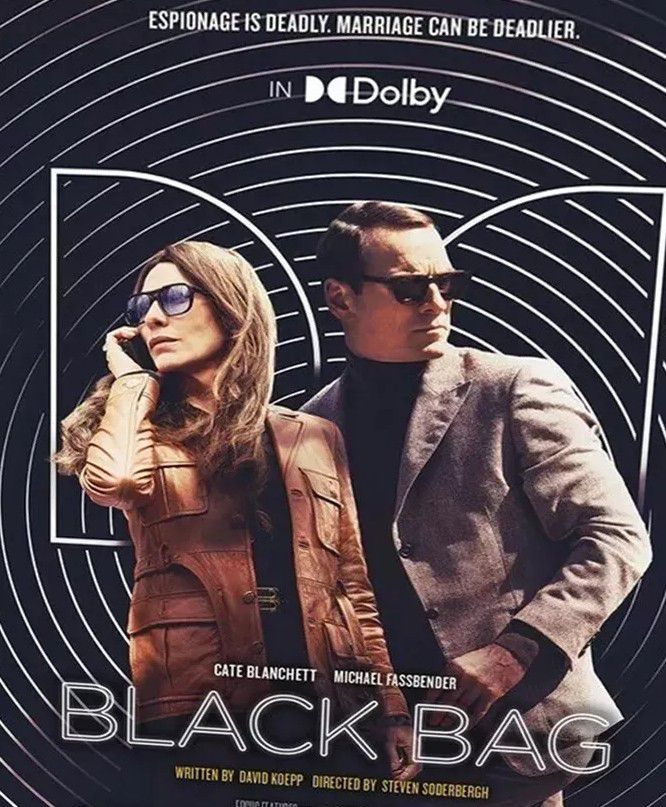
A ridiculously absurd collection of scenes that play like solid screenwriting exercises trapped inside a plot that makes absolutely no sense. I imagine David Koepp came up with the general premise—a female CIA operative manipulates everyone around her, and her husband, also an agent, is willing to do anything to protect her—and then spent hours using AI to research technical details. The result? A screenplay that feels overly economical, rushed, and oddly truncated.
The film is packed with strange scene ideas, clichés galore, and absurd character dynamics. Why do these agents work together, see each other as psychological patients, and also party together like college roommates? Michael Fassbender’s character gets everyone to take polygraph tests just because he’s the main character, apparently.
Everything feels too written. The entire movie takes place over a week, with title cards announcing each day—“Monday,” “Tuesday,” “Wednesday,” etc.—in a way that distracts more than it adds. Koepp knows how to write a great scene, but this script is proof that writing great scenes isn’t the same as writing a great screenplay.
I understand why Cate Blanchett took the role: it gives her mystery, intelligence, presence—she is the film’s center. And I get why Fassbender signed on too—it’s probably the best role he could land post-scandal. But it’s also telling that no other A-listers are in this. Everyone else feels like filler, characters written to fill a scene rather than a world.
Not a worthless movie. But definitely a frustrating one. A weak premise that could’ve been done much, much better.
The big break that made Kurt Cobain forever resent the neighbors riding on Nirvana’s coat tails.
Music video is here. Age restricted, so it must be viewed on YouTube.
https://youtu.be/MS91knuzoOA?si=zjNAsEJlBBkTNSKv The most popular song by Pearl Jam in 2025 is not “Jeremy,” their big breakout that burned them out on music videos and made them refuse to return to the medium for years. You might assume their biggest song today would be “Black”—by far the fans’ most favorite track at the time—or possibly something from Vs. or Vitalogy. But no. It’s “Even Flow,” a song that seems to have found fans among younger listeners precisely because of how overwrought and dated it sounds. The band is trying so hard—bless their little hearts.
Objectively, “Jeremy” holds up. It’s got genuine hooks and imaginative eccentricities. It’s impossible not to admire how inspired the band was here. I know people who are still sick of the song from its overplayed era, back when it seemed to air on MTV every 20 minutes. But how can you really hate a song with melodic phrasing like this:
> “Clearly I remember picking on the boy Seemed a harmless little fuck But we unleashed a lion Gnashed his teeth and bit the recess lady’s breast, how can I forget? And he hit me with a surprise left My jaw left hurin’, ooh, dropped wide open Just like the day Oh, like the day I heard”
This is actual poetry—but Eddie Vedder’s songs like this were never meant to be read on paper. They’re meant to be vocalized. My favorite line is the bit about being hit “with a surprise left.” He emphasizes just that line with a raspy volume boost and a melodic change that’s totally unique in the song. Why make that the line of central emphasis? Eddie didn’t actually know this boy, but inserting a moment of direct interaction was meant to really sell the idea. Singing it that way makes the listener feel like it must be utter truth.
In 1991, Eddie read an article in a newspaper about Jeremy Wade, a 15-year-old from Richardson, Texas, who died by suicide in front of his English class. Many remember the song as being about a school shooting, and I honestly wonder if the ability to be misconstrued was intentional. The music video is certainly open-ended, and Eddie includes the line:
> “And the dead lay in pools of maroon below.” Since when can you call a single corpse “the dead”? The jump to mass violence is unavoidable. This can only really be about a school shooting—or at least, that’s how it would be read if it were written after 1999.
The song began humbly, as a demo by bassist Jeff Ament months before they had any vocalist at all. It was called “Dollar Short.” Same basic structure as “Jeremy,” but no dynamic contrast. No build.
When Eddie was being considered as lead singer, he took home several tapes to write lyrics to. One of them was “Dollar Short,” and while surfing in San Diego, he thought about how to make it a full song. He read the article about Jeremy Wade and imagined an entire scenario—complete with a fictional backstory in which he’d known Jeremy personally. He had no aversion to bullshit, and he wrote the lyrics as a confessional from someone with firsthand knowledge.
The band heard his vocal demo and were blown away. “Jeremy” became one of the main reasons they brought him in. Eddie encouraged everyone to build intensity as the track went on, and it worked.
The band later claimed they never meant for it to be a single—but it’s hard to believe Eddie bought that. He clearly thought of “Jeremy” as his “Dream On” moment, using many of the same key ingredients as Aerosmith’s embarrassingly dramatic mega-anthem. The swelling major second chord changes and Eddie’s “Ooo”s sound exactly the same to my ears.
If anything, “Jeremy” is too big. Eddie maybe goes a bit overboard with his meaningless “Aye! Aye! Aye! Aye! Aye! Aye! Aye! Aye!” line. But he tapped into something real. He thought about kids who were depressed and felt they had nowhere to turn. He empathized with the feeling of believing that anything you say will fall on deaf ears.
Jeremy Wade’s mother, Wanda Crane, has spoken candidly about the song—and her feelings are complicated. She was never contacted by the band. She only found out about the song when it started playing on the radio. She was deeply moved by the sentiment, but also saddened that her son became the centerpiece of a dramatic rock anthem rather than a nuanced portrait.
> “That day that he died did not define his life,” she said. “He was a son, a brother, a nephew, a cousin, a grandson. He was a friend. He was talented.”
Maybe Eddie should’ve done a bit of research. Or maybe he shouldn’t have tried so hard—in both the song and the video—to make it seem like he personally knew Jeremy or was the same age. Maybe the only real mistake was naming the song after him. That feels like the kind of mistake a band like Pearl Jam would make in their early days: sincere, pretentious, self-serious, and desperate for irresistible press coverage. All the things Kurt Cobain hated them for.
But the song worked. The band never expected it to catapult them into megastardom—or to overshadow everything else they’d do for years. “Jeremy” eventually faded, and other early tracks became more listenable in hindsight: time capsules of early grunge. Most of the waning popularity of this track is from the sensitive subject matter. The band no longer promotes the song, I never hear it on alternative radio, and the video is even age-restrcites on YouTube. One day, the song will be rediscovered, used in a movie or Netflix TV show in a way that will make the song iconic once again.
Pearl Jam might have been one of the least cool bands of their era, but their weird earnestness made them fascinating. They were the ‘70s stadium rock band that insisted they hated ‘70s stadium rock bands.
The year Nirvana “changed music forever”, the album Metallica (1991) by Metallica was actually a bigger deal. The album sold more than Nevermind, and its legion of fans were arguably much more fervent. If James Hetfield had died in 1994 instead of Kurt, the legacies of Nirvana and Metallica might have been swapped in media rounds.
Metallica will always be a Gen X favorite, but even Gen Z seems curious about them. They might be less open to metal overall, but Metallica is familiar enough to be ripe for memes. On the final episode of Stranger Things Season 4, “Master of Puppets” was featured to great effect. (Eddie Munson played the riff in the Upside Down to distract the demobats.) Metallica has had a resurgence in popularity over the last few years.
I, personally, do not like “Enter Sandman” very much. I used to play the riff in pep band during breaks at basketball games. I feel like everyone has heard the song, or at least the guitar part, from the bleachers at some low-level sporting event. It is remarkably easy to play, which is both a positive and a negative in terms of the song’s appeal.
The guitar lick was written by Kirk Hammett at home. Despite the intuitive nature of the clean riff at the beginning of the song, the demo he brought into the studio actually began with the distorted version of the lick heard at the :55 second mark. Producer Bob Rock wanted the band to embrace tighter, more focused songwriting, and the clean guitar intro was likely decided as a way to bring the song quickly to life. The formula worked well for “One”, …And Justice For All’s only well recognized single.
The songwriting process for Metallica is highly peculiar, as even though Kirk came up with the main riffs and recorded them on a demo he brought into the studio, only James Hetfield and Lars Ulrich are credited as songwriters. As typical, the lead guitar solo—arguably the most iconic part of any Metallica track—was all Kirk Hammett. He’s said it only took a couple of minutes to write and that he was surprised it became so iconic.
The lyrics came later. On the first version of the song, James brought to the band lyrics about Sudden Infant Death Syndrome (crib death), with lines that originally included:
> “Disrupt the perfect family Sleep with one eye open”
Bob Rock and Lars Ulrich said that the lyrics were too literal and upsetting and encouraged James to go broader. The lyrics became about childhood nightmares, and it evolved into the titular character coming to get you in your dreams. Metallica, just as the rest of the world, had been exposed to the idea of the boogeyman coming to get you in your sleep via Freddy Krueger and a decade of Nightmare on Elm Street movies.
I don’t necessarily credit James for coming up with a revolutionary concept, and some would argue that the start of James’s bad era of lyrical output began right here. After four albums of lyrics that held up remarkably well under scrutiny, James went a little simple. Some would even say trite. Here is a sample line from “Poor Twisted Me”, from Load (one album later):
> Swallow whole the pain Oh, it’s too good to be That all this misery Is just for oh, poor twisted me, oh yeah Poor twisted me
So James was getting burnt out with his lyric-writing process during the 1980s. During Metallica’s first 10 years, James was known to obsess about phrasing, rhythm, and word choice to make the lyrics both resonate and fit the core sound Lars and Kirk brought him. He often took his ideas from literature and intentionally avoided hard rock clichés, like sex and drugs. There seems to not be one literature reference on The Black Album, and on subsequent albums like Load and St. Anger, he had shifted to songs about self-doubt, internal rage, and writer’s block. He may have stopped reading entirely, actually.
Whereas Metallica had opposed the idea of MTV and making music videos (their first three albums went platinum without one), they tested the water with “One” off of …And Justice For All. The band’s manager and their music label (Elektra) encouraged the band to reach a wider audience. The band relented, and they filmed black and white footage of them performing in a warehouse, and the band’s management came up with the idea to juxtapose it with clips from the 1971 film Johnny Got His Gun, which was based on a 1939 anti-war novel that inspired the song. The band actually bought the film outright to avoid paying licensing fees every time the video was played. Despite initial reservations, the band was extremely happy with the final product.
The band was also reportedly happy with the video for “Enter Sandman”, despite having the look and feel of MTV du jour. The band is only filmed using strobe lighting, with motion that seems to only use about 3 frames per second. The imagery is straightforward: a little boy sleeping, an old man scowling at the camera, someone running towards the camera as a semi-truck crashes into a parked car behind him. “Just run off the road!,” we used to say. Aside from “Enter Sandman”, director Wayne Isham’s most famous work included Bon Jovi’s “Livin’ on a Prayer” and Pink’s “Get the Party Started”. If you’re like me, you probably asked, “Those songs had music videos?”
“Enter Sandman” was cool, but in a way that felt slightly out of step with the visual culture of the moment. It had a dated quality, but there was charm in how hard the band was clearly trying—despite having little experience in the medium. Hardcore video enthusiasts were satisfied just having a reason to experience this style of music on TV, which was more or less what the band had hoped for anyway.
The song’s legacy peaked with its usage at Yankees games. Famed relief pitcher Mariano Rivera used the song as his entrance music from the late ’90s until 2013. Every time he entered Yankee Stadium, the song blasted over the speakers, a ritual heard by the most widespread fan base of any baseball team. The band leaned into this, even playing it live at Rivera’s retirement ceremony.
While Metallica continuously breaks out the song for awards ceremonies and events like their Rock and Roll Hall of Fame induction in 2009, the song will always be associated first with sporting events. “Enter Sandman” is a mainstay at WWE events (to represent certain wrestlers’ aggression/intimidation), although it is often played at patriotic events for the military. Unlike most “most popular songs” by bands, Metallica seems to have never gotten tired of promoting it.




 Avidavr: Media Reviews