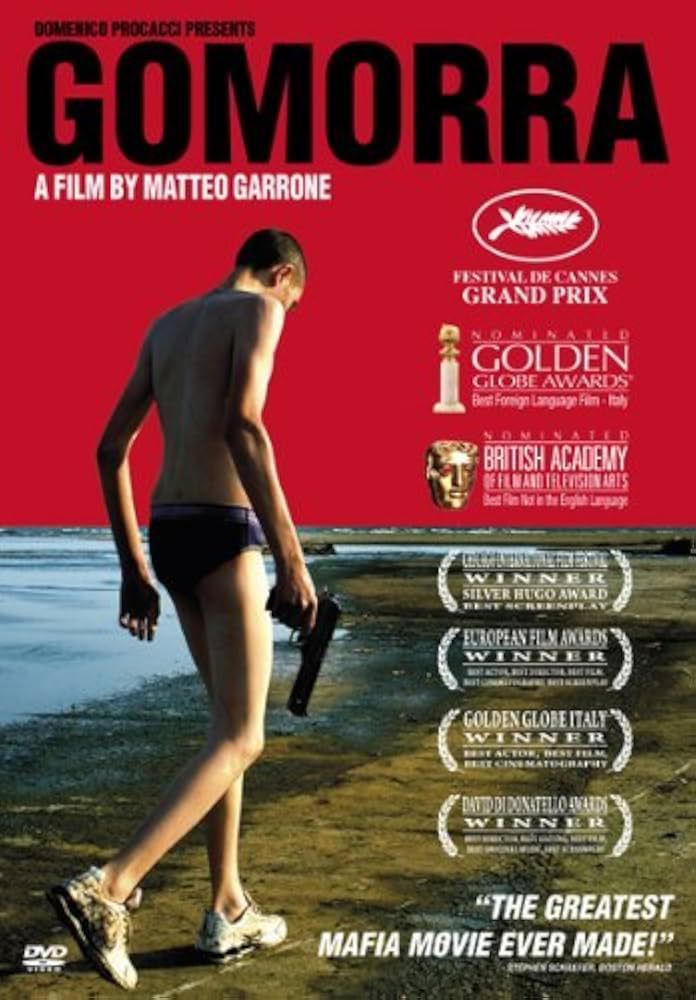
This one felt real to me—the culture, the power dynamics, the hierarchy of command. I believe this is what the Mafia really is.
There is no honor here. No sacred “Mafia code.” It all comes down to the bottom line: money, and no liability.
The difference between life and death is arbitrary. Early on, a 15-year-old is asked why he’s shaking—is he scared? “No,” he says. The older man is pointing a gun at his head. “Are you scared?” “No.”
Bang.
He’s dead. For no reason other than being too afraid to admit he was afraid. The next kid wears a bulletproof vest and survives. Why? Luck. You have to guess right. What will offend the Camorra? What will charm and delight them? The difference is negligible. The consequences are massive.
Director Matteo Garrone shows us the world of the Camorra through two central perspectives. The A story follows two kids raised in a world where the mob is king, trying to break into it. The B story centers on a high-end fashion tailor who makes no money because the syndicate exploits his skill. This second story is more compelling.
The kids are idiots. I would’ve preferred to see what this system does to the smart ones—but I fully believe kids like this exist. And they’re doomed.
Gomorra presents a world of crime that is consistently fascinating. Every scene feels like something I haven’t seen in a film before. For this type of movie, that’s miraculous. Beat for beat, it’s consistent in the psychology of its world-building. I’m not sure if Gomorra is a necessary film the way City of God was five years earlier—but it’s absolutely a purposeful one.
I am watching a movie for each letter of the alphabet I would otherwise not get to for a while. So far I have watched:
13 Assassins (Takashi Miike, 2010) – 9/10
—
Days 2: A
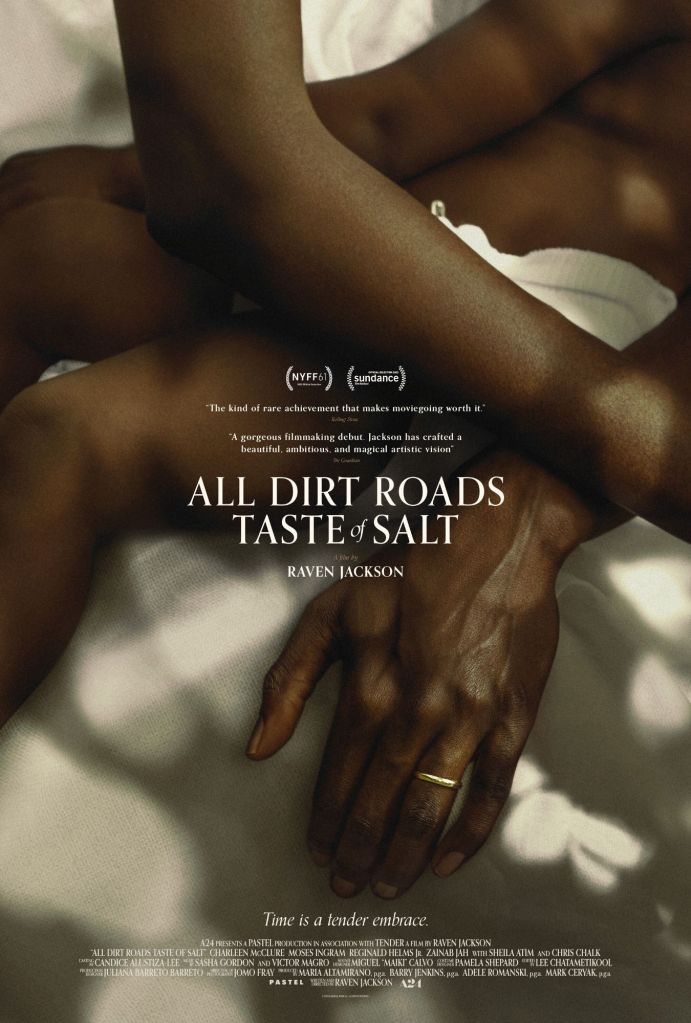
All Dirt Roads Taste of Salt (Raven Jackson, 2023)
All Dirt Roads Taste of Salt (2023) is halfway in between Terrence Malick’s Tree of Life and David Gordon Green’s George Washington. The film quietly paints a portrait of a black family living in rural Mississippi over multiple decades, using beautiful cinematography and an incredible nature sound design. It creates a dreamlike atmosphere, like a collage of memories from childhood. There isn’t enough “there” there. The dialogue is way too minimal, and the actors seem overly blocked, always trapped inside invisible walls.
I can’t stress how beautiful this looks, though. For the last half hour, I continuously thought every shot was going to be the final image of the movie. Any would have made a perfect ending. The movie resonates and lingers.
The title is curious. It recalls one’s reaction to always tasting unpaved road when you travel down one, tires kicking debris in the air. But…salt? Wouldn’t dirt roads taste like…dirt? The director has talked about it, and I’m not satisfied. She said it is a metaphor. “Roads” are metaphorical roads. Also, geophagy (eating clay dirt) is common among poor families in the south, but the family does not seem to be overly poor. Also, why would she be eating the dirt from a dirty road? That would be the dirtiest dirt?
A movie like this is only as good as its weakest component. It is very impressive for many reasons, but it is also rather vacuous in content and intent. Still, make sure to keep your eye on Raven Jackson. She made a polished, expensive feeling movie on likely almost no budget. I expect big things from her.
An incredibly ambitious piece of low budget filmmaking.
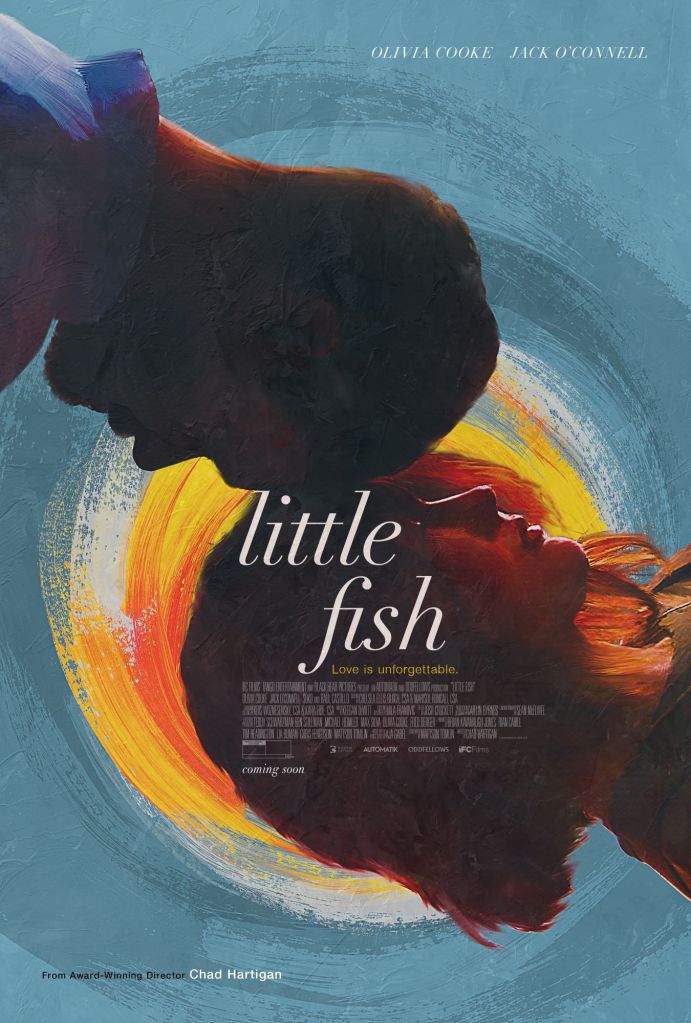
The idea here is a good one: what if Alzheimer’s disease was something you could catch?
Now, imagine giving that premise to Terence Malick to write and direct and you will have a basic idea of what Little Fish is like.
The story follows Emma (Olivia Cooke) as she grapples with the Alzheimer’s-like disease that is erasing the memory of her husband, Jude (Jack O’Connell). The disease can either affect you all at once or it can affect you gradually. Jude’s loss is very gradual.
The script relies on Emma’s narration, both to explain what is happening in the plot and what is happening to her emotionally. I am reminded of Days of Heaven‘s voice-over narration. It isn’t the greatest idea in a movie to have most of the plot just flatly told to you instead of shown visually, but here it works. I usually hate voice-overs, but when it seems purposeful in many ways, I dig it. Because we hear her narration, we understand everything: what each idea means to her, why it means to her to choose the specific details she is recalling, what her emotions have been like during this process.
Badlands is associated with extreme world-building. PT Anderson held it up as a pinnacle of filmmaking because it “used pictures on the walls.” What he seemed to mean was that they found pictures that looked like Sissy Spacek’s family from childhood and put them on a wall. Just to have in the background for a few seconds. Either they asked Sissy to bring in pictures of herself or someone spent time finding photos that could work. In the days before online photo libraries that could be searched with a few keywords, this was almost unheard of.
There are little touches like that in Little Fish. Giant murals are chosen for quick shots. Mysterious paintings that just display a word on the entire side of a building. Did they scout out the location themselves? Or did they commission the painting? Either way, it would have required over a hundred hours of work for a shot that lasts only a few seconds.
In the world of Little Fish, every little word counts. There is one scene where Emma and Jude stand looking at a collage of pictures of details from their lives with their names taped to them. Dogs, friends, locations.
Literal pictures on walls.
Tattoos are also used to keep memories of importance alive, but again, the plot doesn’t dwell on this. It doesn’t affect the plot in the way such a device was used in, say, Memento.
For a low-budget film, it’s nice to see care put into the little details.
I feel like the team (the writer, the director, the producer, et al.) worked their hardest in a mad fit of effort to come up with ways to maximize the resources they had. At one point, a car crashes into another car in a scene that in no way affects the plot. It is just a way to add punctuation to the emotional changing world.
Little bits of effort make an impact. Noticing these moments that seem superfluous made me wonder, “why would they do this? What meaning does this bring?”
In a different scene, the camera follows the characters through a nice area in the city when, in the background, someone has crudely spray-painted the words “Iris come home” on the wall outside. The shot only lasts six seconds and the camera doesn’t focus on the wall. That moment is so subtle and adds an extra layer of meaning.
Who is Iris? What is her story? Did she paint it herself? Why would the community leave it?
Is the thought of Iris never making it home too heartbreaking to remove the graffiti?
Perhaps the biggest problem this movie had critically: if there is a contagious epidemic going on, why does no one wear masks? It was kind of unfortunate this came out when it did, as it was made in a pre-Covid world and came out post. There actually is one scene where scientists made everyone wear masks. However, there is a moment where a main character takes off the mask out of confusion and no one seems to care. This, to me, spoke volumes. The scientists were making people wear the masks as a technicality, but it seems like everyone has figured out that the disease is not airborne. That is my reading of the world as it is portrayed.
The movie is about memory loss, but in a way that embraces quiet melancholy. The movie recalls, specifically Eternal Sunshine of the Spotless Mind, in a way that has the characters protective of their love for each other instead of actively trying to remove such memories. Trying to hold on to memories or trying to remove them. Either way, I appreciate the depth of thought that went into this: both movies are told nonlinearly in a method that cherry-picks the important moments. This relationship feels very lived in.
Overall, this is a quiet movie that explores how Alzheimer’s affects people struggling to keep hold of themselves and the people they love. And it asks the age-old question: is it better to lose a loved one or lose the memories of the person you loved?
Best of all is the final line. Poetic and meaningful, it conveys a real message. When remembering the love of your life, even the most important emotions fade into the background when you remember him.
Releasable, but not otherwise a cause for celebration.
“Oh my God. They’re making a re-quel.” “A what?” “Or a Legacy-quel. Fans aren’t quite sure on the terminology.”
That’s not a good sign. If the trend you’re referencing doesn’t even have a proper name, you might not want to hinge your entire script on it.
So let’s investigate this legacy-quel idea. If I understand it based on Scream (2022), it’s when a movie shares the same name as the original, looks like a remake, but is actually a sequel. It takes place in the same world, continuing the story while trying to pass the torch to new characters. The film presents this as a major trend worth parodying. But… is it?
At the time of this movie’s production, there was really only one clear case: David Gordon Green’s Halloween (2018). For some reason, they just called it Halloween, instead of adding a number or subtitle, making it confusing for audiences. But even that wasn’t entirely new—Halloween H20 had already tried to ignore past sequels and return to the original’s vibe. The franchise then spiraled into chaos with Halloween: Resurrection (widely considered the worst entry), Rob Zombie’s divisive remakes, and finally, a nine-year dormancy before the 2018 reboot.
So, was Halloween (2018) really the start of a trend? At the time Scream (2022) was being written, two more so-called “legacy-quels” were in development: Candyman and The Texas Chainsaw Massacre. But those movies weren’t even out yet. Scream treats legacy-quels like they’re an established Hollywood phenomenon, but this feels premature—more like the filmmakers heard the term floating around and rushed to cash in.
And even among recent sequels that revive old franchises, most don’t just reuse the original title. Ghostbusters: Afterlife, Blade Runner 2049, Star Wars: The Force Awakens—all of these continued the story but at least had unique names. The only recent example I can find of a sequel taking the exact same name as the original is Ted, the TV series. And even that could have just been called Ted: The TV Show—but I guess that sounded too much like CSI: Crime Scene Investigation – The Board Game.
The worst offender is Scream itself. Naming Scream 5 just Scream is obnoxious. It forces fans to refer to it as Scream (2022)—which I hate typing—just to differentiate it from the 1996 classic. If Hollywood insists on doing this, at least give us a color-coded logo system, like Peter Gabriel and Weezer do with their self-titled albums.
So how’s the movie?
It’s fine. It seems aware that modern horror has evolved past the slasher formula, but instead of fully embracing that, it just points it out. The characters openly discuss how “elevated horror” (The Babadook, It Follows, Hereditary) is what people actually watch now. That’s another bad sign. If your own script admits the genre has moved on, why are we here?
The script overall is hammy and half-baked. The vibe is: “We noticed this trend, so we rushed this out the door. We didn’t put much effort in, because this won’t be relevant anyway.” Reviews have been generous, probably because they brought back as many surviving original characters as possible. Scream (1996) had the benefit of satirizing a slasher trend that was still relevant enough to participate in. Scream (2022) tries to satirize a trend that barely exists.
As for the returning cast, the energy feels like: “I’m too old for this. But what else am I doing? This is the script? Really? I’ll only need to be there for a week? Good enough, let’s go.”
The movie strains with its meta-humor and callbacks. “Do you know what happens to the expert?” You mean Jamie Kennedy? He survives the first movie. So, “Do you know what happens to you?” “Yeah. I’ll survive… for a while at least.” The self-awareness borders on lazy winking.
There are a couple of cute modern touches: kids watching YouTube breakdowns of bad sequels, using phone tracking apps to monitor a partner’s location. These ideas feel relevant but barely impact the plot. They were probably brainstormed in the writers’ room and then forgotten.
The Most Unrealistic Scream Movie Yet?
For a franchise built on exaggerated horror tropes, this might be the most unrealistic Scream yet. Where are the returning characters’ partners and kids? Wouldn’t they have obligations keeping them from abruptly chasing down a serial killer? Also, how does Scream (2022) manage to reference the exact dialogue from the original’s opening scene? Spoiler: everyone present in that scene was dead. Even if they made a movie (Stab) based on those events, how would they have an exact transcript?
The ending is… fine. It doesn’t make much sense, but it has the pulpy, page-turning quality of an airport thriller. There are enough twists that I didn’t outright reject the movie.
But Scream (2022) definitely misjudged the legacy-quel concept, or at least overestimated its importance. It’s trying to make a trend happen that doesn’t really exist.
Final Verdict
The sixth installment is supposedly “just as good” as this one. I might watch it.