Family ily estrangement, artistic legacy, and the limits of self-mythology.
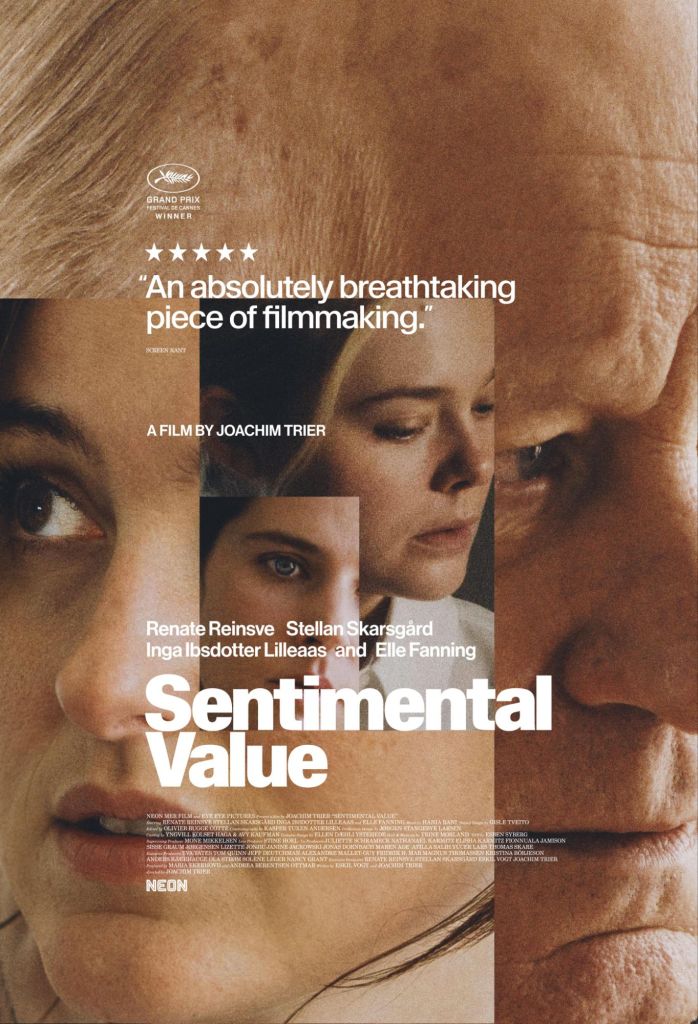
Sentimental Value (2025) review
Sentimental Value is another deceptively slight movie about coping with tragic loss, but one that feels far more likely to linger. Stellan Skarsgård plays Gustav Borg, a Lars von Trier–like director who hasn’t made a film in over a decade and now feels pressure to deliver one final artistic statement before he dies. His daughters have long since stopped needing him, and the distance feels permanent. Gustav is the kind of man who only loves punishing, perverse cinema—to the extent that he thinks DVDs of Irreversible and The Piano Teacher would be appropriate gifts for a twelve-year-old’s birthday.
Movies about filmmakers rarely thrill me—they tend to be self-congratulatory, and therefore less honest—but this one is handled with restraint and surprising humility. The central question cuts deep: how do you convince anyone your story is worth hearing when you’ve spent a lifetime showing no interest in listening to others? Elle Fanning plays one of his collaborators, and even she seems uncertain whether this man’s vision deserves her faith. And honestly: why isn’t she already regarded as one of the finest actors of her generation?
Sentimental Value comes and goes for me a little. It says something real, and I don’t doubt that it matters, but it didn’t stay with me in quite the way The Worst Person in the World did, which felt like the movie I’d want all my friends to watch when I die. That film felt big—about terminal illness, infidelity, and the stories people tell themselves about their own lives. Sentimental Value feels smaller by comparison, more about famous people having problems that will probably never apply to me. My boyfriend loves it. I admired it. I’m just not sure how much I’ll think about it later.
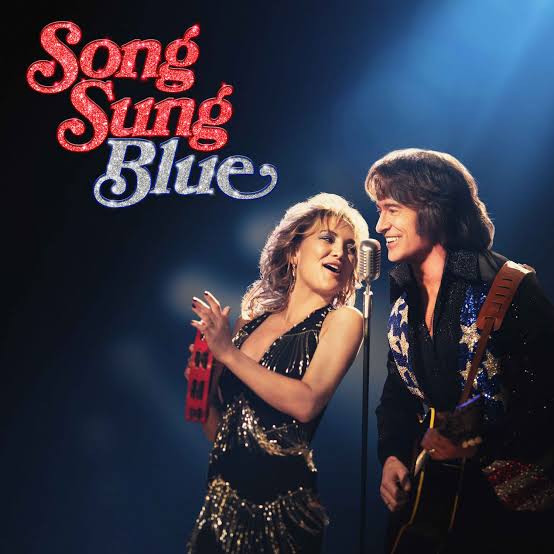
A gentle love story about music, missed chances, and making the most of the time we have. Song Sun Blue (2025) review
Song Sung Blue feels like exactly the kind of movie that would play the Heartland Film Festival, doesn’t it? Let me check… okay, it didn’t. But they gave it some sort of award anyway. You can almost hear the thought process: “We’re not letting a movie this modest—and this transparently engineered to make audiences cry—go by without our name attached to it.”
And yet.
This is actually a very sweet love story about two people dealing with genuinely relatable problems—at least to me. Kate Hudson does her own singing, and she sounds great: exactly like an extremely talented performer who can’t quite turn that talent into a full career.
The real pang here is that Hugh Jackman never played Neil Diamond in a biopic. He looks and sounds uncannily like him. That said, I can’t imagine there’s a story we urgently need to see about a 60-year-old Neil Diamond—and, truth be told, this story didn’t strictly need to be told either.
But it was told, and it’s very sweet. The film gently reminds us of the importance of making the most of our lives while we still have time on Earth. I’m glad to have this one available for people grieving the loss of family members.
A somber meditation on solitude, memory, and the slow passing of a life.
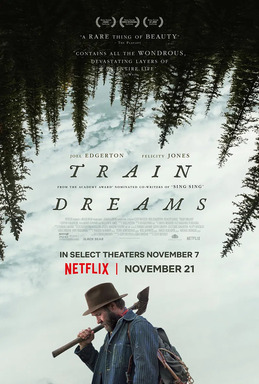
Train Dreams
Train Dreams may be one of the most somber movies ever made. For comparison, I thought of films like Bringing Out the Dead, Palindromes, and Synecdoche, New York—all famously bleak works that offer little to no emotional reprieve. This film is quieter, sadder, and somehow lonelier still.
It captures the immensity of solitude: what it feels like to be briefly, modestly happy; to watch that happiness erode; and then to wake up one day and realize the world has kept moving without you—that you may be the only truly sad person left in it. The performances are restrained and affecting, communicating grief and endurance without overt dramatics.
Still, the film’s devotion to mood comes at a cost. It often feels less like a story unfolding than an emotional state being sustained, and at times it nearly forgets to become a story at all.
Talking Animals, Shakespeare, and Amazonian Aliens.
At some point these stopped being short reviews and started turning into whatever this is. I’m fine with that. Here are the next three movies, in the order I watched them.
Here you go:
Zootopia 2
Zootopia 2 benefits enormously from revisiting Zootopia, which has aged surprisingly well—far better than Moana, which now feels small and oddly muted, like a wannabe epic propped up by great songs. The problem with Moana as a franchise is structural: it barely has characters. There’s Moana, her stern father, her dead grandmother, Maui, a chicken, and the ocean. That’s not a world; it’s a fable. Moana 2 clearly didn’t know where to take those pieces next, and the result felt pointless. (Also: why did no one ever eat the chicken?) Disney’s recent sequel strategy has been so uninspired that it briefly makes you wonder whether they should just stay out of theatrical sequels altogether.
Or maybe not. Zootopia 2 is fun, clever, and densely packed with jokes. The original film had a deceptively simple premise that left room to grow, and this sequel smartly picks up only a week after the first movie ends. It initially feels odd, but it works—the film plays like episode two of a throwaway detective TV show that accidentally became excellent. Unlike Moana 2, which lists four credited screenwriters, Zootopia 2 is written by a single voice: Jared Bush, who also co-directs. That cohesion matters. Even when the movie leans into procedural rhythms, it feels confident—like an artist cracking jokes, experimenting and laughing at his own instincts. It’s lighter than the original, but boldly understands its own strengths.
8/10.
Hamnet
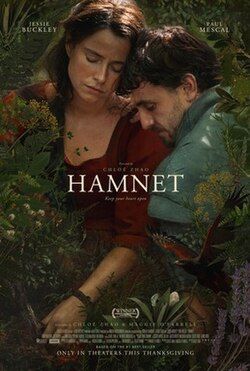
Hamnet is intermittently compelling while you’re watching it, but I don’t think the world will ultimately care very much. The first half works surprisingly well, unfolding with a meditative patience that recalls the style of Chloé Zhao—a comparison that will excite the half of the audience that tolerated Nomadland and bore everyone else senseless. There’s a quiet confidence early on, an observational calm that suggests grief as a lived condition rather than a dramatic event. For a while, Hamnet feels like it knows exactly what kind of movie it wants to be.
That confidence collapses by the end. Some have positioned Hamnet as the “real” Shakespeare in Love, but that comparison only highlights how much that film got right. Hamnet can’t decide how its characters should exist: they often speak like modern people who binge Outlander, then suddenly shift into scenes written in full Shakespearean verse. The tonal whiplash is baffling. Are we meant to believe the audience can’t handle period language—except when it’s convenient? The final act fails outright. Leaning on Adagio for Strings—arguably the most famously depressing piece of music ever written—to sell Shakespearean tragedy feels desperate, not profound. The camera lingers on Jessie Buckley’s face for so long that people around me literally fell asleep, and the staging of the finale makes entering the center of the Globe Theatre feel about as casual as finding a spot near the stage at a rock concert. I liked too much of Hamnet to recommend against seeing it—but I give a thumbs down to the very elements most people seem to praise. 6/10.
Bugonia
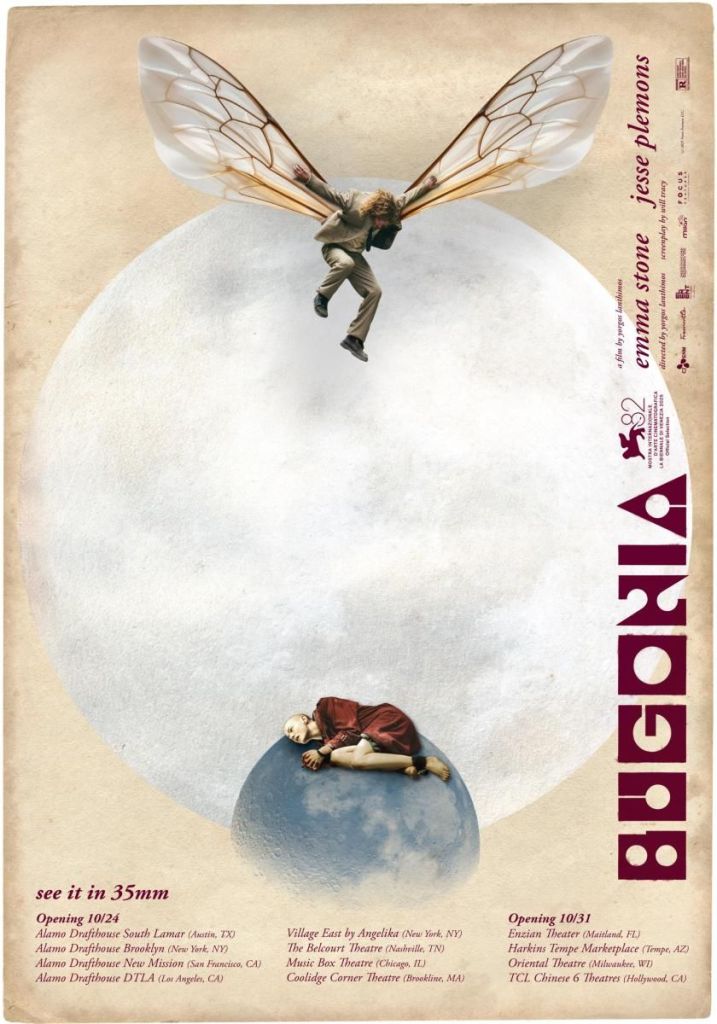
Is Bugonia a place? A character’s name? Apparently, it has something to do with Greek mythology and bees. I’ve always thought that if the human race died, it would have something to do with colony collapse disorder. I just never imagined it could really happen—or look quite like this.
Emma Stone plays Michelle, an executive at a vast, vaguely defined conglomerate—something like Amazon filtered through the pharmaceutical industry. She delivers corporate edicts that sound humane while being quietly coercive, the kind of language designed to make people work harder for less while thanking management for the privilege. Stress is treated as a given. Burnout is reframed as responsibility. Somewhere in the background, the bees are dying.
There’s enough good in Bugonia to almost compensate for Yorgos Lanthimos’s increasingly questionable sense of humor. The film has the shape and texture of something very familiar—procedural, paranoid, vicious. With only minor adjustments, it could easily pass for a season of Fargo. The score and cinematography are immaculate, the performances relatably absurd. Everything feels carefully built. It might even feel like a masterpiece—right up until it decides not to be one. But what’s the fun in that?
The Oscar buzz around Stone feels less about nuance than about her continued commitment to being Lanthimos’s most pliable collaborator (yes, she really shaved her head for this). The film flirts with weighty ideas—mental illness, institutional power, corporate systems managing human behavior—in ways that feel unnerving and recognizable. But it keeps shifting, nudging, testing how much disbelief the audience is willing to suspend.
The whole thing plays like a meticulously structured Upright Citizens Brigade sketch that refuses to announce where the joke is—or when it’s over. I understood what it was doing. I admired the confidence. This could have been No Country for Old Men or The Silence of the Lambs. I just couldn’t shake the feeling that it was laughing at a version of the movie I would have liked better.
Bugonia is handsome and deeply committed to its own logic. In real life, we probably already know these characters. Whether we recognize them as such is another matter.
7.5/10
This will all continue in a third and final-ish part.
Goal: Find a horror movie I am embarrassed to have never seen.
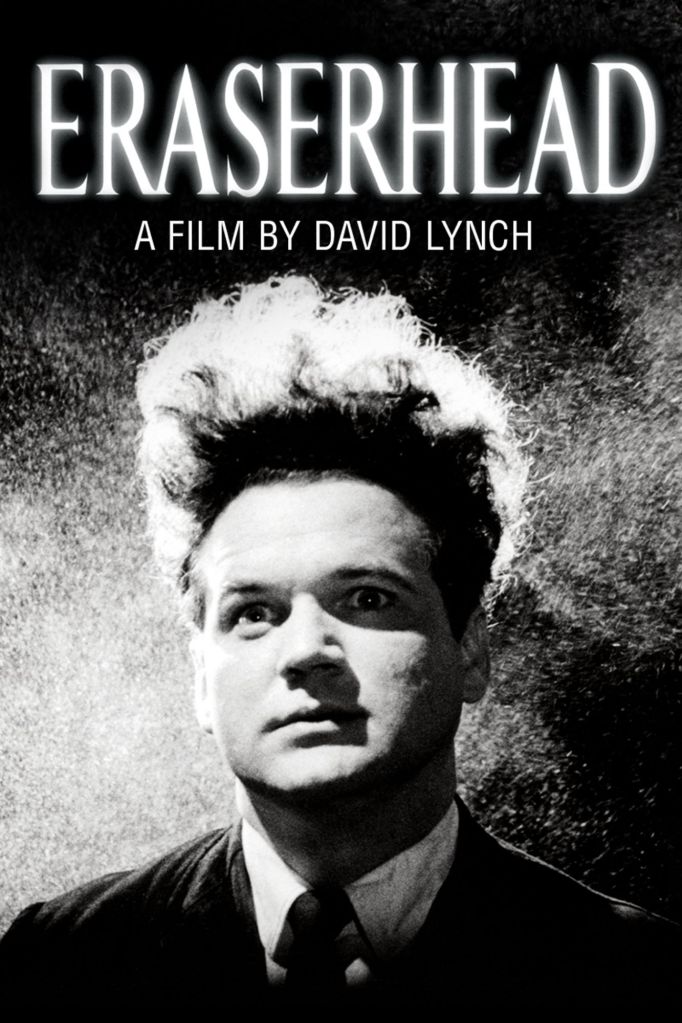
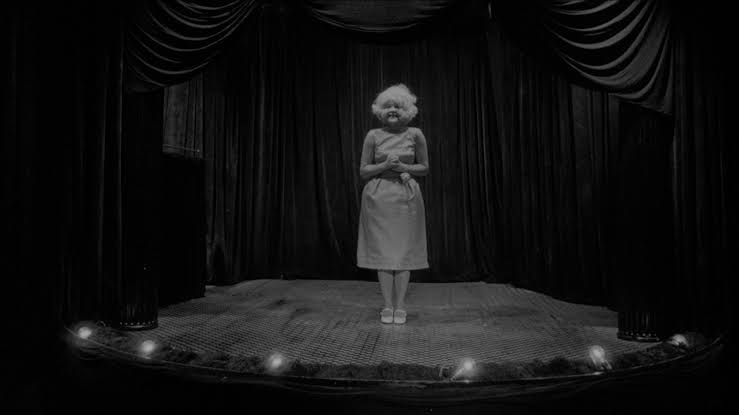
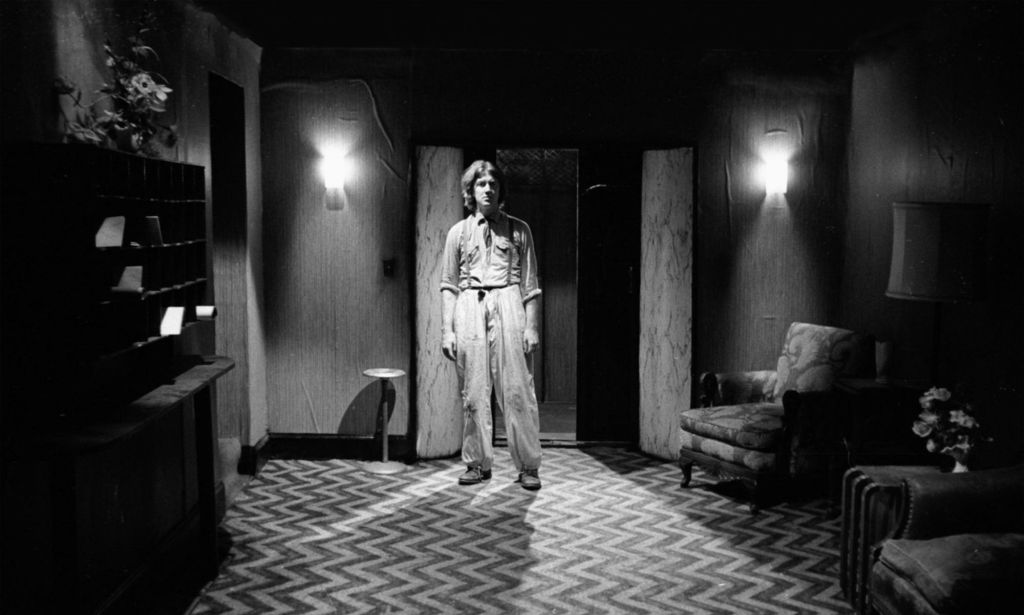
Eraserhead (1977)
What I know about it: A black and white horror movie from the same guy that did Twin Peaks and Mulholland Dr. RIP. This has a very strange trailer that I can’t remember, and I saw it last week. Long static shots of a guy with a high-cut hairstyle looking blankly at the camera. Ok, now I’ll read the premise on IMDb.
So this is a survival movie. “Henry Spencer tries to survive the screams of his newborn mutant child.” Shouldn’t those adjectives be in reverse order? Does Henry have a mutant newborn child, or does he have a newborn mutant child? Describing the child like that makes it sound like some sort of irregular baseball card, or like he came with a set of superhero clothes. “Mutant Child here! Now with a detachable umbilical cord and noise chip!”
As someone who regularly saw the grosses for midnight movies nationwide, this was one of the standards, particularly in New York and California. If you specifically like watching cult or midnight films, you have already knocked this off your list long ago. I don’t know what it is, but it’s the type of movie that I want to know as little about as possible.
—
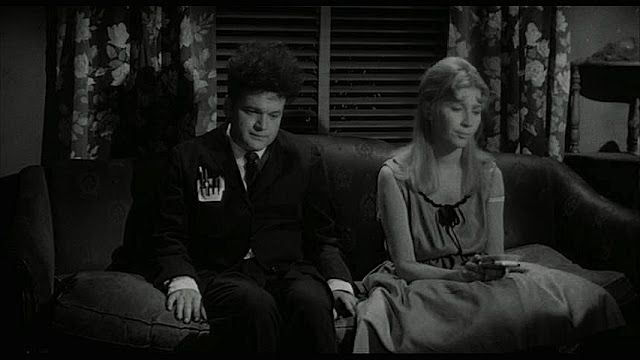
After the movie: Hair in the 1970s. You couldn’t mess with it. Today, if someone looked in the mirror and said, “You know, my hair kind of looks like a pencil eraser,” they would then get clippers and a pair of scissors and cut it down until it seems like the average length trending right now. But in 1976, that length was inches, which equated to a white man afro on some unlucky men. So all you could do was look out the bedroom window from the fetal position and sulk.
The terminology “newborn mutant baby” is definitely accurate. It isn’t a mutated normal baby. It is a normal mutant baby, with a head that looks curiously like a human elbow. David Lynch deserves some sort of medal for comedy for playing such a long game for such a minor joke. Blink and you’ll miss it.
I watched this with Josh, who seemed to mostly agree with me on Dead Calm. With Eraserhead, he realized it was boring and considered leaving 30 minutes in. “This movie is just *dull*. People in 1977 watched this because there wasn’t anything else to do.” He never left the room and watched the screen the entire time. He said he kept waiting for it to get better, although I think just enough new things happened to—not keep him interested, maybe—but to keep him from becoming bored out of his mind.
I realized while watching this: mostly, this was an extremely influential movie for certain directors. It is clear that Barton Fink, which won the Palme d’Or in 1991, was about 70% Eraserhead when the Coen Brothers thought out what to do for their fourth feature film. Is it a drama? Thriller? Comedy? The decision to give it the biggest award was unanimous, which is as if they were saying, “Bravo. We saw Eraserhead, too.”
This was pre–the mutated creature film boom of the late 70s and 80s, from directors David Cronenberg, John Carpenter, Joe Dante, Ridley Scott, et al. The stop-motion and practical effects were influential on many 1980s films. David Lynch figured out how to take the effects used in Jason and the Argonauts and claymation movies and do them on a next-to-nothing budget. The sequences don’t last long, but the effect feels straight out of Beetlejuice a decade later. The body imagery, which includes a rib cage split open, feels right out of John Carpenter’s The Thing.
If the film is about anything, it is the crushing routine and existence of working-class, industrialized city life. Henry Spencer lies down and looks out his bedroom window, and then we cut to his perspective and see what it is he sees. When someone’s bedroom has a contender for “world’s worst view,” I always think, “How did he get stuck here? Henry must be the worst person alive at finding a job. Or the worst at finding an apartment.”
I always assumed Angelo Badalamenti specialized in 1950s jukebox-style music, which is where the strange lounge act aesthetic came from in Blue Velvet, Twin Peaks, et al. But no. That seems to mostly be Lynch’s idea as the origin point. The song here, “In Heaven,” was mostly written by the man himself. I like to think he started with this idea just to find something absurd to be “the mutant squish-y” song, and then he just decided to keep that style and really commit. The Twin Peaks aesthetic started here, in this bizarre, dark horror movie that no one was supposed to see.
Because Eraserhead is must-see cinema. For anyone who grew to love David Lynch for Twin Peaks or Mulholland Dr., this is where a surprising amount of his craft was first seen. I could name 30 movies now considered classics released in the next 20 years that were directly indebted to Eraserhead. The entire 1980s cult movie genre was trying to be the next Eraserhead!
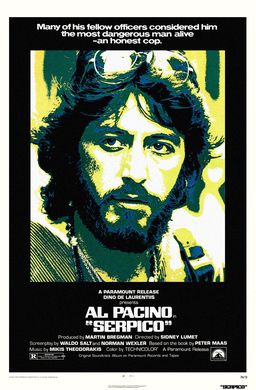
Serpico is life summarized. If I could recommend it to one group, it’d be college-aged people considering law enforcement. This should be required viewing. It’s a true story — and it feels like one. The effect is sobering. Serpico isn’t a saint; he just sticks to a couple of moral rules, and for that, he’s targeted. Mostly, he’s punished for being a nonconformist who won’t take bribes. Turns out that’s a real problem.
There’s one scene that nearly derailed the film for me. Early on, Serpico stumbles on a group of young Black men assaulting a woman. It’s brief and has no impact on the story. I initially excused it as something that “probably happened.” But it didn’t. It’s not in Serpico’s memoir and appears to be completely invented. That makes its inclusion worse. It plays into a racist stereotype under the guise of “filling in context.” This isn’t harmless background — it’s racially charged mythmaking.
Structurally, the movie is messy. It jumps between years, jobs, and relationships with little concern for narrative momentum. The fabricated scene I mentioned only exists to make Serpico look sympathetic — even to a rapist. He helps the man, walks him to a café, and threatens to shoot him if he runs. It’s absurd and undermines the film’s credibility.
And that’s the problem: if this film invents major scenes, how much can we trust the rest? So much of the runtime is spent on relationships and moments that never happened. Serpico’s partner leaving him in the bathtub to marry someone else? Pure invention. These scenes feel like homework: are they fair to minorities, to Serpico, to the police?
Still, the core story remains: Serpico faced relentless pressure to conform, constant harassment, baseless rumors, and professional roadblocks. He did the right thing, and it made his career stagnant and his personal life chaotic.
The film feels endless by design. That’s part of the truth it captures: being a good cop in a corrupt system leads to isolation, thanklessness, and futility. No promotions, no recognition, no peace.
Serpico is not a great film. Its liberties are frustrating. But it’s essential viewing. If someone sees this and still wants to be a cop, maybe — just maybe — that’s the kind of person we need.
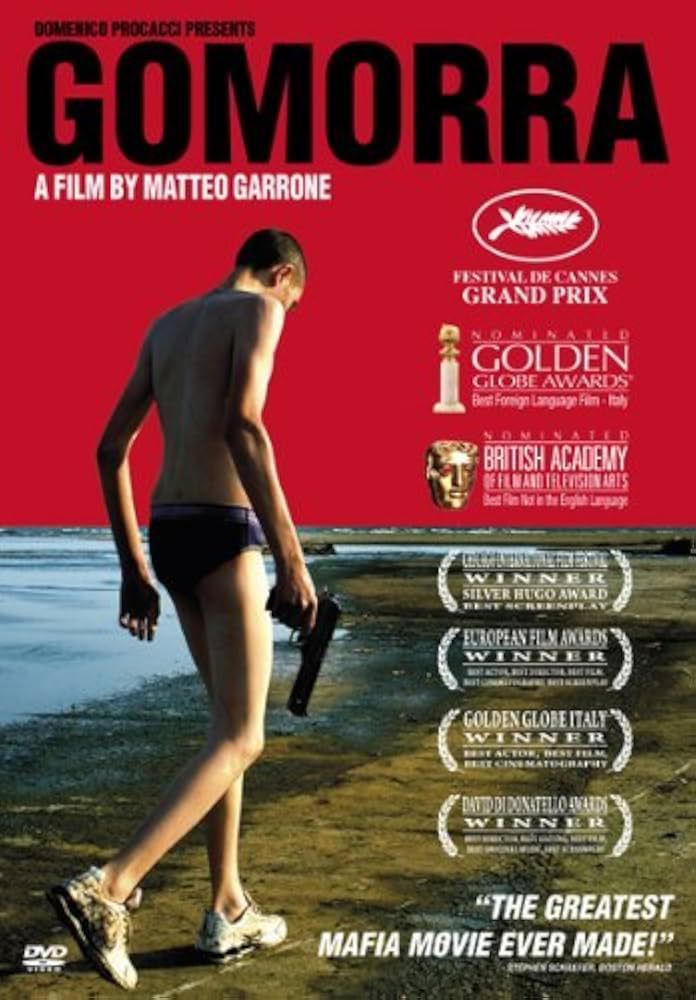
This one felt real to me—the culture, the power dynamics, the hierarchy of command. I believe this is what the Mafia really is.
There is no honor here. No sacred “Mafia code.” It all comes down to the bottom line: money, and no liability.
The difference between life and death is arbitrary. Early on, a 15-year-old is asked why he’s shaking—is he scared? “No,” he says. The older man is pointing a gun at his head. “Are you scared?” “No.”
Bang.
He’s dead. For no reason other than being too afraid to admit he was afraid. The next kid wears a bulletproof vest and survives. Why? Luck. You have to guess right. What will offend the Camorra? What will charm and delight them? The difference is negligible. The consequences are massive.
Director Matteo Garrone shows us the world of the Camorra through two central perspectives. The A story follows two kids raised in a world where the mob is king, trying to break into it. The B story centers on a high-end fashion tailor who makes no money because the syndicate exploits his skill. This second story is more compelling.
The kids are idiots. I would’ve preferred to see what this system does to the smart ones—but I fully believe kids like this exist. And they’re doomed.
Gomorra presents a world of crime that is consistently fascinating. Every scene feels like something I haven’t seen in a film before. For this type of movie, that’s miraculous. Beat for beat, it’s consistent in the psychology of its world-building. I’m not sure if Gomorra is a necessary film the way City of God was five years earlier—but it’s absolutely a purposeful one.
I am watching a movie for each letter of the alphabet I would otherwise not get to for a while. So far I have watched:
13 Assassins (Takashi Miike, 2010) – 9/10
—
Days 2: A
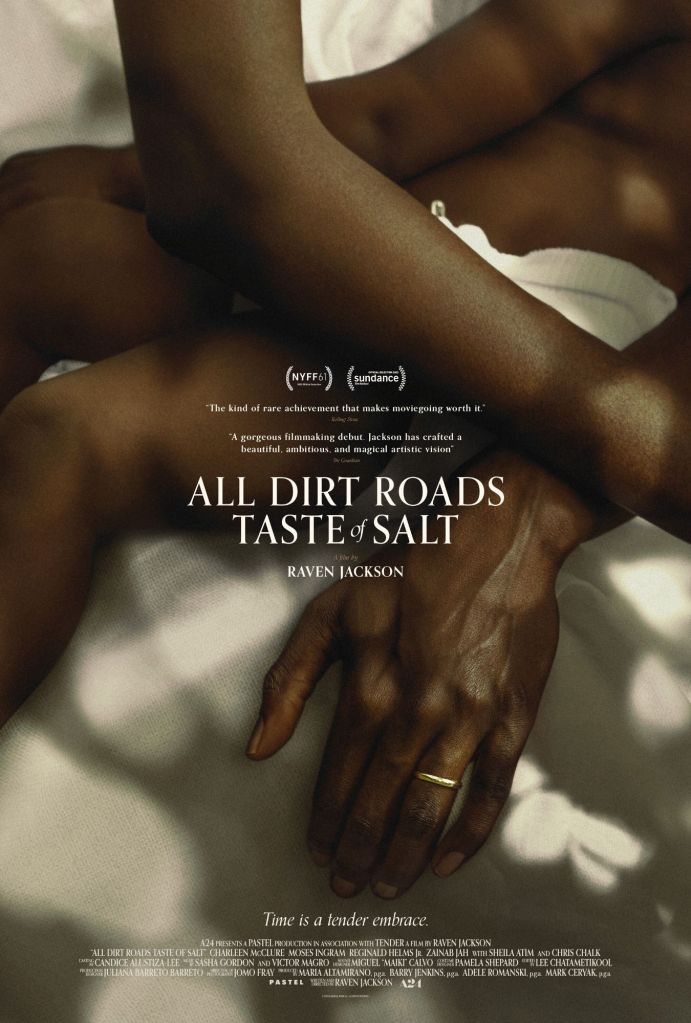
All Dirt Roads Taste of Salt (Raven Jackson, 2023)
All Dirt Roads Taste of Salt (2023) is halfway in between Terrence Malick’s Tree of Life and David Gordon Green’s George Washington. The film quietly paints a portrait of a black family living in rural Mississippi over multiple decades, using beautiful cinematography and an incredible nature sound design. It creates a dreamlike atmosphere, like a collage of memories from childhood. There isn’t enough “there” there. The dialogue is way too minimal, and the actors seem overly blocked, always trapped inside invisible walls.
I can’t stress how beautiful this looks, though. For the last half hour, I continuously thought every shot was going to be the final image of the movie. Any would have made a perfect ending. The movie resonates and lingers.
The title is curious. It recalls one’s reaction to always tasting unpaved road when you travel down one, tires kicking debris in the air. But…salt? Wouldn’t dirt roads taste like…dirt? The director has talked about it, and I’m not satisfied. She said it is a metaphor. “Roads” are metaphorical roads. Also, geophagy (eating clay dirt) is common among poor families in the south, but the family does not seem to be overly poor. Also, why would she be eating the dirt from a dirty road? That would be the dirtiest dirt?
A movie like this is only as good as its weakest component. It is very impressive for many reasons, but it is also rather vacuous in content and intent. Still, make sure to keep your eye on Raven Jackson. She made a polished, expensive feeling movie on likely almost no budget. I expect big things from her.
An incredibly ambitious piece of low budget filmmaking.
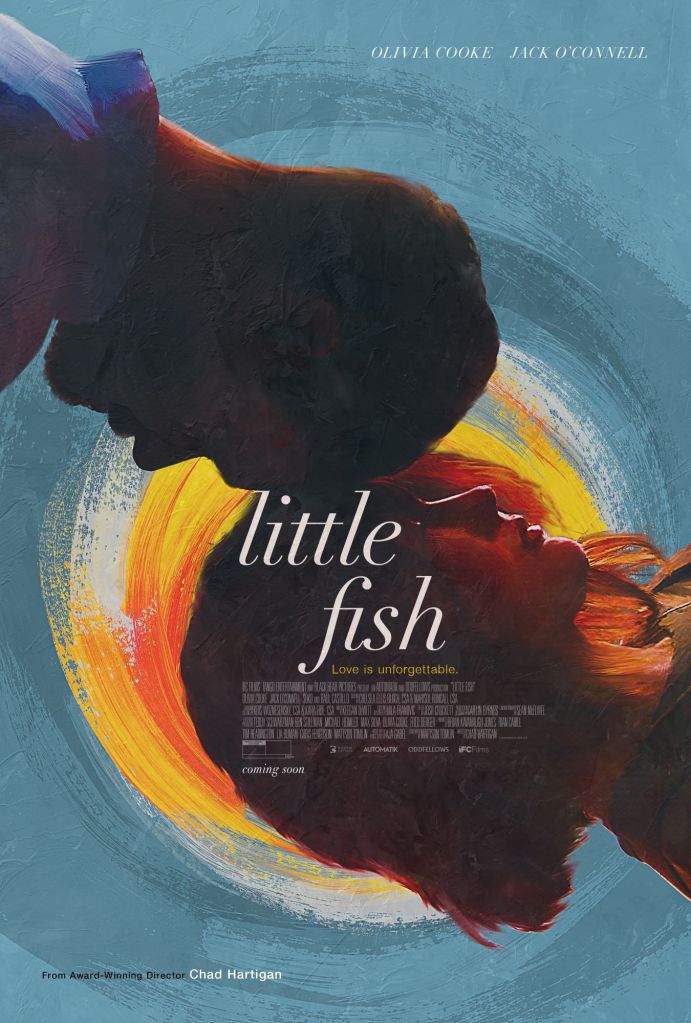
The idea here is a good one: what if Alzheimer’s disease was something you could catch?
Now, imagine giving that premise to Terence Malick to write and direct and you will have a basic idea of what Little Fish is like.
The story follows Emma (Olivia Cooke) as she grapples with the Alzheimer’s-like disease that is erasing the memory of her husband, Jude (Jack O’Connell). The disease can either affect you all at once or it can affect you gradually. Jude’s loss is very gradual.
The script relies on Emma’s narration, both to explain what is happening in the plot and what is happening to her emotionally. I am reminded of Days of Heaven‘s voice-over narration. It isn’t the greatest idea in a movie to have most of the plot just flatly told to you instead of shown visually, but here it works. I usually hate voice-overs, but when it seems purposeful in many ways, I dig it. Because we hear her narration, we understand everything: what each idea means to her, why it means to her to choose the specific details she is recalling, what her emotions have been like during this process.
Badlands is associated with extreme world-building. PT Anderson held it up as a pinnacle of filmmaking because it “used pictures on the walls.” What he seemed to mean was that they found pictures that looked like Sissy Spacek’s family from childhood and put them on a wall. Just to have in the background for a few seconds. Either they asked Sissy to bring in pictures of herself or someone spent time finding photos that could work. In the days before online photo libraries that could be searched with a few keywords, this was almost unheard of.
There are little touches like that in Little Fish. Giant murals are chosen for quick shots. Mysterious paintings that just display a word on the entire side of a building. Did they scout out the location themselves? Or did they commission the painting? Either way, it would have required over a hundred hours of work for a shot that lasts only a few seconds.
In the world of Little Fish, every little word counts. There is one scene where Emma and Jude stand looking at a collage of pictures of details from their lives with their names taped to them. Dogs, friends, locations.
Literal pictures on walls.
Tattoos are also used to keep memories of importance alive, but again, the plot doesn’t dwell on this. It doesn’t affect the plot in the way such a device was used in, say, Memento.
For a low-budget film, it’s nice to see care put into the little details.
I feel like the team (the writer, the director, the producer, et al.) worked their hardest in a mad fit of effort to come up with ways to maximize the resources they had. At one point, a car crashes into another car in a scene that in no way affects the plot. It is just a way to add punctuation to the emotional changing world.
Little bits of effort make an impact. Noticing these moments that seem superfluous made me wonder, “why would they do this? What meaning does this bring?”
In a different scene, the camera follows the characters through a nice area in the city when, in the background, someone has crudely spray-painted the words “Iris come home” on the wall outside. The shot only lasts six seconds and the camera doesn’t focus on the wall. That moment is so subtle and adds an extra layer of meaning.
Who is Iris? What is her story? Did she paint it herself? Why would the community leave it?
Is the thought of Iris never making it home too heartbreaking to remove the graffiti?
Perhaps the biggest problem this movie had critically: if there is a contagious epidemic going on, why does no one wear masks? It was kind of unfortunate this came out when it did, as it was made in a pre-Covid world and came out post. There actually is one scene where scientists made everyone wear masks. However, there is a moment where a main character takes off the mask out of confusion and no one seems to care. This, to me, spoke volumes. The scientists were making people wear the masks as a technicality, but it seems like everyone has figured out that the disease is not airborne. That is my reading of the world as it is portrayed.
The movie is about memory loss, but in a way that embraces quiet melancholy. The movie recalls, specifically Eternal Sunshine of the Spotless Mind, in a way that has the characters protective of their love for each other instead of actively trying to remove such memories. Trying to hold on to memories or trying to remove them. Either way, I appreciate the depth of thought that went into this: both movies are told nonlinearly in a method that cherry-picks the important moments. This relationship feels very lived in.
Overall, this is a quiet movie that explores how Alzheimer’s affects people struggling to keep hold of themselves and the people they love. And it asks the age-old question: is it better to lose a loved one or lose the memories of the person you loved?
Best of all is the final line. Poetic and meaningful, it conveys a real message. When remembering the love of your life, even the most important emotions fade into the background when you remember him.
Releasable, but not otherwise a cause for celebration.
“Oh my God. They’re making a re-quel.” “A what?” “Or a Legacy-quel. Fans aren’t quite sure on the terminology.”
That’s not a good sign. If the trend you’re referencing doesn’t even have a proper name, you might not want to hinge your entire script on it.
So let’s investigate this legacy-quel idea. If I understand it based on Scream (2022), it’s when a movie shares the same name as the original, looks like a remake, but is actually a sequel. It takes place in the same world, continuing the story while trying to pass the torch to new characters. The film presents this as a major trend worth parodying. But… is it?
At the time of this movie’s production, there was really only one clear case: David Gordon Green’s Halloween (2018). For some reason, they just called it Halloween, instead of adding a number or subtitle, making it confusing for audiences. But even that wasn’t entirely new—Halloween H20 had already tried to ignore past sequels and return to the original’s vibe. The franchise then spiraled into chaos with Halloween: Resurrection (widely considered the worst entry), Rob Zombie’s divisive remakes, and finally, a nine-year dormancy before the 2018 reboot.
So, was Halloween (2018) really the start of a trend? At the time Scream (2022) was being written, two more so-called “legacy-quels” were in development: Candyman and The Texas Chainsaw Massacre. But those movies weren’t even out yet. Scream treats legacy-quels like they’re an established Hollywood phenomenon, but this feels premature—more like the filmmakers heard the term floating around and rushed to cash in.
And even among recent sequels that revive old franchises, most don’t just reuse the original title. Ghostbusters: Afterlife, Blade Runner 2049, Star Wars: The Force Awakens—all of these continued the story but at least had unique names. The only recent example I can find of a sequel taking the exact same name as the original is Ted, the TV series. And even that could have just been called Ted: The TV Show—but I guess that sounded too much like CSI: Crime Scene Investigation – The Board Game.
The worst offender is Scream itself. Naming Scream 5 just Scream is obnoxious. It forces fans to refer to it as Scream (2022)—which I hate typing—just to differentiate it from the 1996 classic. If Hollywood insists on doing this, at least give us a color-coded logo system, like Peter Gabriel and Weezer do with their self-titled albums.
So how’s the movie?
It’s fine. It seems aware that modern horror has evolved past the slasher formula, but instead of fully embracing that, it just points it out. The characters openly discuss how “elevated horror” (The Babadook, It Follows, Hereditary) is what people actually watch now. That’s another bad sign. If your own script admits the genre has moved on, why are we here?
The script overall is hammy and half-baked. The vibe is: “We noticed this trend, so we rushed this out the door. We didn’t put much effort in, because this won’t be relevant anyway.” Reviews have been generous, probably because they brought back as many surviving original characters as possible. Scream (1996) had the benefit of satirizing a slasher trend that was still relevant enough to participate in. Scream (2022) tries to satirize a trend that barely exists.
As for the returning cast, the energy feels like: “I’m too old for this. But what else am I doing? This is the script? Really? I’ll only need to be there for a week? Good enough, let’s go.”
The movie strains with its meta-humor and callbacks. “Do you know what happens to the expert?” You mean Jamie Kennedy? He survives the first movie. So, “Do you know what happens to you?” “Yeah. I’ll survive… for a while at least.” The self-awareness borders on lazy winking.
There are a couple of cute modern touches: kids watching YouTube breakdowns of bad sequels, using phone tracking apps to monitor a partner’s location. These ideas feel relevant but barely impact the plot. They were probably brainstormed in the writers’ room and then forgotten.
The Most Unrealistic Scream Movie Yet?
For a franchise built on exaggerated horror tropes, this might be the most unrealistic Scream yet. Where are the returning characters’ partners and kids? Wouldn’t they have obligations keeping them from abruptly chasing down a serial killer? Also, how does Scream (2022) manage to reference the exact dialogue from the original’s opening scene? Spoiler: everyone present in that scene was dead. Even if they made a movie (Stab) based on those events, how would they have an exact transcript?
The ending is… fine. It doesn’t make much sense, but it has the pulpy, page-turning quality of an airport thriller. There are enough twists that I didn’t outright reject the movie.
But Scream (2022) definitely misjudged the legacy-quel concept, or at least overestimated its importance. It’s trying to make a trend happen that doesn’t really exist.
Final Verdict
The sixth installment is supposedly “just as good” as this one. I might watch it.
 Avidavr: Media Reviews