Author: Avidavr

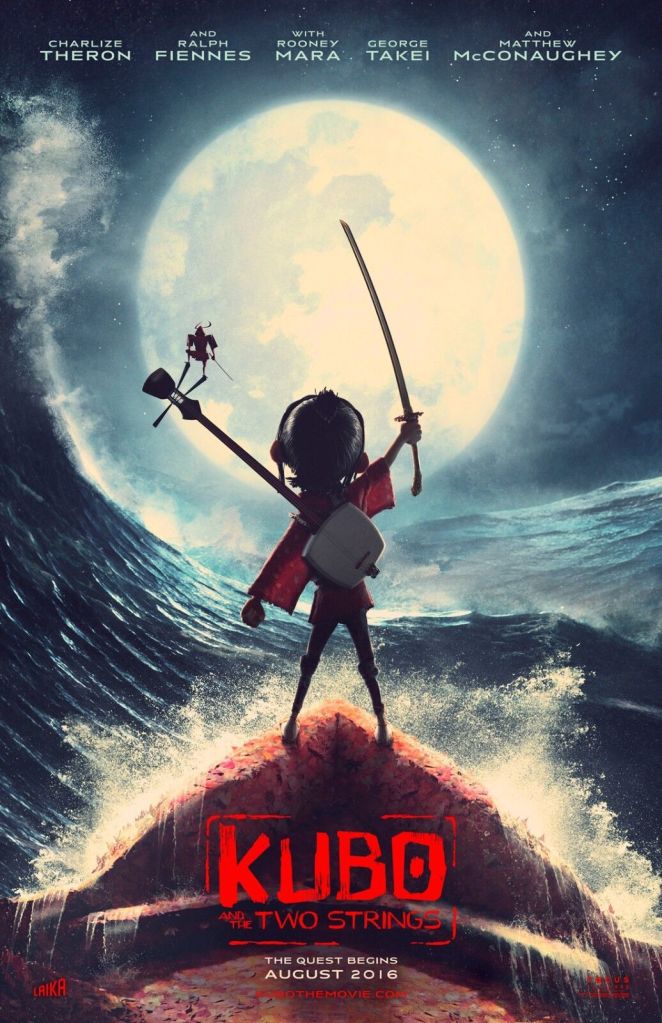
  • Kubo and the Two Strings (2016)

    My 27 movie A-Z film-a-thon: Day 12


    This era of animated films contains many clunkers.
    Okay, that’s a little unfair. It doesn’t just apply to animated films, but to almost any large, big-budget or franchise movie from 2016 to 2019. Scripts from this time often offered nothing new—or if they did, it felt like the result of throwing darts at a wall.


    Kubo and the Two Strings is creative, yes, but also absolute nonsense. Nothing here is grounded in reality. Kubo can control origami by playing a magical shamisen—but where did that power come from? The movie isn’t interested in asking, or answering, that question. Compare this to Miyazaki’s Spirited Away, where every surreal moment still feels rooted in something emotionally familiar. In Kubo, things just… happen. Every minute, it feels like another random idea is yanked from a grab bag and dropped into the script with little development or organic integration.


    The animation is impressive, considering the budget, but the character models are oddly generic. Everyone seems to have Gru’s face shape from Despicable Me, and the animation feels a little “floaty”—there’s not much weight when characters fly or step. Not a dealbreaker, but noticeable.


    More frustrating is how little the film resembles the culture it supposedly draws from. Set in early feudal Japan, Kubo features no Asian voice actors in key roles, and everyone speaks in a flat, stereotypically American tone. Why build a story around such a specific cultural setting, only to strip it of that culture in execution?


    In the end, it’s a jumble: generic animation, generic music, a scattershot script that relies on its uniqueness of ideas rather than their development. Worst of all, the movie constantly tells instead of shows. Kubo is sent away with his mother’s magic, then wakes in a snowy field next to a talking monkey—who was once a wooden charm named Monkey. “I said, your mother is gone. Your village is destroyed! Burned to the ground!” Monkey yells. Would’ve been nice to see that scene, right?


    Kubo and the Two Strings isn’t a bad movie. In fact, it’s rather engaging, and refreshingly distinct in a sea of interchangeable animated films. It’s just… this could have been so much more in the right hands. I enjoyed it—even though I found something to complain about in every scene.


    6.5/10

  • The Joy Luck Club (1993)

    My 27 movie A-Z film-a-thon: Day 11.5.

    I added another J entry, this time a request. I decided that both Johnny Guitar and the movie would have enough to write about to do them both.

    A beloved critical darling at the time of its release, The Joy Luck Club has largely faded from public memory. I first heard of it in Roger Ebert’s year-end collections, but for some reason, I always assumed it was a relationship drama among recent college grads—something more in the vein of St. Elmo’s Fire. I was way off.

    In reality, The Joy Luck Club is one of the first major Hollywood films centered entirely on Asian characters, played by Asian actresses. The title refers to a mahjong club formed by the main character’s mother during wartime in China. “Joy luck” is the idea that, even in the worst of circumstances, one can find fortune through joy and friendship.

    The film follows four Chinese-American women and their immigrant mothers, weaving together stories from both generations. I’ll be honest: I had trouble telling some of the characters apart. The actresses have similar looks, voices, and even plot arcs. At times, I thought the same woman had multiple white husbands. A more exacting director—maybe someone like Spielberg—might have pushed harder to visually or tonally differentiate the stories.

    That said, this is a compelling “women’s picture,” packed with enough plot turns to stay engaging without dipping into melodrama or cliché. The central thread follows June Woo and her mother, who escaped from war-torn China after abandoning her infant twin daughters by the side of the road. The film asks, “How could a mother do such a thing?”—and then slowly, powerfully, answers it.

    The other daughters of the Joy Luck Club all carry histories that echo each other in meaningful ways. Second-generation immigrants often face similar tensions, especially when navigating between tradition and assimilation.

    I feel like this film is a perfect introduction to Amy Tan’s novel. I never thought I’d want to read it, but now I might. The characters are strong on screen, but you can sense there’s even more to them on the page—more cultural nuance, more inner life.

    A strong, meaningful film with a clear place in cinematic history. It’s just a shame the writing/directing team couldn’t quite replicate the success—Maid in Manhattan is a far cry from this. But this one’s great.

    8.5/10

  • Johnny Guitar (1954)

    My 27 movie A-Z film-a-thon: day 11.

    Johnny Guitar is named after a sagely gunslinger (Sterling Hayden) who carries a guitar — sans case — on his back. But the movie is all about the women: Joan Crawford as Vienna, the mysteriously affluent saloon owner who can play the piano, and Mercedes McCambridge as Emma Small, the vengeful zealot who relishes the chance to take the esteemed Vienna down.

    I watched a great deal of the Grit channel for a few years. If I had seen this on there, it would’ve been one of my very favorites. It has everything I want from a 1950s Western: beautiful, well-scouted locations, gruff gunslingers, double crosses, vigilantes, and beautifully (if unnecessarily) cinematic imagery that begs to be seen in a theater. Sure, they used explosives to blow the hell out of priceless natural landscapes and burned down a million-dollar mansion attached to a cliffside rock, but the film has constant movement. There’s never a time when something interesting isn’t happening onscreen.

    Nicholas Ray seems to be doing too much to prove himself here. It might be a tad over-directed, and in doing so, it feels more like a producer’s movie than a director’s one. “Make sure you can see all the movie onscreen!” I can hear someone say. It’s the kind of film that feels made for the trailer — long before that was much of a thing.

    The movie has amassed a devoted cult following, mostly due to the resolve of Joan Crawford, who excelled at roles steeped in determination and melodrama. Vienna is highly respected by almost every man in town, yet she accepts it when the little chain of dominoes gradually descends to crush her. “What am I to expect? This is a man’s world, and I’m in the way,” seems to be her outlook. The men end up turning on her, even if they don’t want to.

    Johnny Guitar isn’t great cinema, maybe, but if you like classic Westerns, it checks all the right boxes.

    8/10

  • In the Loop (2009)

    My 27 movie A-Z film-a-thon: day 10.

    I am watching a different movie every day that I otherwise wouldn’t get to for a long while. One for each letter of the alphabet. What I have watched so far:

    _13 Assassins (Takashi Miike, 2010) – 9/10

    _All Dirt Roads Taste of Salt (Raven Jackson, 2023) – 7.5

    _Blow Out (Brian De Palma, 1981) – 8.5

    _Cold War (Pawel Pawlikowski, 2018) – 6.5

    _Darby O’Gill and the Little People (Robert Stevenson, 1959) – 9 

    _EO (Jerzy Skolinowski, 2022) – 5

    _Fat City (John Huston, 1972) – 9

    _Gomorrah (Matteo Garrone, 2018) – 8.5

    _Happy as Lazarro (Alice Rohrwatcher, 2018) – 7

    It’s been a little heavier than my usual tastes, so I thought I would try another comedy. I have been meaning to see this one for quite a long time, since it was out probably. I am not sure why I haven’t gotten to it.

    _

    Day 10: I

    In the Loop (2009)

    Twice as interesting as The Office.

    “I am making you pump Chad. Go on, it will be easy-peasy-lemon-squeezy.”
    “No it won’t. It will be difficult. Difficult-lemon-difficult.”

    I remember that line very well from the trailer 16 years ago. It’s a perfect sample of In the Loop’s rapid-fire dialogue—a very small Sundance film released in April 2009 that somehow made enough of an impression to earn a nomination for Best Adapted Screenplay.

    If you’ve seen The Death of Stalin, Armando Iannucci’s 2018 political meisterwerk, this is a more manic, modern-day version of that, with two parts The Office stirred in. Zach Woods plays a version of his character from The Office—“A.A.” Ron—but this came first.

    The plot follows a dozen key players scrambling through a blitzkrieg of political turmoil after a British cabinet minister says that a war in the Middle East is “unforeseeable.” Of course, saying a war is unforeseeable means you don’t think it’s going to happen—but literally every single person in the movie takes it to mean the opposite. “Unforeseeable” means “foreseeable” in political-speak, apparently. That misreading becomes a darkly hilarious domino that drives much of the chaos.

    The film presents situations that likely feel grounded in real-life. Mid-level politicians and their aides rush to put out fires while jockeying for influence and trying not to compromise either their image or their mission. Characters make “pros and cons lists for war” and struggle to appear busy without unraveling.

    “I need to get out of here. Otherwise, I’ll end up staying in and watching a f___ing shark documentary and having a wank. Because I’m too scared to order porn on the hotel TV.”

    The script is consistently engaging, with little details that return in clever, rewarding ways. I’d argue that the climax—if there is one—doesn’t feel like the movie was building toward it. But that doesn’t really matter. The rest of the film works so well, like a sharper, less cringe-inducing version of The Office. If your brain wants something fast-paced and packed with details worth piecing together, I very much recommend this one.

    8/10

  • Happy as Lazzaro (2018)

    My 27 movies A-Z film-a-thon day 9.

    I am choosing a movie for each letter of the alphabet that I want to see but likely would not get to in years. So far, I have seen:

    _ 13 Assassins (Takashi Miike, 2010) – 9/10

    _All Dirt Roads Taste of Salt (Raven Jackson, 2023) – 7.5

    _Blow Out (Brian De Palma, 1981) – 8.5

    _Cold War (Pawel Pawlikowski, 2018) – 6.5

    _Darby O’Gill and the Little People (Robert Stevenson, 1959) – 9 

    _EO (Jerzy Skolinowski, 2022) – 5

    _Fat City (John Huston, 1972) – 9

    _Gomorrah (Matteo Garrone, 2008) – 8.5

    Maybe I should stick to films at least 10 years old. I feel like a fogey, but I wonder if I have seen all of the most necessary films of recent years. I feel like the trend may be that some of these highly acclaimed movies have so much critical support because they have to like *something*. Every film since 2018. I think are graded on a curve. “Shows promise”, should be attached to the report card.

    Happy as Lazzaro (2018)
    Mixed metaphor city.

    This is an allegorical reference to Lazarus in the Bible. But which Lazarus, you ask—Lazarus of Bethany or the beggar Lazarus? The answer is both. Lazarus of Bethany was raised from the dead by Jesus. His story is about miraculous resurrection and faith. The beggar Lazarus, on the other hand, was denied entrance at the gates of a rich man’s home, only to be accepted into Heaven while the rich man suffers in Hell.

    I’m not a religious man. I don’t like stories from the Bible—especially not ones that end with someone suffering for eternity in Hell. So this story didn’t really work for me.

    Lazzaro is a “blank canvas” character. But in this case, he’s a total blank. He has no discernible traits beyond being passive and agreeable. He makes no major sacrifices and undergoes no deep suffering. At most, he’s overworked. Someone asks him to cover their post—he agrees. They never return. Grueling stuff.

    And yet, I might’ve found that charming: the idea of a pure-hearted man quietly enduring a lower-class life while being used by those above him. It has the ingredients of a good Renoir film, exploring class divisions and how each side protects its own. But it didn’t need to reference such dramatic, life-or-death biblical stories to tell that tale.

    Did I mention the wolves? This is where the metaphors start stacking up to the point of collapse. A mystical wolf appears, seemingly tied to Lazzaro’s nature or fate. Another character teaches him to howl back, and a narrator even tells a story about a wolf that may, in fact, be about Lazzaro himself. It’s all very… much.

    That said, Happy as Lazzaro is gorgeously directed and features a few genuinely inspired moments. The story of the rich exploiting the poor certainly has cultural resonance. Lazzaro is a nice idea for a character, and the message has value. But the rich don’t seem quite rich enough, and the poor don’t seem quite poor enough.

    Mostly, there are too many moments of allegory that feel forced or unnecessary. I won’t spoil them here—this deserves to be seen, and some viewers will walk away feeling deeply satisfied.

    For me, Alice Rohrwacher would go on to do a much better version of these themes in La Chimera—a film that feels deeper, more believable, and uniquely necessary.

    7/10

  • Gomorrah (2008)

    My 27 movie A-Z film-a-thon: Day 8

    This one felt real to me—the culture, the power dynamics, the hierarchy of command. I believe this is what the Mafia really is.

    There is no honor here. No sacred “Mafia code.” It all comes down to the bottom line: money, and no liability.

    The difference between life and death is arbitrary. Early on, a 15-year-old is asked why he’s shaking—is he scared? “No,” he says. The older man is pointing a gun at his head. “Are you scared?” “No.”

    Bang.

    He’s dead. For no reason other than being too afraid to admit he was afraid. The next kid wears a bulletproof vest and survives. Why? Luck. You have to guess right. What will offend the Camorra? What will charm and delight them? The difference is negligible. The consequences are massive.

    Director Matteo Garrone shows us the world of the Camorra through two central perspectives. The A story follows two kids raised in a world where the mob is king, trying to break into it. The B story centers on a high-end fashion tailor who makes no money because the syndicate exploits his skill. This second story is more compelling.

    The kids are idiots. I would’ve preferred to see what this system does to the smart ones—but I fully believe kids like this exist. And they’re doomed.

    Gomorra presents a world of crime that is consistently fascinating. Every scene feels like something I haven’t seen in a film before. For this type of movie, that’s miraculous. Beat for beat, it’s consistent in the psychology of its world-building. I’m not sure if Gomorra is a necessary film the way City of God was five years earlier—but it’s absolutely a purposeful one.

    8.5/10

  • Fat City (1972)

    My 27 movie A-Z film-a-thon: day 7

    Most sports movies are about the 0.1% who achieve something extraordinary. Fat City is about the other 99+.

    I’ve never really understood the sports mindset. I get being a casual fan. I get enjoying physical activity and the social element. But I don’t get the fantasy footballers who desperately need Chuba Hubbard to rack up yards, or the guys betting their paychecks on the Knicks winning by 14. I especially don’t understand the middle-aged men still clinging to glory days on their high school wrestling team.

    That mindset is what Fat City explores. When deciding what to watch for the letter F-Fresh (2022) or Fat City-a friend said he got why I was leaning toward Fat City: “It’s gay.” I asked what he meant. He said the trailer was homoerotic. Queer-coded.

    I went in cold, knowing only the premise and that comment. And honestly, I think he was onto something. John Huston seems genuinely fascinated by men who are drawn to other men but can’t quite articulate or even understand that desire.

    “When I first saw you at the Y, I thought, ‘Now there’s a guy who is soft in the center.’ (beat) Never mind.”

    Jeff Bridges plays a boxer everyone gravitates to-not for his skill, but for his movie star looks. A coach lies in bed, unable to stop praising him: “He’s good looking. He’s white. People like to see a white boy fight.” His wife pretends to be asleep. It’s hard not to read something queer in a middle-aged man fixating on a 19-year-old at 1 a.m.

    Despite being quiet and subdued, the movie never feels dull. Every scene adds something. Each minute offers a new idea, another glimpse into the psychology of small-town people living in the past. There’s no wasted space here-just a deepening sense of melancholy.

    Fat City received a single Oscar nomination: Supporting Actress for Susan Tyrrell, playing a hot mess of a drunk who can’t decide whether to accept the steak Stacy Keach cooks for her. But it’s Keach who anchors the film. His performance is the story-his expressions, his reactions, the silent things his character carries.

    John Huston didn’t write this script, but his films always had an ear for natural, revealing dialogue. Fat City ranks among his very best in that regard.

    9/10.

  • EO (2022)

    My 27 movie A-Z film-a-thon: Day 6

    The idea is to watch and review 27 movies I would likely not have gotten to anytime soon. I am trying to knockout some well reviewed movies I am curious, but not overly excited, about.

    My journey so far has been:

    _ 13 Assassins (Takashi Miike, 2010) – 9/10

    _All Dirt Roads Taste of Salt (Raven Jackson, 2023) – 7.5

    _Blow Out (Brian De Palma, 1981) – 8.5

    _Cold War (Pawel Pawlikosski, 2018) – 6.5

    _Darby O’Gill and the Little People (Robert Stevenson, 1959) – 9 

    This is one I had picked out from day 1. I was so sure I was going to like this. It seemed to be a little bizarre and bat crazy, usually my wheelhouse.

    EO (2022) Review

    For whatever reason, EO seems to drag on forever — which is odd, because it’s only 90 minutes long. I kept asking myself: Why is this so dull? It’s intriguingly filmed, but emotionally hollow.

    The plot veers from one extreme turn to another, often stretching believability. Time and again I found myself repeating, “This is unlikely.” If this were a film about magical realism or something genuinely inspirational, I might have adored it. The one compelling thread is that EO, having once been a circus performer, has the temperament and training to keep escaping trouble. He genuinely likes people — and that’s what keeps him alive.

    In that sense, EO reminded me most of The Pianist. Adrien Brody’s survival hinges on his exact combination of virtues, just as EO survives by possessing the right qualities at the right time. But whereas The Pianist builds its world with weight and consequence, EO feels more like a series of self-conscious flourishes.

    That brings me to the style. Why is there a red filter over so many scenes? Why does the film periodically burst into epilepsy-triggering strobe effects? Do donkeys only see in strobing reds? These choices come off more like art-house affectation than anything rooted in the film’s themes or perspective.

    I wanted EO to feel necessary or believable — ideally both. Instead, it offers implausible set pieces that don’t hold up under scrutiny. The football scene, where EO is brutally attacked by rival fans with metal poles, is particularly absurd. There’s no documented history of such animal abuse occurring after a loss, and the fans themselves don’t even seem that emotionally invested in the match to begin with. Then, late in the film, we get a cameo from Isabelle Huppert that leads to an unearned and out-of-nowhere incest subplot. It’s baffling.

    The idea of EO excited me. On paper, it sounds like a children’s film with heart — a donkey’s odyssey across a hostile world. But it lacks the soul, wonder, or even plausibility to make that concept land. It’s not touching. It’s not believable. It’s just a beautifully shot, meandering series of affectations.

    5/10

  • Darby O’Gill and the Little People (1959)

    My 27 movie A-Z film-a-thon: Day 5

    My 27 movie A-Z film marathon, day 5.

    I am watching a movie for each letter of the alphabet I otherwise probably wouldn’t get to (anytime soon).

    So far, my journey is this:

    13 Assassins (Takashi Miike, 2010) – 9/10

    All Dirt Roads Taste of Salt (Raven Jackson, 2023) – 7.5

    Blow Out (Brian De Palma, 1981) – 8.5

    Cold War (Pawel Pawlikosski, 2018) – 6.5

    The next one is one I was *hoping* I would enjoy, but didn’t think I actually would much. It’s the exact type of film this project was made for.

    Darby O’Gill and the Little People (1959) – Review

    I wish I had watched this on VHS instead of Disney+. The Disney+ version uses a widescreen 1.85 aspect ratio rather than the original 1.33 full frame—the image feels zoomed in, with the tops and bottoms noticeably cropped.

    Nevertheless, I’m glad I finally saw this little-known Disney classic. Why I don’t watch it every St. Patrick’s Day, I have no idea. It’s wall-to-wall Irish charm: Celtic music, drinking, leprechauns… It’s a slightly altered Beauty and the Beast, only it’s the father who must remain instead of the daughter.

    This movie ticks all the boxes for a holiday tradition: tall tales, improvised Irish pub songs, elaborate dance numbers, even a house cat chasing a leprechaun. It’s full of charm—the kind of film my grandma would’ve adored, smiling through the whole thing. It really is what so-called “classics” like White Christmas and The Sound of Music only aspire to be.

    My favorite part is the music. Every minute is soaked in the very best of the era—it’s joyful and varied. The plot keeps introducing new ideas to match the melodies and movement. I love this for all the same reasons I love Singin’ in the Rain and A Night at the Opera. This might be my third-favorite feel-good movie.

    9/10

  • Cold War (2018)

    My 27 movie A-Z film-a-thon: Day 4

    Each day, I choose a movie that looked interesting but I was not planning on watching soon.So far, I have watched the following, with my rating.

    13 Assassins (Takashi Miike, 2010) – 9/10

    All Dirt Roads Are Made of Salt (Raven Jackson, 2023) – 7.5

    Blow Out (Brian De Palma, 1981) – 8.5

    Day 4: C

    I was deciding between Creed and Cold War, and wound up choosing the movie that seemed less like Blow Out. Cold War seemed different the rest of the movies previously, and I did not realize it got an Academy Award nomination for Best Director (Despite not Best Picture). I have thoughts about that, but maybe I will get to those 

    Cold War (2018) Review
     

    Wiktor comes to bed. His wife is awake, waiting for him.


    “Were you out whoring?”
    “I don’t have money for whores. I was with the woman of my life.”
    “Let me go to sleep then.”

    There are little bright moments that rise above the dull pretension of Cold War. The heart of the film isn’t bad. I was sold a story about a musician who uses his influence to help a young ingénue break out of the limits of Soviet-era Poland. In reality, he’s just a horny guy who sleeps with a girl who auditions for him. They sleep together almost immediately. He likes her enough to ask her to run away with him. She says no. And so begins their decades-long emotional standoff—a “cold war” of romantic indecision. That part of the movie works. It has some truth to it.

    But Cold War is strangely passionless. I believe Wiktor and Zula when they say they’re in love. The film, however, does little to show it. Even the music—arguably the one thing that could tie them together—feels pushed to the background. The Parisian scenes brush against interesting questions about art and politics, but don’t do anything with them. They come and go like set dressing.

    Despite the title, there’s not much “Cold War” in Cold War. I have strong feelings about Stalin and what it meant to live under his regime and the years that followed. This movie doesn’t share those feelings. It doesn’t seem to have any.

    Instead, the film plays like a kind of revisionist history. Everyone, everywhere, feels roughly the same. Only the music tastes change. Paris is full of snooty people; Poland is a land of sincerity. The message feels less about telling a historical story and more about making a nationalistic point: Poland was always great. A 20-year-old girl with just a high school education can be just as worldly and wise as any of those smug intellectuals in the West. I don’t really buy that.

    What’s more, every character feels modern, like they were written by and for people in 2018, not people shaped by the trauma, fear, or ideology of their time. This movie is made with characters who have more to say about now than about the Soviet era. I also can’t ignore the way it tries to frame Wiktor’s power over Zula as romantic. It wants us to root for a man sleeping with someone who looks up to him, and calls it love. That’s not just dated—it’s subtly two layers of gross.

    6.5/10