Modern day America set in a slightly dystopian alternate reality? Could it work?
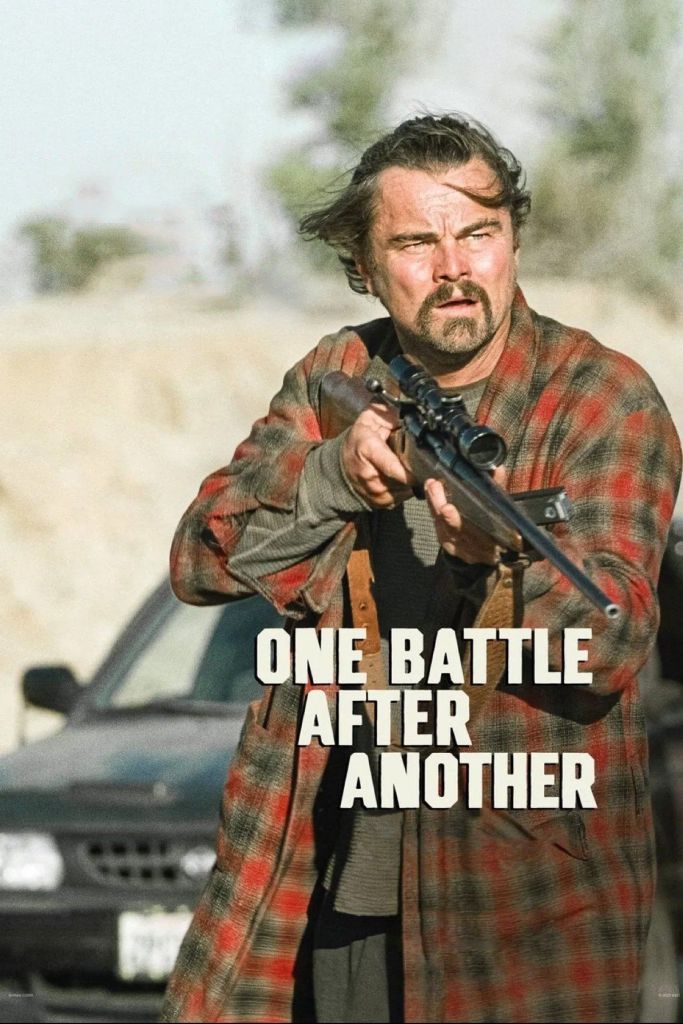
When I first heard about this, I thought it had potential to be a disaster. Leonardo DiCaprio plays a down-on-his-luck American revolutionary whose daughter is kidnapped, so he must use the revolutionary system to get her back. What?! The American Revolution? 1776? No — this takes place in modern day.
The world needs a revolution because the American government has been overtaken by a party of white supremacists. The president is part of an organization known as the Christmas Adventurers Club. “Hail Saint Nick!” is their salute and greeting. We never hear the name of the actual political party in power or whether they’re openly racist.
I was cautiously excited: can this premise possibly work? Do we really want to see an Oscar-contending film that shows America in such an absurdly negative light? Will this movie seem to have anything to do with the real world at all?
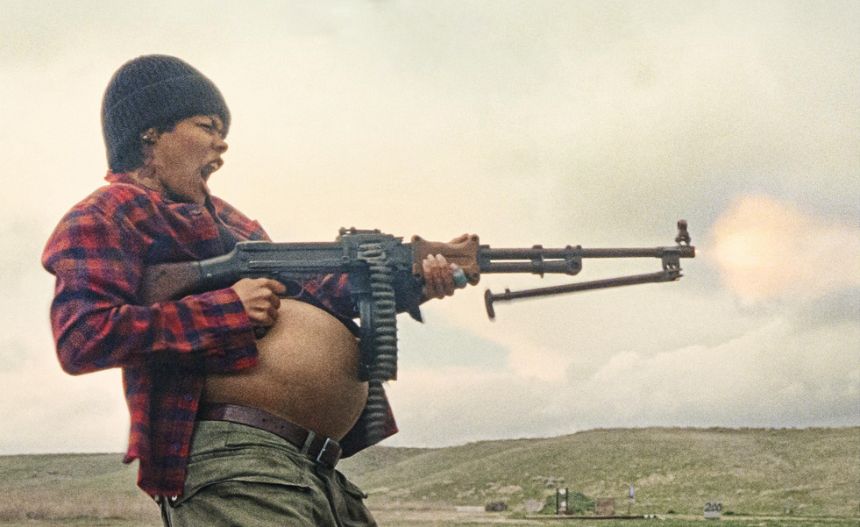
> “I don’t want you. I just want your money. Your money paid for my artillery, my supplies, my transportation, my dynamite, my message. I am what black power looks like.”
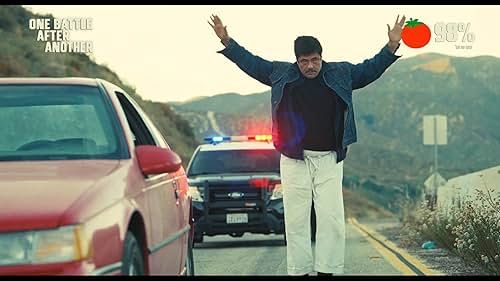
By the time the movie got to this speech, I knew I loved it. Sure, you could try to read political relevance into it — something about the state of the world right now — but I think that would be reaching. At worst, the movie is a far-fetched suggestion for black power: if the world ever does turn to ****, this is what you can do about it.
The speech above is given by a character named Junglep****, played by an actress who performs under the same name when she raps. So Paul Thomas Anderson is letting real life filter into his movie, even when the context seems to relate to nothing. This world, with its crass language and pseudonyms, feels influenced by what happens when the 21st century’s hacking and hip-hop communities are pushed to a breaking point.
The language is actually very restrained compared to what it could have been. The p-word for female anatomy seems to be the dirtiest word in the world of One Battle After Another, but compared to the kinds of usernames used on the dark web by hackers, it’s remarkably tasteful. Quaint, even.
I had read that the first hour of One Battle After Another was constant action, which isn’t actually true. What it is is exciting. New ideas are constantly being introduced — every scene, every cutaway. There are brief action scenes, but only about a minute’s worth in any one sequence. Then it cuts, and suddenly we’re months or years later. There are no extended battle or chase sequences. Those are saved for the very end.
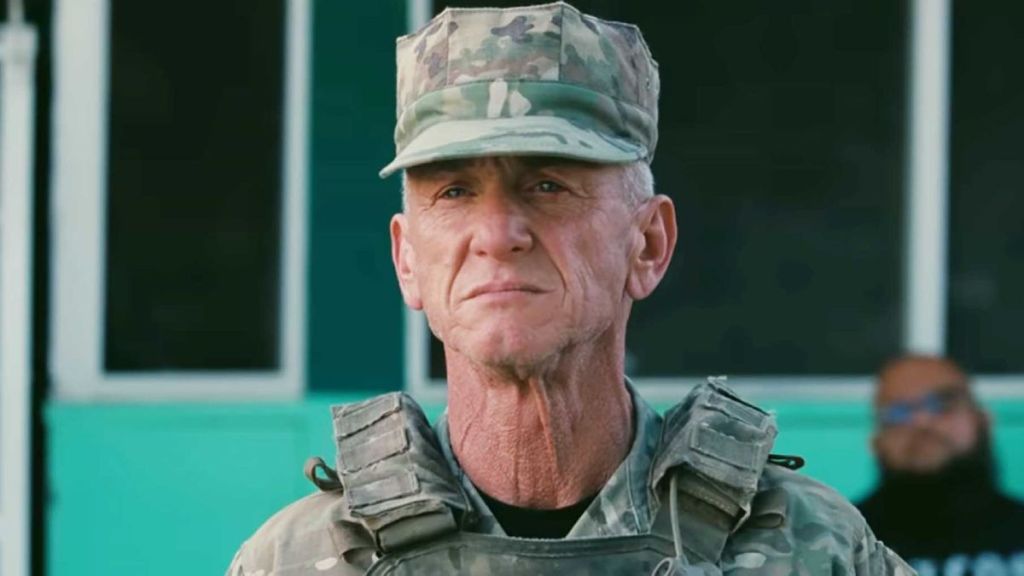
This is being touted as a Leonardo DiCaprio vehicle since it’s only the fourth movie he’s made since winning the Oscar in 2015 (The Revenant). However, Sean Penn is the one getting all the awards buzz, with him being the odds-on favorite to win Best Supporting Actor — which would give him Academy Award number three. It feels like forever since Sean Penn mattered in Hollywood, and the industry seems to be realizing, “Oh yeah. There is sort of a second Daniel Day-Lewis in the world.”
Penn plays Col. Steven J. Lockjaw, who appears to be in the U.S. military (implying that in this dystopia, even military leaders are expected to have pseudonyms). Lockjaw isn’t a true white supremacist, though he goes through the motions — fetishizing the taboo of lusting after what he can’t have. The movie has a lot to say about the mindset of white supremacy: how much of their hogwash do they actually believe, and how much are they willing to tolerate?
There is no calm before the storm. Every scene is filled with tension, and the script follows the “two things at once” rule, meaning nothing is ever written that isn’t also saying something about something else. Being a revolutionary in the 21st century is about the hardest job there is, so it makes sense that the characters wrestle with occupational substance use and post-partum jealousy. The intensity of trying to do the right thing only appeals to people who are likely borderline addicts — to sex, to drugs, or both. One likely intensifies the other. This phenomenon carries over into the real world too: righteous, highly demanding jobs — emergency medicine professionals, public defenders, war journalists — are likely to have a Bon Ferguson in their midst.
I suspect Paul Thomas wrote One Battle as a world that could have franchise potential. The movie is definitely complete, which is a relief. I thought the only problem Anora had was that it didn’t really feel satisfying as the last time we’d ever see its characters. One Battle has no such issue. The world is so well thought out that it would be a shame if it weren’t mined for more stories. If PT is done with this world, expect a TV series remake within ten years.
In the Magnolia DVD documentary, Paul Thomas Anderson screened a movie every day during pre-production — Short Cuts, Nashville, Melvin and Howard. One of those movies was Network, which he prefaced with a warning: “I will not make a movie as good as Network. You won’t see a movie as good as Network.”
I disagree with PT. He managed to one-up it. He’s created a setting that’s an upside-down version of the real world and proven: this isn’t real, and it probably won’t be — but it still has plenty to say about where we’re going, and where we are right now.
One Battle After Another is a Chuck Palahniuk novel done right.
10/10
 Avidavr: Media Reviews