You’ll never listen to the Counting Crows in the same way ever again.
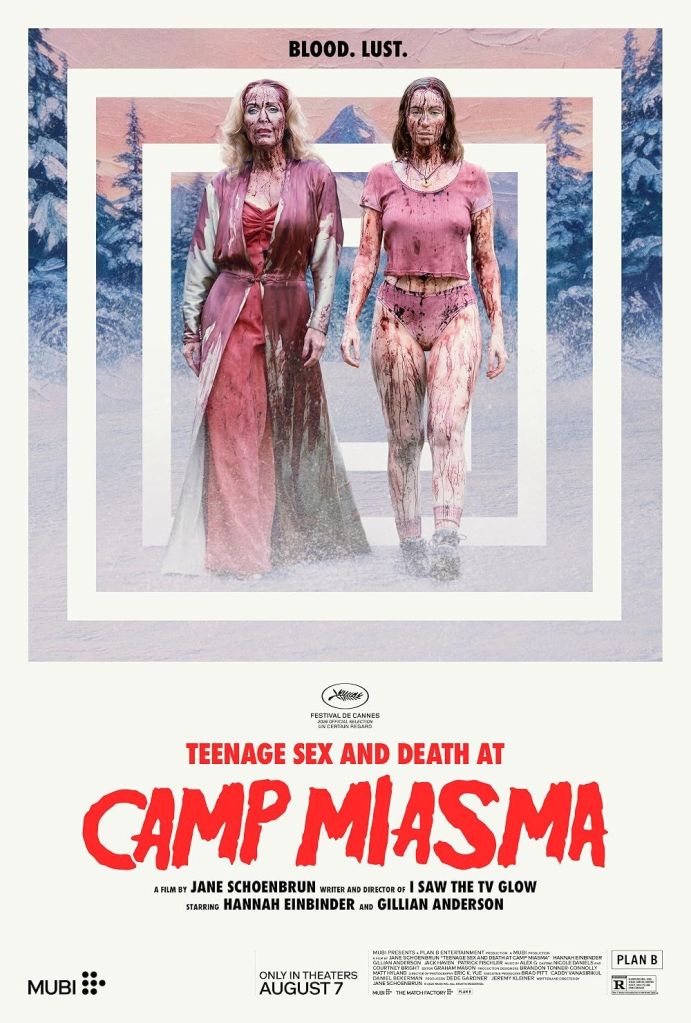
Jane Schoenbrun movies are like olives. You have to keep tasting them before you really understand the flavor.
I liked I Saw the TV Glow, but I was confused by its trajectory. Why was the narrative extended over multiple decades? Was there no way to tell the story in a slightly more compressed time frame? The perspective of that movie seemed designed to create the moment when a person suddenly realizes, “Oh no! I have utterly wasted my entire life!” I am not sure this is a theme that a filmmaker in their 30s can easily approach without some distance showing. For this and other reasons, I found the movie slightly confusing and inauthentic, even though there was obviously something there that stayed with me.
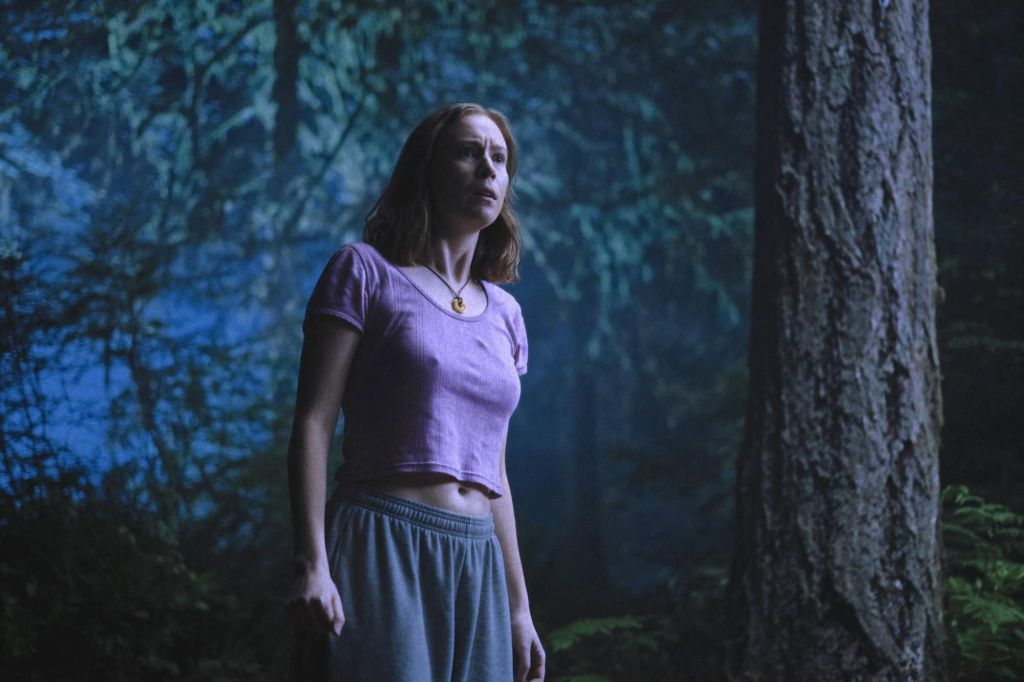
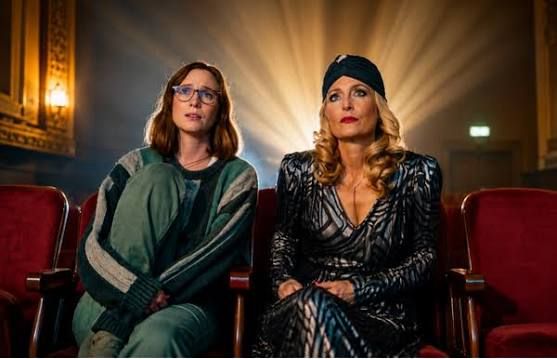
Teenage Sex and Death at Camp Miasma takes many of the same instincts and puts them somewhere that seems to make more sense to audiences overall. Hannah Einbinder (Hacks) plays Kris, a young filmmaker hired to resurrect the long-dormant Camp Miasma slasher franchise, something she has been obsessed with since childhood. She has a quick monologue where she explains why the series is a “zombie IP” to studios in modern times because of its transphobic qualities in the “post-MeToo era,” and she keeps talking long after her description alienates the only other person in the room. At this point, I whispered to my movie-watching companion, “I like her.”
The first movie starred Billy Presley (Gillian Anderson) as Squeak, its “final” girl, who was still alive when the original Camp Miasma concluded. Nonetheless, Billy refused to return for the sequels and disappeared from acting afterward. She now lives at the abandoned camp where the movie was filmed. Kris travels there hoping to convince her to participate in the reboot. Her partner refers to Billy as Norma Desmond from Sunset Boulevard, though, hilariously, Kris pretends to be a little fuzzy on the details: “I know who you are talking about, but I can’t remember her name,” she lies.
Kris tries to leave, but Billy, starved for company, literally orders her to stay. She likes Kris, even though her first movie was “a remake of Psycho from the perspective of the shower curtain.” Kris seems a little lost and is trying to find herself, but the fact that she loves Camp Miasma is fascinating to Billy. Billy is an awkward sort of fangirl herself, and she wants to share her unique passion with the only person who can understand it. Subsequently, the two spend several days getting high, watching old Camp Miasma movies, talking about the original production and becoming increasingly fascinated with one another.
The best choice in Teenage Sex and Death at Camp Miasma is reducing the time frame from decades to less than a single week. Schoenbrun transfers over almost everything that made I Saw the TV Glow so strange: extremely specific lore for a cultural hodgepodge that has no exact equivalent in reality, period details that don’t actually represent the era being presented, people who sometimes seem to be functioning under different rules of human behavior, and an absurdly over-stylized visual style. Here, though, there is marked restraint somewhere else. This is a big story in a very small setting, mostly one camp over a few days. Instead of watching somebody’s life dissolve across decades, the movie can go completely insane while remaining anchored to a fairly simple thing: two odd people falling in love.
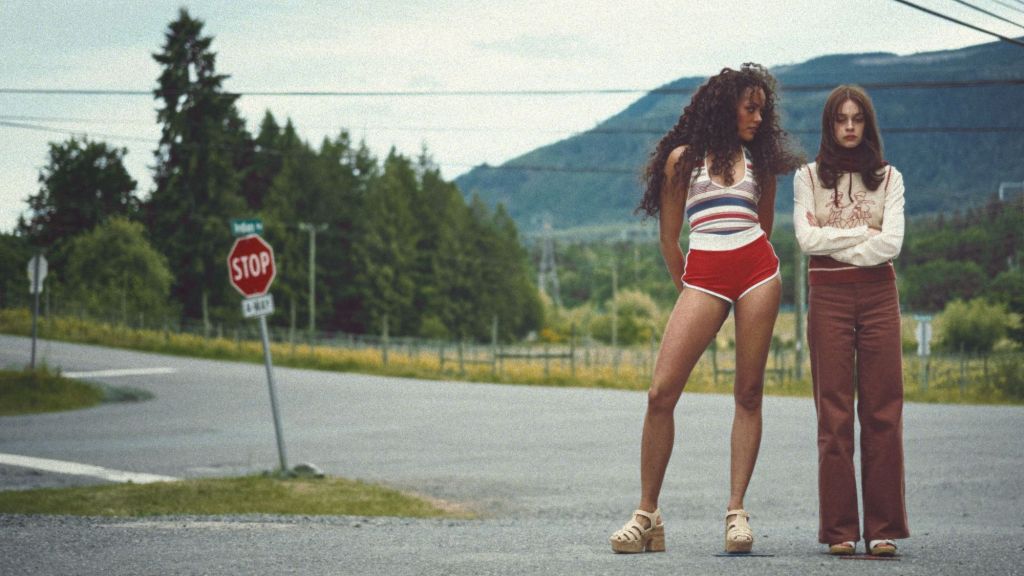
There is also a social dynamic here that felt strangely recognizable to me. In a pivotal scene, a team of professionals begins to suspect that somebody in their midst is no longer operating on an understandable mental plane. Everyone remains polite. They listen, respond and try to continue doing their jobs while gradually becoming less certain that Kris is describing a reality they share. Having experienced serious borderline schizophrenia myself, there is something very familiar about that particular kind of interaction. Kris and Billy eventually develop a romance through a shared hysteria, a folie à deux, if you will. Those usually don’t end very well, but it turns out these two may simply be a little fanatical. Not fully identifiably off-their-meds crazy.
The relationship between Kris and Billy is nothing but sweet, even though no one around them can begin to understand it. The movie is also deeply queer. Even if you are not in any way gay, knowing that there might be one person out there who is the same type of weird as you is something we all want for ourselves. It is about finding the ideal person who complements your particular oddities, then seeing what happens when the two of you keep exploring and celebrating those differences together. The nostalgia is obsessive enough that almost anyone looking in from the outside would probably consider it unhealthy. But what other joy makes life worth living?
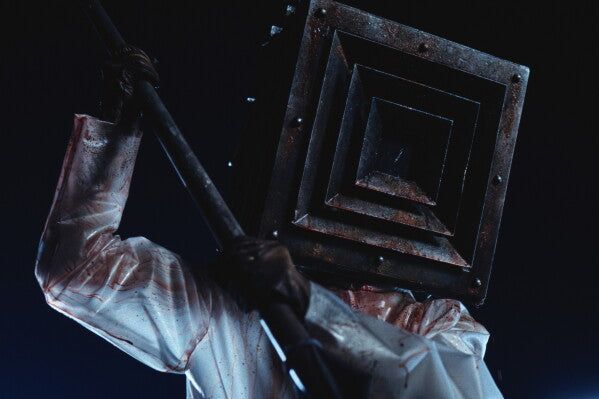
The strangest example of the movie’s relationship with nostalgia comes during an extended sequence set to Counting Crows’ “A Long December.” The song was released in 1996, but the Camp Miasma movie containing the sequence is supposed to have been made in 1983. More strangely, the entire thing looks like 1996. The campers wear clothes much closer to the mid-’90s than the early ’80s. One is wearing the sort of Mexican poncho that seemed to be everywhere for about fifteen minutes in 1995 or 1996. The camera uses the body-mounted “drunk cam” vocabulary that became familiar through ’90s music videos and later movies. Jonathan Dayton and Valerie Faris used a similar effect in the Smashing Pumpkins’ “1979” video in 1995. Darren Aronofsky would later use it extensively in Requiem for a Dream. Schoenbrun has apparently cited Michael Bay as an influence on the sequence. Nothing about it has much interest in resembling an actual slasher movie made in 1983.
Logic isn’t really relevant here. Schoenbrun is not recreating 1983 so much as recreating the memory of watching an old horror movie while growing up in the 1990s. The sequence looks as if Jonathan Dayton and Valerie Faris, the ’90s Buzz Bin music-video directors, teamed up with Monty Python’s Terry Jones to direct a grotesquely hyperviolent music video for MTV, who would never in a million years play it. Little Death brutally slaughters campers while fountains of blood erupt in every direction and Adam Duritz sincerely sings “A Long December.” Then the film treats this sequence as if it were footage that absolutely existed in 1983, in this reality or any other reality. Portraying it with complete confidence may be one of its funniest jokes.
In that sense, Camp Miasma feels almost like Schoenbrun doubling down on the things detractors found irritating about I Saw the TV Glow. The chronology doesn’t make sense? Fine. The period details don’t match? Fine. The world seems to have been assembled from several generations of pop culture that have somehow collapsed into one another? Yes, that was apparently the idea. It reminds me a little of Wes Anderson’s progression from Bottle Rocket and Rushmore to The Royal Tenenbaums. Rather than sanding off everything people considered mannered or artificial about his earlier work, Anderson exaggerated it until there was no longer any possibility of mistaking it for an accident. The Royal Tenenbaums essentially announced, “No, my movies are actually supposed to feel like this.” Teenage Sex and Death at Camp Miasma feels like a similar moment for Schoenbrun.
The difference is that this time Schoenbrun has also made something very funny and surprisingly accessible. I would not previously have called Jane Schoenbrun a crowd pleaser, but this seems designed to get audiences on their side rather than challenge them to understand why they aren’t. It is intentionally confusing without being unenjoyable, the spoonful of sugar after I Saw the TV Glow‘s dose of somewhat nauseating medicine. Calling it a “slasher parody” doesn’t really get at what it is doing, because parody implies some distance from the thing being mocked. Schoenbrun clearly understands that these movies are ridiculous, but also that ridiculous things can become enormously important to the people who love them. The joke is never simply that Camp Miasma is stupid. The joke is that something this stupid can become the organizing mythology of a person’s entire emotional life.
I am very impressed by this movie, even though I am still not sure I quite understand it. I don’t know if I love the flavor yet, but I definitely want to ingest a few more Jane Schoenbrun movies soon. For now, mark me down as a likely future fan.
9/10
 Avidavr: Media Reviews