E is for extremely poor apartment safety.
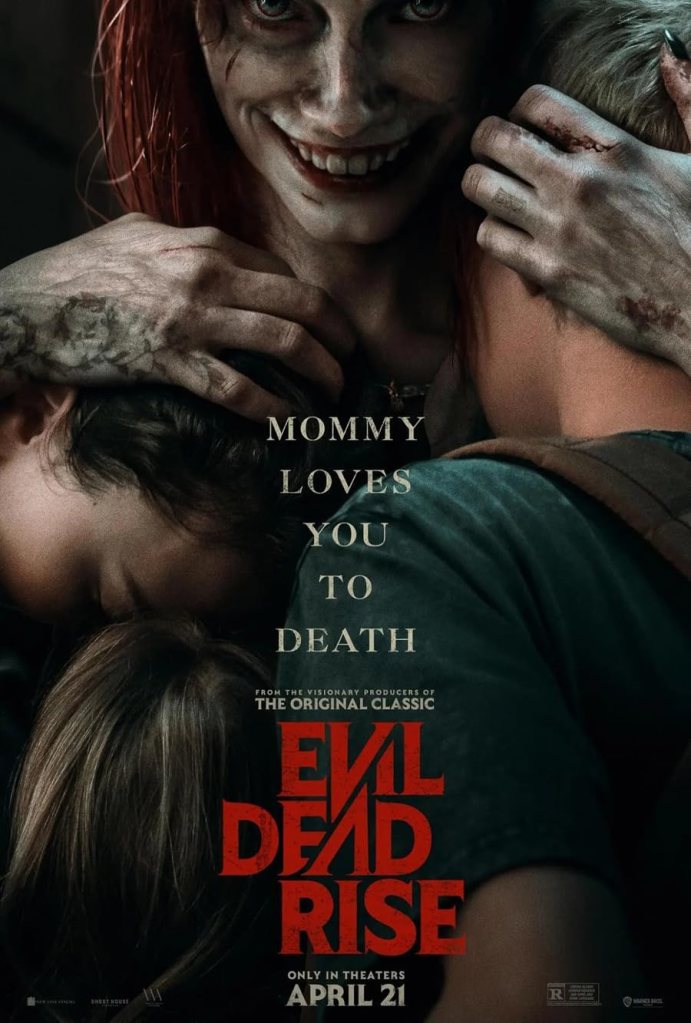
If someone asked me what Evil Dead II was, I would say it is one of my favorite movies, and I could even tell you why, but I could not, for the life of me, give you a clean account of what it is actually about. I remember Bruce Campbell in a cabin, with a shotgun in one hand and, eventually, a chainsaw where the other hand used to be. The villain is an evil first-person camera shot that leaps into people and corrupts them: an unstoppable force that nevertheless seems capable of getting confused. It is unleashed by reading a passage from a book out loud, I think. And years later, Sam Raimi would shoot Doc Ock’s tentacles in Spider-Man 2 as if they had learned how to move from the woods around that cabin.
Evil Dead Rise is similarly polished, a tour de force of splatter-gore effects shots and set pieces, but I cannot say the story is as inspired. Of all the ways to tell this story, the movie chooses one of the strangest: it opens with an apparently disconnected scene that takes place after the main events. The synopsis promises a movie about two estranged sisters trying to survive an unleashed evil. The opening gives us two sisters who are obviously annoyed with each other, so the viewer naturally assumes they must be the sisters in question. They are not. They are two different sisters, almost entirely unrelated to the main storyline.

Beth, played by Lily Sullivan, is the movie’s most promising human anchor: a guitar technician who makes her living on tour, tuning guitars and moving from show to show before anyone else takes the stage. She may not be famous, but she exists adjacent to fame, juggling technical proficiency and backstage fraternization in a way that prioritizes proximity over boundaries. The movie introduces her just after she learns she is pregnant, most likely by one of the musicians whose guitars she maintains. That detail immediately sharpens her character. Beth has spent her adult life trying to look self-possessed and indispensable, only to be confronted with a fact that makes her seem, at least to herself, like the cliché everyone has always been waiting to call her. The horror, before the demons even arrive, is that her life has suddenly become readable in the cruelest possible way: she can bury the secret and preserve her credibility, or admit the truth and risk being reduced to the oldest backstage stereotype in the book.
Beth’s family is filled, at least structurally, with expendable characters, but Cronin gives them just enough intelligence to make their deaths feel cruel rather than mechanical. Her sister, Ellie, played by Alyssa Sutherland, is guilty of the greatest sin a person can commit in a horror movie: believing she has made all the better choices in life. She has built a home, raised three children, and settled into the kind of adult responsibility Beth has spent her life avoiding. Ellie’s children are smart too, but in the dangerous, unfinished way children are smart. Danny is technically curious enough to play the cursed record at full speed, turning his DJ instincts into an accidental summoning ritual. Bridget has the moral seriousness of a teenager who already thinks she understands the brokenness of the world, while Kassie has the imaginative resourcefulness of a child who can turn a doll’s head on a stick into both a toy and a weapon. None of them are idiots. That is what makes the family’s destruction more frustrating: they are not punished for stupidity so much as for curiosity, confidence, and proximity to the wrong object at the wrong time.
The grotesqueness of the splatter gore that Cronin unleashes is the star of the show. Evil Dead Rise turns biting at the eyes, fire, broken glass, and kitchen utensils into instruments of punishment, including one moment of domestic-object body horror nasty enough to put Cabin Fever to shame. What makes the violence work is not just its extremity, but its horrible intimacy: Cronin turns the ordinary objects of a home into evidence that no domestic space in this movie can remain safe. Watching Evil Dead Rise may make you look around your own living room and wonder how, exactly, one child-proofs a home against evil.
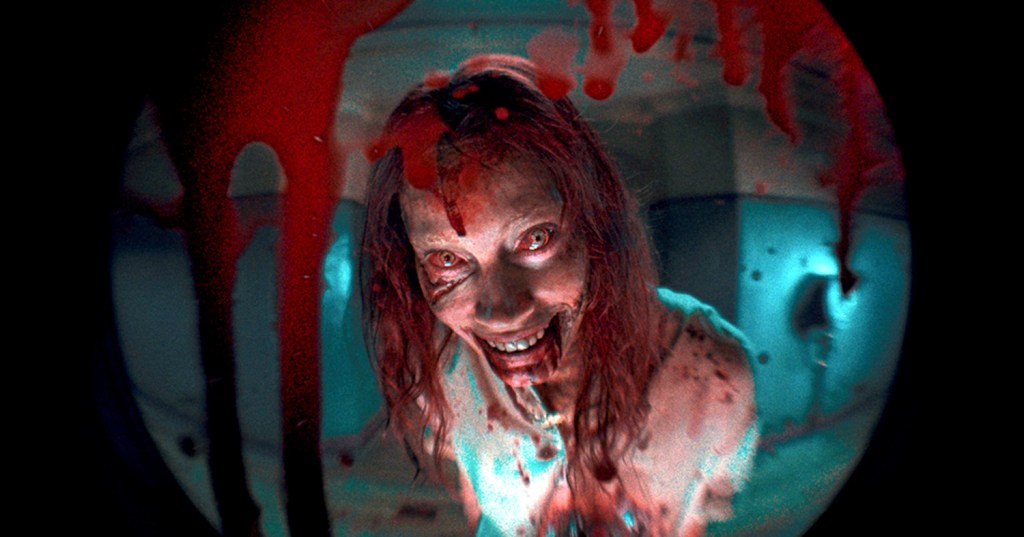
For the most part, Lee Cronin’s Evil Dead entry functions randomly. Whether one lives or dies here depends on smart decisions and good instincts, yes, but some of the most likely to survive are overtaken unceremoniously, as though they were in the wrong place at the wrong time and rolled a 1 on a Will Save. In other words, the movie often treats survival less like a matter of character or consequence than a cruel accident of timing.
And, for the most part, this works. It increases the dread and makes the evil seem like an unstoppable force that can bypass anything. Going back to the RPG analogy, there is something called a “funnel” in the Dungeons & Dragons-inspired game Dungeon Crawl Classics, where each player controls four level-zero characters through a short adventure likely to kill most of them. Run away from a dragon and choose a house to hide in. The house might be a monster-house, waiting for its next meal. If all four characters go into the monster-house together, you just lost all four characters.
The reason Evil Dead Rise feels so unsatisfying is that this is a funnel, not a story. That can make for a great origin story, but an origin story implies a promise: eventually, it will lead to something more complete, with characters who have grown, adapted, and actually seem to know what they are doing. I wanted another movie to pick up where this one left off.
Watching a bunch of level-zero characters get killed off can be fun, but it is too easy to admire from a distance. There is a character or two who manages to seem like the “new Ash,” but not in a way that makes Evil Dead Rise feel like the singular achievement Evil Dead II was. This movie is gory and frightening, but often at the expense of character. I am invested enough in these people to want to see what happens in chapter two. Instead, Cronin has said he has no interest in making another Evil Dead movie, at least not a direct sequel. It seems like these characters will never continue on, and that the next Evil Dead movie will be a different origin story with entirely new characters.
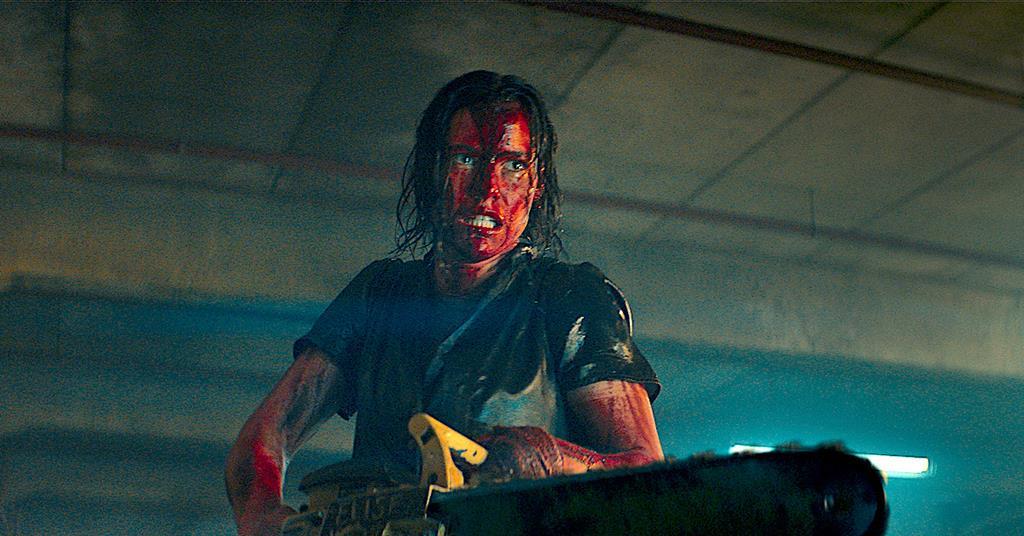
I am suspicious of Lee Cronin. The industry seems eager to turn him into a name before interest has built organically. There is a sense that studios are trying to “make fetch happen” with him, asking us to recognize his authorship before the general public has had much reason to know who he is. In that way, he reminds me a little of Gore Verbinski: a visually fluent studio craftsman whose early work suggested that, with the right material, he might one day deliver something enormous. Cronin’s greatest gift is that he can make a dime look like a buck. Evil Dead Rise is as glossy and well-produced as horror movies made for several times its budget; the fact that it reportedly cost less than $20 million is almost incomprehensible from the evidence onscreen. That explains why he is suddenly in demand, even if his work has not yet given us anything truly indispensable. Lee Cronin’s The Mummy proved the strange limit of that strategy: profitable enough to justify itself, but culturally invisible enough to make the title feel faintly ridiculous. The movie asked audiences to treat “Lee Cronin” as a brand, and audiences mostly responded as though they had never been consulted. He is excellent with texture, pacing, intelligent characters, and finishing touches. What he has not yet proven is that he can make the story itself feel as inevitable as his imagery. Before he is handed yet another franchise to revive, he may need to figure out how to finish one.
6.5/10

