F is for federal agents failing a frightened little girl
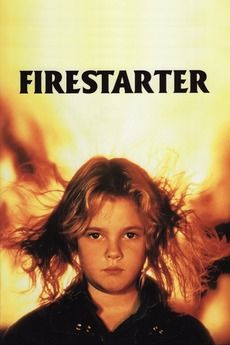
My theme for this A–Z film-a-thon is “Hidden Gems,” or movies I might love more than their reputations would suggest. I chose Firestarter as my letter F movie for a single reason: I saw E.T.: The Extra-Terrestrial again recently and thought Drew Barrymore was so good that she might have been robbed of an Oscar nomination. I thought afterward, “Whatever happened to her, anyway?”
The world knows of a grown woman who goes by the name Drew Barrymore, known mostly for romantic comedies for women, mostly, like Never Been Kissed, Ever After, and several Adam Sandler movies, for some reason. She also has a daytime talk show now, known for up-close, tear-ridden conversations with guests she seems to know extremely well. Everybody knows the show exists, although I don’t know a single person who admits to watching it. This is Drew Barrymore the celebrity. I wanted to know what happened to Drew Barrymore, the radiant child actress.
So I started up Firestarter.
The most interesting thing about Firestarter is that its villain is not merely a rogue laboratory, a corrupt official, or a handful of overzealous agents. The federal government itself is the monster.
I believe the government is almost as much the villain here as it is in One Battle After Another. In that movie, the government has effectively been taken over by devout white supremacists. That was a hyperbolic fantasy, so I don’t believe it would be reasonable to say that the movie is meant to be considered a valid depiction of the world right now.
I can think of only a few other stories in which the state is treated as this completely corrupted: both versions of The Manchurian Candidate and George Orwell’s novel Nineteen Eighty-Four. This paranoia about government power seems to come directly from Stephen King’s original book. For some reason, at the very end of the 1970s, King apparently thought, “Perhaps people will definitely buy that every level of the United States government is rotten to the core right now.”
Firestarter begins with Charlie, played by Drew Barrymore, on the run with her father, Andy. Andy appears to be a remarkably capable grifter when circumstances require it. He gives a taxi driver a one-dollar bill but convinces him it is a $500 bill. The driver is elated, although presumably only temporarily.
Andy can control people’s minds because he once took a hallucinogen in college. This is not an exaggeration. A secret government agency known as “The Shop” gave LOT-6, an LSD-like experimental drug, to a group of college students and studied its effects. Andy and Vicky, Charlie’s mother, were placed on beds beside each other and discovered that they could communicate telepathically. Almost immediately, they announced that they loved one another, had always loved one another, and had known each other for a thousand years.
This is a movie that believes in love at first sight, although I would have preferred some dialogue conveying an actual personal connection. What we get is closer to: “Wow, this drug allows us to communicate using only our minds. Therefore, I have apparently been spiritually married to this total stranger for several reincarnations.”
Andy and Vicky subsequently married and produced Charlie, who inherited a much more powerful mutation: she can start fires with her mind. The Shop believes Charlie can be studied, controlled, and eventually weaponized.
The Shop’s cruelty is not impulsive. It is methodical, patient, and likely very expensive. After deceiving a group of college students into taking an experimental hallucinogen that killed most of its subjects, the government spends the next decade monitoring the survivors to determine whether their children have developed any unusual abilities. I have to wonder: Was this really the sort of work our government was doing in the 1970s? Paying agents to spend a decade stalking people who they watched take a drug once? No wonder the country was in a recession.
Vicky is tortured and killed by The Shop, which abducts Charlie from the family home. Andy tracks down the agents almost immediately and rescues his daughter by psychically convincing the men that they are blind. Father and daughter then spend the next year running from a government agency with apparently unlimited manpower, eventually taking refuge with an elderly farming couple and later hiding in a remote cabin.

The Shop finally captures them and takes them to its facility, where Andy and Charlie are imprisoned separately. Charlie refuses to demonstrate her powers until she is befriended by a kindly orderly named John, who presents himself as the only adult in the facility who sees her as a frightened child rather than a laboratory specimen. He assures her that cooperating with the scientists will help her reunite with her father.
Unknown to Charlie, “John” is John Rainbird, the Shop assassin who captured her and her father. What is he doing exactly? Is he really planning to murder this impressionable child after deliberately becoming the only person she trusts? Charlie believes that using her pyrokinetic abilities is morally wrong, and she is trying desperately not to hurt anyone.
The government’s response is to manipulate her into doing the very thing she considers terrible, survey the results, and then hand her over to an assassin who believes that killing her at the moment of her greatest trust will somehow transfer her power to him. What are these people doing? They convince a girl to violate her own conscience just so an assassin can feel spiritually satisfied while murdering her. By this point, Firestarter has transformed a vague government paranoia into something much more intimate: the calculated psychological abuse of an eight-year-old girl.
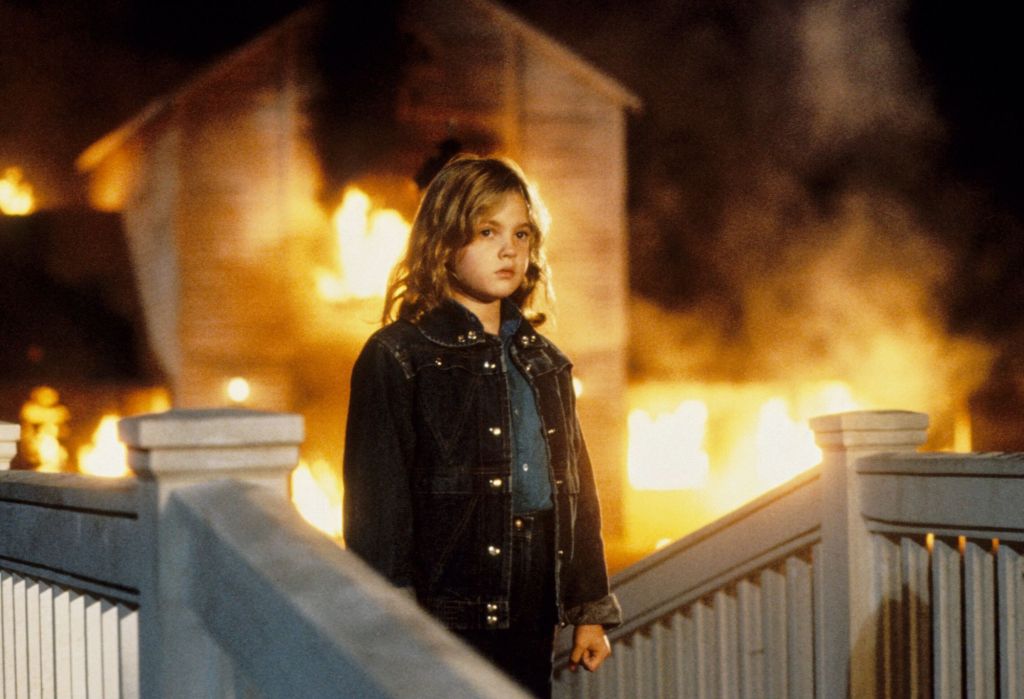
I suppose I should mention the fire. There is a lot of it, particularly toward the end, and much of it appears to have been produced by placing stunt performers alarmingly close to actual flames. The destruction is impressive in the way expensive practical chaos often is, although I found myself much less interested in what Charlie could burn than in the series of adults calmly explaining why she ought to burn it.
I call movies like Firestarter schizophrenia fuel, or at least inspiration for delusions of grandeur. It resembles something written by a person who took LSD once, felt as though they had acquired special superhuman abilities, and immediately thought, “What is the government hiding from us?”
I kid. I do not really think taking drugs inspired the entire premise of Firestarter. The basic question was likely, “An eight-year-old girl has pyrokinetic powers. Why? Who is the villain here?” The answers King came up with were, “Her parents took drugs, and the United States government. Obviously.”
In 2026, is this a good movie? It is certainly interesting for its audacity, and for having the nerve to portray the federal establishment as thoroughly diseased as many Americans must have suspected it was after two decades of mysterious assassinations, a pointless war, and the Watergate scandal. It is also interesting for anyone who wants to see an obvious influence on “Stranger Things”. The character Eleven is basically Charlie grown a little older, with a firmed-up backstory and a collection of peers to settle in with, for better or worse.
Charlie is just put in a room with cartoons. This leads to several questions: Has Charlie never had a friend? Has she never gone to school? Perhaps that is the most telling thing about Firestarter. Charlie lives in a world in which the social development of little kids is taken entirely for granted by the adults around them.
This was mostly my world at the time, and perhaps Stephen King’s childhood as well. In a world like this, kids just live in a vacuum. Why introduce your child to peers when she might set them on fire on a particularly bad day? I wonder how King’s parents felt about sharing their creative-minded offspring with the world. Was King kept inside a lot, with only his TV and books to keep him company?
The movie this reminded me of most was The Dead Zone, another Stephen King adaptation that came out one year earlier and was directed by my favorite living director, David Cronenberg. If you want more of that experience, you could do much worse than this particular adaptation of Firestarter. It is weak around the edges, and it is easy to pull apart and point out elements that make little to no sense. It takes its absurd premise completely seriously, however, and that seriousness is part of what makes it satisfying.
Drew Barrymore is largely left to herself. She does not have a true genius coaxing a completely natural, nuanced performance out of her, as Spielberg managed to do in E.T. Mark L. Lester is more like the David Yates of the Stephen King-verse than a true visionary. Yates is the largely anonymous director who took over the Harry Potter movies and reliably gave J.K. Rowling and the studio the safe, respectable, slightly bland product they wanted. Lester can follow a template well enough, but he does not give us much that expands upon the formula or makes the material feel distinctly his own.
Lester frequently asks Barrymore to look frightened, stare intensely, and scream while objects explode around her. Still, she is the rare child star with enough magnetism to lead an entire science-fiction action movie. Even when the material does not help her, and the direction gives her little more to play than fear and concentration, you understand why the camera keeps watching her.
So what happened to Drew Barrymore, the radiant child actress? She was still there. Firestarter just was not quite the movie capable of revealing everything she could do.
Good enough, and it fulfilled my nostalgic curiosity.
Rating: 6.5/10
 Avidavr: Media Reviews