Day 2: My A Movie
I went through my giant 4,600-movie watchlist trying to find this week’s pick. I found three strong contenders: Atom Egoyan’s Ararat, one of the few narrative features about the Armenian Genocide ever to get any real attention; Sam Mendes’s Away We Go; and John Huston’s 1982 version of Annie. Ararat felt too heavy for the moment, and Away We Go seemed slight enough to ease into. My partner suggested the 1999 made-for-TV Annie with Kathy Bates, which is probably the “good” movie version anyway: closer to the Broadway tone, and without Carol Burnett seeming determined to prove how drunk a person can act on camera.
Since I had just watched a kids’ movie, 8-Bit Christmas, I decided to keep things relatively light. Better, I thought, to start with lighthearted fare than go straight to the Armenian Genocide. So, away we go to…
Away We Go (2009)
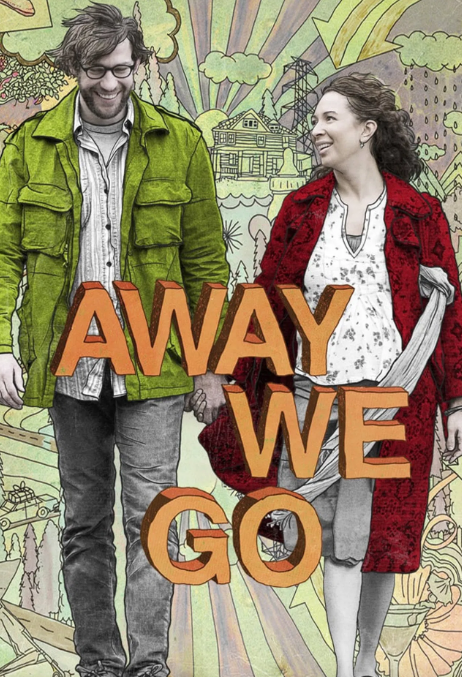
The theater where I used to work played Away We Go during my time there, which meant that for a few weeks I saw the end of it over and over while cleaning during the closing credits. The song over those credits, “Orange Sky” by Alexi Murdoch, is by far the best thing about the movie. It is so good, in fact, that I can almost imagine Sam Mendes hearing it and deciding he needed to build a film around the feeling it gave him.
That may sound flippant, but it gets at the problem. Away We Go feels less like a movie with something urgent to say than a movie assembled around a mood. Mendes, working from a script by Dave Eggers and Vendela Vida, seems to want to make a lightweight road movie about an expectant couple drifting through America in search of home. There is nothing wrong with that in theory. In fact, it sounds promising: a small, funny, observant movie about adulthood, parenthood, and the panic of trying to build a life before the baby arrives.
For a while, it almost works.
Burt and Veronica, played by John Krasinski and Maya Rudolph, learn that Burt’s parents are moving to Belgium just when the couple had apparently assumed they would have family nearby for support. That premise is good enough to launch a movie. The trouble is that the script never quite makes the couple’s situation cohere. Did they move to Denver specifically to be near his parents? Were they already there? Was the pregnancy planned, half-planned, or an accident they are calmly absorbing? The movie wants the looseness of real life, where people do not always explain themselves in neat dramatic terms, but it never finds the confidence to make that vagueness meaningful. Instead, it often just feels underwritten.

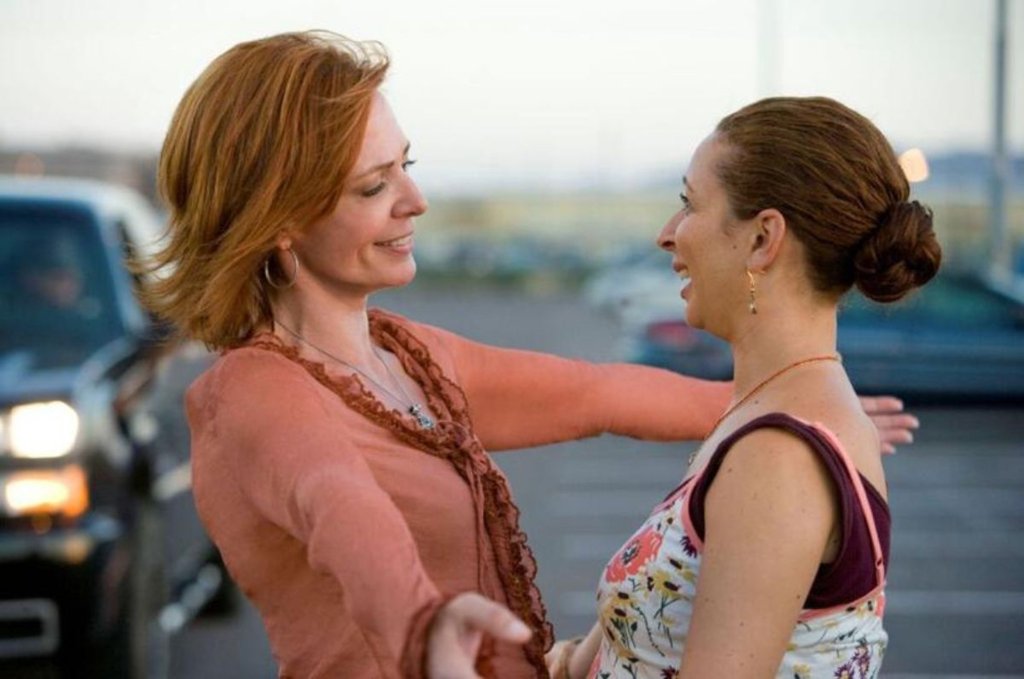
That becomes clearer as soon as the couple begins visiting the various people who are supposed to show them different models of adult life and parenthood. On paper, this is a strong structure. In practice, it produces a series of half-finished sketches. Catherine O’Hara and Jeff Daniels are amusing as Burt’s foolish, self-involved parents. Allison Janney, meanwhile, arrives like she has been dropped in from an entirely broader comedy. Her character Lily is one of the most obnoxious people I have seen in a movie in quite a while, which could have been funny if the film understood her as a grotesque. The problem is that it seems to want us to accept her as someone Veronica would plausibly choose to spend time with.
That is where Away We Go repeatedly loses me. The script wants characters to have relationships because the scene needs those relationships to exist, not because the story has made them believable. Veronica laughs with Lily, chats with her, and appears to enjoy her company. Fine. But why? What is the shared history there? What quality in Lily once made her seem worth keeping around? The movie never shows us. It simply assumes that because these two women are in the same room, we will accept that they are old friends. I did not.
The same problem applies elsewhere. Maggie Gyllenhaal’s LN is memorable, certainly, but she does not feel like a person so much as a satirical parenting exhibit. She breastfeeds older children, co-sleeps to an absurd degree, and generally behaves in a way that is plausible enough to be recognizable but so exaggerated that she stops being useful as observation. That is the movie in miniature: it wants the authority of realism and the comic payoff of caricature, and it keeps straining itself by trying to have both.
The first half of the film, at least, has enough oddity and momentum to keep a person engaged. The second half simply runs out of gas. The later stops on the road trip blur together, and the movie begins introducing dramatic material so abruptly that it feels less like life unfolding than screenwriters throwing fresh obstacles onto the road. Burt’s brother suddenly appears with a devastating marital crisis, and instead of deepening the movie, it feels imported from another draft. I do not object because bad things are unrealistic. I object because the screenplay has not earned this degree of melodrama. A movie about ordinary, mildly confused people can absolutely contain pain, but it has to arise from the emotional world the movie has built. Here it feels like the film panicked when it realized it had very little left to say.
That, more than anything, is the disappointment of Away We Go. It is filled with the appearance of insight. It has tasteful music, shaggy dialogue, quirky side characters, and the outline of a human-scale story. But it never cooks any of it through. It gestures toward conversational wisdom, emotional honesty, and slice-of-life ambiguity without ever turning those qualities into drama. By the last stretch, I was no longer annoyed so much as bored. The movie had spent so much time pretending to be observant that it forgot to actually observe.
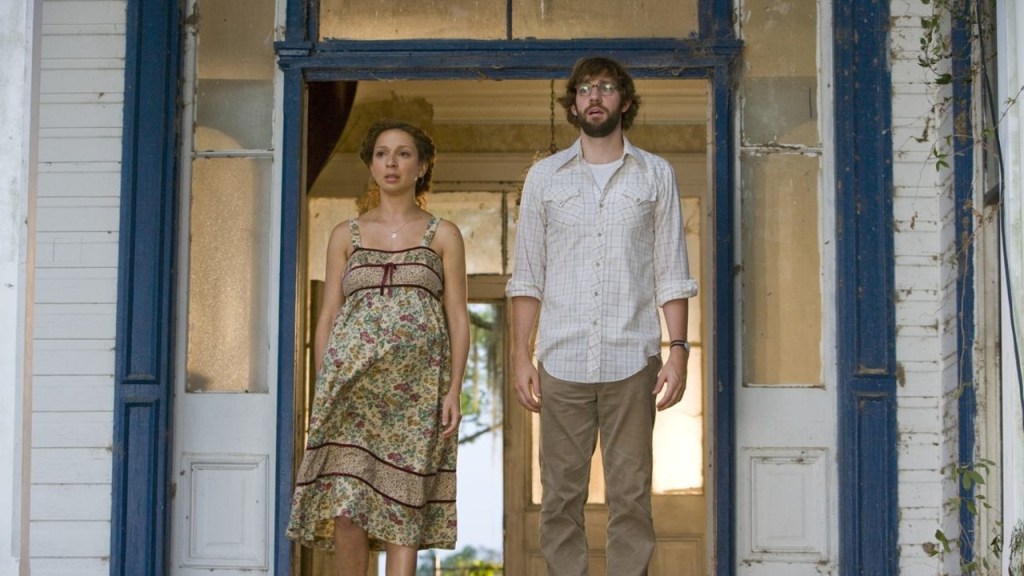
The final emotional turn is where Away We Go really loses me. Veronica reveals that she never wants to have a wedding ceremony because her parents died when she was in college, and she cannot bear the idea of getting married without them there. Fine. That is sad. It is also, at some point, something a partner is allowed to find exasperating. The movie even gives Burt a scene where he is allowed to raise his voice, but he goes through the motions about something comparatively inane, as if the script wants credit for letting him yell without making him confront the one thing actually worth yelling about. Why is he not allowed to say the obvious? If Veronica does not want to get married, then she should admit she does not want to get married, instead of hiding behind the fact that her parents will always be dead and therefore can never attend the wedding. Veronica herself says they do not fight enough. Exactly. Happy couples fight. They especially fight about things this unreasonable. The movie’s refusal to let that argument happen is one of its most infuriating evasions.
I went in hoping that Dave Eggers’s involvement might lead to something sharp and emotionally cumulative, if not exactly heartbreaking. Instead, Away We Go feels half-raw: all premise, tone, and suggestion, with very little finished thought underneath. You can nibble at the crispy edges and survive. But as a meal, it is about as satisfying as reheated hamburger.
4/10
 Avidavr: Media Reviews