The first film in my new series about the lowest rated movie by actors I love.

Great actors make bad movies. Sometimes they make choices that result in merely disappointing films. Sometimes they make movies that hurt their careers for no real reason at all. And sometimes they make movies so strange, so fundamentally misguided, that you almost have to admire whatever thought process led them to say, “Yes, this is a good idea. Let’s make this.”
That is the idea behind Big Swings, Big Misses, a series where I pick an actor I love and watch the lowest-rated movie on Metacritic that they were involved with. A Metacritic score below 30 is, in my mind, always unreleasable. Yet these movies get released anyway. It is the cinematic equivalent of accidentally replying-all to the entire company. You do not want one of these on your résumé.
For Bill Murray, that movie is Passion Play (2010), a film that currently sits at the bottom of his Metacritic page with a score of 21 out of 100. It is also the lowest-rated movie on Metacritic for Megan Fox. Mickey Rourke has somehow managed to make two movies rated even lower than this. We may get to those movies at some point.

Mickey Rourke plays Nate Poole, a washed-up trumpet player whose life is going to get worse very soon. He has to steal money from his boss’s poker game just to get paid for work he has already done. Shortly after that, he is kidnapped by criminals and taken into the desert to be executed. Just before he is killed, his would-be executioner is killed by a group of Native Americans dressed like baseball players. Or perhaps they are baseball players dressed like Native Americans. The movie never really clarifies. I am not entirely certain who they are or why they are there. The movie is not especially interested in answering those questions. Nate survives, walks through the desert, and eventually stumbles into the nearest town.
This town contains a carnival. More specifically, it contains Megan Fox, who plays Lily, a carnival attraction with actual angel wings. Not fake wings. Not a costume. Real, feathered, fully functional angel wings growing out of her back. Nate pays admission to see her, becomes fascinated by her almost immediately, follows her back to her trailer, and somehow convinces her to let him in for a drink. The movie treats this as the beginning of a tragic romance. I spent much of the first act trying to determine whether the movie wanted me to take the angel wings literally, metaphorically, or both. The answer appears to be yes.
Lily’s life is controlled by Sam, the carnival owner, who reacts to Nate’s presence by threatening him. This is the second time in the movie that Nate finds himself fearing for his life, and we can only roll our eyes at how quickly and conveniently these plot developments arrive. Lily eventually crashes a truck into Sam’s trailer, rescues Nate, and drives away with him. The two spend time together and develop a relationship, although “develop” may be too strong a word. It is a love affair of plot convenience rather than emotional conviction. The movie is constantly reaching for a dreamy, melancholy atmosphere, but it often feels as if entire scenes are missing between the scenes that actually made it into the final cut.
Is Passion Play a parable about angels? You can tell the screenwriter watched Wim Wenders’ Wings of Desire, although I am less certain that he understood it. What exactly is Lily, and why does everyone become so entranced by her almost immediately? Nate sees her and falls in love. Happy sees her and becomes obsessed. Wealthy patrons will eventually pay money just to stand around looking at her. Megan Fox spends much of the movie speaking softly and staring into the distance, yet she somehow becomes the gravitational center of the story. The screenplay treats her appeal as self-evident.
Meanwhile, Bill Murray enters the movie as Happy Shannon, a gangster with a personal grudge against Nate. It turns out Nate once slept with Happy’s wife. Happy responded by having his wife killed, which is a comically disproportionate reaction. Nate attempts to save himself by telling Happy about Lily and her wings. This is where the movie takes a turn from strange to fascinatingly strange. Our hero falls deeply in love with a stranger and then almost immediately betrays her. Happy sees Lily, becomes captivated by her, and decides that her wings can make him rich. The exact mechanics of this business plan remain unclear throughout the movie, but everyone involved treats it as a completely reasonable proposition.
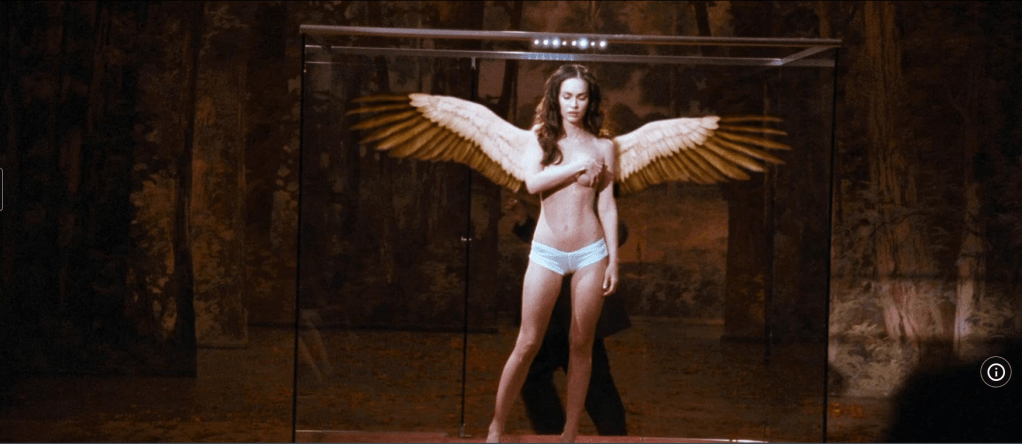
This brings me to one of my favorite scenes in the film. Happy eventually sets Lily up in a theater and begins charging wealthy customers for the privilege of seeing her. The movie builds this up as if we are about to witness some extraordinary spectacle. What is the act? Does she fly? Does she sing? Does she perform miracles? The answer is no. Lily stands on a stage in a small plexiglass box. That is the act. She stands there displaying her wings while wealthy patrons watch. Bill Murray sits in the balcony observing the proceedings like a man who has finally discovered the perfect business model.

I spent the entire scene trying to understand the economics of this operation. Are people buying repeat tickets? Is there a second act? Does anyone ask questions? How many times can a person pay to see Megan Fox stand motionless in a box before they begin demanding additional value for their entertainment dollar? These are the sorts of questions that occupied my mind while the movie was trying very hard to be profound.
The movie is filled with moments like this. It wants desperately to be a tragic fantasy romance, but it keeps getting distracted by ideas it never fully develops. My favorite example comes when Nate attempts to find work. A character who I believe is connected to his former employer tells him:
“You can’t bus tables. You can’t clean toilets. You can’t even buy a drink in here. Not here, or anyplace else.”
How omniscient.
This line is intended to be devastating. Instead, it raises a number of practical questions. Who is this man? What authority does he possess? Is he merely a bar manager, or does he somehow control employment opportunities throughout North America? The screenplay needs Nate to hit rock bottom, so it simply has a minor character announce that rock bottom has arrived. The effect is unintentionally hilarious. It is the kind of line that sounds dramatic while you are writing it at two in the morning and considerably less dramatic once another human being says it out loud.
If Bill Murray had said this line, I might have taken it seriously. If the movie had established some kind of criminal blacklist, I might have accepted it. Instead, it comes from a character we barely know, and he delivers it with the confidence of a man who has personally surveyed every restaurant, bar, and janitorial department in the Western Hemisphere.
The frustrating thing about Passion Play is that there is a better movie hiding somewhere inside it. The premise alone is bizarre enough to justify its existence. A washed-up jazz musician falls in love with an angel while a gangster attempts to turn her into a profitable attraction. That is not the plot of a movie assembled by market research. Someone genuinely believed in this idea. Someone thought this could be a great film.
I cannot justify actually hating this movie.
The screenplay is underwritten. Entire character motivations seem to disappear between scenes. Characters fall in love because the screenplay says they should be in love. Characters betray one another because the next scene requires a betrayal. The score often sounds like it was recorded in a spare bedroom after a weekend spent listening to Pearl Jam albums. Yet the movie never feels generic.
I was rarely surprised by individual plot developments, but I never found the movie predictable. There is a difference. Most bad movies fail in familiar ways. They are bland, corporate, cynical, or lazy. Passion Play fails in its own unique way. It is reaching for something melancholy and mythic and romantic. It wants to be a noir fairy tale. It wants to be tragic. It wants to be profound. It simply has no idea how to get there.
Should Bill Murray be embarrassed that this is the lowest-rated movie on his Metacritic page? Probably not. Actors who spend their careers taking chances inevitably end up with a few disasters. The same instincts that lead someone to appear in Lost in Translation or Rushmore can occasionally lead them somewhere much stranger.
I suspect Murray did Passion Play for the same reason many odd movies get made in the first place: somebody he liked pitched him an idea he couldn’t quite say no to. Mitch Glazer wrote Scrooged, but this feels like his Gigli—a passion project that never figured out how to become a movie. Still, I can imagine Glazer at a Denny’s at one in the morning, talking excitedly about a washed-up trumpet player, an angel with real wings, and a gangster who wants to put her on display. Eventually, keeping the conversation going feels easier than ending it. “You know what?” Bill Murray says. “I’d act in this. Want another shot of whiskey in your coffee?”
Rating: 2.5/10
 Avidavr: Media Reviews