Letter C is for criminal cat-sitting confusion.

The idea behind this A–Z Film-a-thon is to find movies that seem underrated and that I might end up loving unequivocally. At this point, I would settle for a movie I think is even slightly underrated, as opposed to one that was already given every possible benefit of the doubt at the time of its release.
With Caught Stealing, I felt like I understood exactly what Darren Aronofsky was going for from the second I heard the premise: when his neighbor asks him to take care of his cat, a former baseball prodigy turned bartender finds himself in the middle of gangster chaos without knowing why. I read that and immediately thought: this sounds like After Hours.
Not because the stories or the characters are especially similar—they are not—but because it suggests a hard, gritty realist director trying to make a true comedy in the only way that would feel natural to him. In other words, by placing an ordinary man inside the absurdities of a criminal after-party that seems to have started slightly off camera and will continue whether he understands it or not.

“Without knowing why” is the key phrase. That is the feeling the movie is after. The criminal world in Caught Stealing is not presented as orderly enough to be fully explained. It has rules, grudges, alliances, and weird little side dramas that seem to have been in motion long before Hank Thompson stumbled into them. The movie trusts that this confusion can be funny, suspenseful, and strangely immersive all at once.
This may be the first outright “fun movie” Aronofsky has made. It is still a hard-R, very adult movie, one with shocking deaths, ugly violence, and an almost gleeful willingness to make the audience squirm, but its energy is playful in a way his films usually are not. The closest thing in his filmography might actually be mother!, which was “fun” only in the sense that its escalating insanity became perversely exhilarating. Caught Stealing is less subversive than that, but it has a similar confidence in its own nastiness.
What kept coming to mind while I watched it was how many movies rush emotional stakes in order to get the plot moving. Recent examples like Novocaine and Marty Supreme both revolve, in one way or another, around a man losing the woman who has suddenly become central to his life. Caught Stealing handles that much better. Hank Thompson, played by Austin Butler, does not lose someone he met yesterday after one especially magical night. He loses someone who has been in his orbit for years, someone who has quietly been on his side while he was too drunk, distracted, or self-involved to notice what was right in front of him.
That history matters. Even though Caught Stealing only unfolds over a couple of days, nothing feels expedited or emotionally synthetic. The movie is wall-to-wall incident, but it never feels like it is frantically skipping steps to get where it wants to go. The relationship at its center has weight, which gives the surrounding chaos something to push against.
It is also, simply, a fun and darkly funny movie. The Charlie Huston source material makes perfect sense as the basis for something like this. Huston has the look of an aging punk rocker—shaved head, tattooed sleeves, gender-non-specific clothes—and that sensibility comes through in the movie. Caught Stealing has the feel of a story written by someone who finds criminal stupidity, physical pain, and bad luck not merely dramatic, but fundamentally amusing.
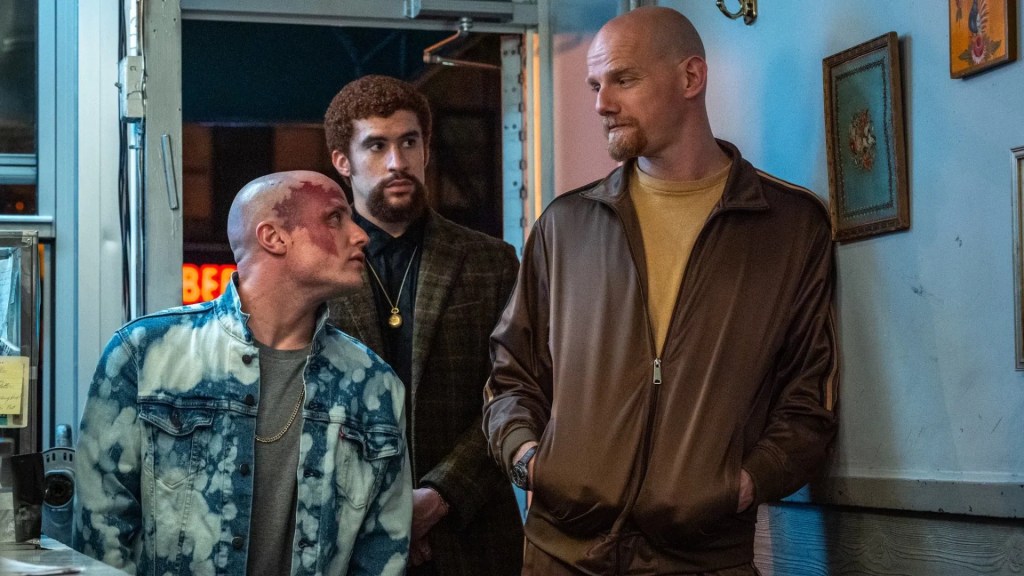
(Bad Bunny is in this)
My partner pointed out that one reason the movie works as a period piece is that it has to exist in a version of New York just before airport security and modern surveillance would make parts of the plot harder to swallow. That sounds like a small point, but it matters. The movie needs the slightly grimier, looser feeling of the late 1990s to sustain its momentum. It wants a city where terrible decisions can still snowball in private for a little while before systems begin closing in.
The soundtrack, by IDLES, is one of the movie’s stranger choices. Their sound is anachronistic for the setting, and the film more or less knows it. Matt Smith plays Russ, a mohawk-sporting punk whose taste in music one assumes must be excellent, and there is a sense throughout that if IDLES had somehow existed in 1998, he absolutely would have listened to them. The music mostly works, though it is used in a relatively muted way. That creates a strange tension: if the soundtrack is going to be this historically out of place and this subtle in the mix, one starts to wonder what the point of the anachronism really is. Still, it contributes to the film’s mood more than it hurts it.
Austin Butler is very good here. This is a role that understands what he is good at: looking beautiful, dazed, a little damaged, and not fully equipped for the world he has wandered into. Hank is decent to the point of near-sainthood by the standards of this movie, but he is still flawed in ways that matter. He is not a blank audience surrogate. He is a man whose passivity and self-medication have left him vulnerable to both bad people and missed chances. Butler gives him just enough sadness and self-disgust that the character remains interesting even when the plot is throwing new disasters at him every few minutes.

A movie like Caught Stealing—the kind willing to maim, torment, or metaphorically cut the fingers off all of its main characters just to keep the audience uncomfortable—lives or dies by the quality of its ending. This one has a great one. It delivers a kind of 1990s twist ending, the sort that makes everything rearrange itself without ever quite going where you think it will. Even if you have seen this kind of mechanism a hundred times before, Caught Stealing keeps finding ways to avoid the most obvious and irritating choices.
It does not add up to profound art. That is fine. Not every good movie needs to. What Caught Stealing does offer is the pleasure of watching a filmmaker and writer navigate a familiar kind of story while making a point of dodging cliché at every turn. It is the kind of movie that could be studied in a film class called “Avoid Cliché. Avoid Mistakes.”
When I turned it off, I felt a little more punk rock for having watched it.
7.5/10
 Avidavr: Media Reviews