You probably don’t know any Puerto Rican artists, and you’ve almost definitely never seen a Puerto Rican movie. You probably don’t know any Puerto Rican music either. The only Puerto Rican cultural work you’re likely familiar with is West Side Story — and even that uses Puerto Rico mostly as a plot device. It flattens the culture into a stereotype: “colorful immigrants with knives.”
It’s not that Puerto Rico doesn’t have great culture — it absolutely does. The problem is that most Americans never hear about it. Colonial repression, racism, and political neglect have created obstacles that keep Puerto Rican voices out of the mainstream. And when Puerto Rican art speaks openly — often saying, “We hate what you’ve done to us” — the United States doesn’t want to hear it.
Puerto Rico has pioneered many different musical genres over the years, but few individual artists have broken through globally. Cuba has Buena Vista Social Club, a supergroup of folk and jazz musicians who came together to preserve their country’s musical legacy. Puerto Rico never had its Buena Vista.
Bad Bunny seems to be trying to change that. His newest album, DeBÍ TiRAR MáS FOToS, feels like an attempt to create a pastiche of Puerto Rican musical culture. In the lyrics of the lead single, he name-checks multiple Puerto Rican genres: salsa, merengue, bachata, and reggaetón. He seems to ask, “How does my music compare?” His album tries to honor his country’s musical history, while still making something new.
Bad Bunny’s 2025 NPR Tiny Desk Concert. Good stuff.
The album title, DeBÍ TiRAR MáS FOToS, literally means “I should have taken more photos.” It’s a fitting entry point for the album’s themes of memory, nostalgia, and regret.
Bad Bunny and Jimmy Fallon in San Juan, Puerto Rico.
I analyzed the lyrics of the lead single, “DtMF,” and here’s what I found:
Bad Bunny sings, with a call and response chant during the chorus::
Debí tirar más foto’ de cuando te tuve Debí darte más beso’ y abrazo’ las veces que pude Ey, ojalá que los mío’ nunca se muden Y si hoy me emborracho, pues, que me ayuden
Which translates to:
I should have taken more photos from when I had you. I should have given you more kisses and hugs whenever I could. Hey, I hope my family never moves away. And if I get drunk today, well, I hope they help me.
At first, it sounds like he’s mourning an ex-lover — someone who might even be dead. But the song becomes more interesting when you dig deeper. In the second verse, he mentions playing dominoes with his grandfather. His grandpa asks about the girl from the first verse, and Bad Bunny casually says he’s not with her anymore.
Zooming out, the meaning shifts: Bad Bunny is drunk, high, and hallucinating — imagining conversations with friends and family members who have either died or moved away. He’s not just pining for a lost love; he’s mourning a whole lost world. The ex-girlfriend probably isn’t dead — she just moved on long ago. The real loss is his grandfather. He isn’t playing dominoes with him now. He’s remembering playing dominoes years ago — or maybe he’s imagining it, wishing he could sit down with him one more time.
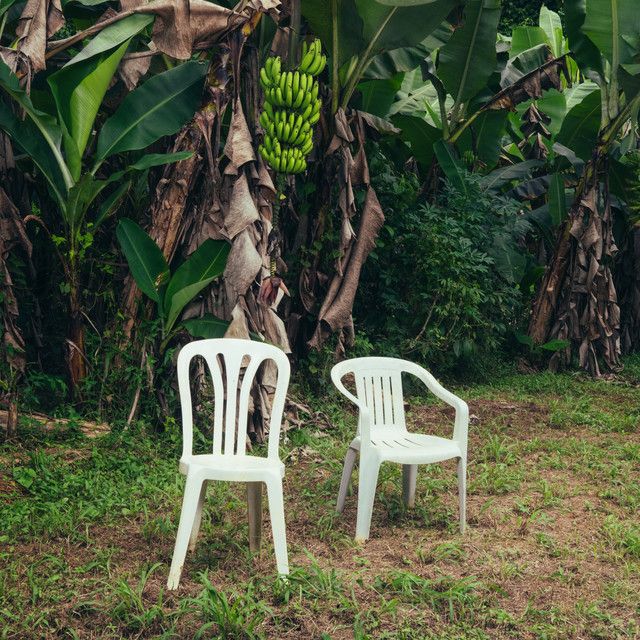
The album cover for DeBÍ TiRAR MáS FOToS.
The album cover of DeBÍ TiRAR MáS FOToS captures this feeling perfectly. It shows two cheap plastic lawn chairs under a few tropical trees — the exact kind of place where you might play dominoes with your grandfather. Since he doesn’t have any real photos of those moments, this empty scene is the closest he can come to capturing them now. The life has been stripped from the landscape, but the memory still lives through context and feeling.
It’s basically the equivalent of Jack’s shirt in Brokeback Mountain. Ennis doesn’t have any photos of Jack either, so he hangs up Jack’s shirt in his closet, preserving what little he can of a love he lost long ago.
How was the most hilariously terrible song of the 2020s made?
That is the version of the song this is about. But here is the (rather great) music video for the clean version:
This is a very popular song right now. 2,345,597,911 streams on Spotify with 2+ million streams every day. It is the second quickest song to ever reach 1 billion streams behind “Die With a Smile” by Lady Gaga and Bruno Mars. The explicit version.
In the history of pop music, a few songs stand out as camp classics—songs that are simultaneously earworms you can’t forget while also being extraordinarily lyrically misguided. The so-bad-it’s-good songs. “MacArthur Park” by Richard Harris. “Afternoon Delight” by Starland Vocal Band. “Never Been to Me” by Charlene. “Seven” by Jungkook. Give it a short amount of time and it will be in a Will Ferrell movie used to portray this exact time in history.
Counting is a highly irritating trope, unless you are counting to eight in Riot Grrrl/punk music or you are rocking around the clock. I am thinking of “In the Year 2525 (Exordium & Terminus)”; Zager and Evans start in the titular year and gradually count forward by 110 years, forecasting probable dystopian future attributes. “Seven” simply states the days of the week, which is irritatingly repetitive, yet it has a similarly fascinating quality.
After stating every day of the week four times, then specifying “Every hour, every minute, every second,” he pulls out a curveball of probable language difficulties. Sung, with emphasis, multiple times: “Night after night, I’ll be fuckin’ you right.” He is Korean, so—does he realize what he is saying?
He spends so much time counting the days and stipulating every moment of time will be filled with something. He just never says what. The only contextual clue is the word “fuckin’,” so what? He is going to be literally inside his lover every second, 365 days a year?
Obviously, the lyric was originally “Loving you right seven days a week,” which is a light and romantic notion. This is how the clean version goes, and I wonder: did they actually make the right decision? This song has unstoppable legs.
Jungkook is a member of the South Korean boy band BTS, who are huge—or, at least, their presence is overwhelming. They release albums in Korean, Japanese, and English, often releasing all three in a year they have an album cycle. Their global presence has been everywhere: music charts, awards shows, commercials, social media, fashion, the UN… If you aren’t a fan, you were probably already exhausted from their inescapable saturation. Their massive fan base, known simply as the ARMY, are extremely vocal and extremely organized. Any high-profile online poll is swamped with submissions by this fan base.
In 2019, BTS was coming off of a landmark year in the US, and everyone expected the ARMY to get BTS into the top categories at the MTV VMAs, such as Best Pop Video or Video of the Year. MTV went a different direction and created an entirely new category for “Best K-Pop,” which I thought seemed very peculiar. Is K-Pop really such a big thing in the US that you had to create an entirely new category for it?
It’s kind of like expecting Ray Charles to be nominated for Record of the Year for “Georgia on My Mind,” only to see on nomination morning a newly created category of “Best Black Song.”
It is a nice gesture to also have this new category, but instead of “Best Video”? If an artist is big enough to legitimately compete for the biggest prize, and you subjugate them to a newly created smaller award, it seems—if not outwardly racist—then bizarrely protective and xenophobic.
But maybe it’s for the best. Here is a list of songs that would have been nominated, likely, for the Grammy of Best Black Song between 1959 and 1969. 95% of them weren’t nominated for any Grammy.
“Seven” by Jungkook is an irritating but charming hit song that might be on your 13-year-old’s most played Spotify list right now. The song’s chorus is slightly different from what you hear on the radio:
“Monday, Tuesday, Wednesday, Thursday, Friday, Saturday, Sunday (a week) Monday, Tuesday, Wednesday, Thursday, Friday (seven days a week) Every hour, every minute, every second You know night after night I’ll be fuckin’ you right, seven days a week”
Most young people probably don’t listen to the song only ironically. The song is made for pop radio, and is quite catchy, smooth, and melodic. But the irony is not lost on the teenagers that are making the song stick around years later. A fan on TikTok posted a reaction video, in which she just appears to be enjoying the music. Then, once Jungkook says what he will do with his lover, she looks suddenly shocked. But by the last chorus, she sings along without batting an eye.
Jungkook was publicized as being the virtuosic youngest member of BTS. He could really sing, wrote his own songs (no hits), and was just an all-around good, wholesome kid. He was a marketed prodigy; he could dance and was remarkably athletic. He became noted by too many people for being squeaky clean, seemingly having nothing to say (he was very quiet in interviews).
In 2019, something had changed. His voice became deeper, he started showing off tattoos, and the tabloids even caught him smoking a—wait for it—cigarette. He officially became a bad boy in the group. By the time 2022 came around, Jungkook embraced his new persona. He had a full sleeve of arm tattoos and new face piercings: eyebrow, lips, and nose. He even appeared on candid livestreams of him drinking late at night.
At age 26, BTS was on hiatus and Jungkook was working on a solo album. The first single was “Seven,” a track written by five songwriters, all of whom are credited with writing the lyrics. According to HYBE CEO Scooter Braun, the track was originally written for Justin Bieber, who passed on it.
The reason Justin Bieber passed was likely timing. There is often a huge push for pop songs to be released as soon as they are written. Pop radio needs music that sounds sound fresh and relevant. Justin released his last album, Justice, in 2021 and has not released another since. The other option is that Justin passed on the song because it didn’t fit his style or his brand.
I would not give the man behind the songs “Yummy” and “Peaches” credit for believing “Seven” was not up to his level of typical quality. However, I could believe that Bieber could see the clean version of “Seven” being too juvenile, and the dirty version might seem downright silly. Justin Bieber always tries hard to support his bad boy branding, and is overall successful. On “Peaches,” he refers to California weed as “the shit” and refers to his girlfriend as a “bad ass bitch” because, presumably, she will go to his home country of Canada with him.
Justin’s taste may be questionable, but he does manage to seem his age, with his casual swearing and drug references. He plays off the bad guy image well, and he probably didn’t feel like coming out of hiatus to perform a hit that is a middle schooler’s idea of what adults want to listen to. Did a fifth grader write this?
I would buy that the track used the “fuck” expletives because Jungkook insisted on it, failing to grasp the specifics of the what words in Korea don’t translate. However, Jungkook is not a credited songwriter for “Seven,” so none of the most questionable parts of “Seven” can be attributed directly to him, supposedly.
I spent some time looking at the credited songwriters of “Seven,” and the blame seems to be: diffusion of responsibility. My theory: the chorus was the work of producer Andrew Watt, whose biggest songwriting credits are “Bad Guy” by Billie Eilish and “Rain on Me” by Lady Gaga and Ariana Grande. He is the first name listed in the credits, and it seems that he was always attached to the song as producer, along with Cirkut.
Andrew Watt was a producer on “Peaches,” which is the definition of diffusion of responsibility. That track has 11 credited songwriters, and the team can’t even finish the central idea. Justin gets his peaches from Georgia, his pot from California, his girl goes north with him, and he gets light from the source. What light? The northern lights?
Pop songs typically have teams of songwriters. Who’s responsibility was it to make sure the central artist wasn’t embarrassing himself? Pitchfork Media was a big supporter of the BTS craze, and they supported the singer V’s solo debut as one of the “five albums out this week you should listen to right now.” Jungkook’s Golden is in another league of success, selling 9 million albums worldwide. Pitchfork has never mentioned the album or the song “Seven.” They have given the guest rapper Latto decent marks. So what does this say about the feelings for Jungkook? Is this indicative of the entire critical community?
Jungkook, by contrast, seems meager, like he is trying on his father’s shoes for the first time. He is a little kid attempting to prove he can pass for 21 to hang at the club with the cool kids. He insists he is older, and yet he seems rather clueless. I’ll blame “Seven” on the language barrier. But Golden has about as much gravitas as a typical album by an American Idol contestant. Will this matter?


 Avidavr: Media Reviews