David Cross once called Alvin and the Chipmunks 3: Chipwrecked “the most miserable experience of my life.” He only did it for the money, as he wanted to find funding for some of his own passionate projects. Sensing utter desperation, a producer coerced David into conditions he felt were pointless. In one scene, he wore a Pelican mascot costume, for real, for days worth of filming during extreme humidity. A stunt person or extra could have been in the costume instead, and, even worse, his character was not even supposed to actually be in the costume. The audience was only supposed to think that he *might* be in the costume.
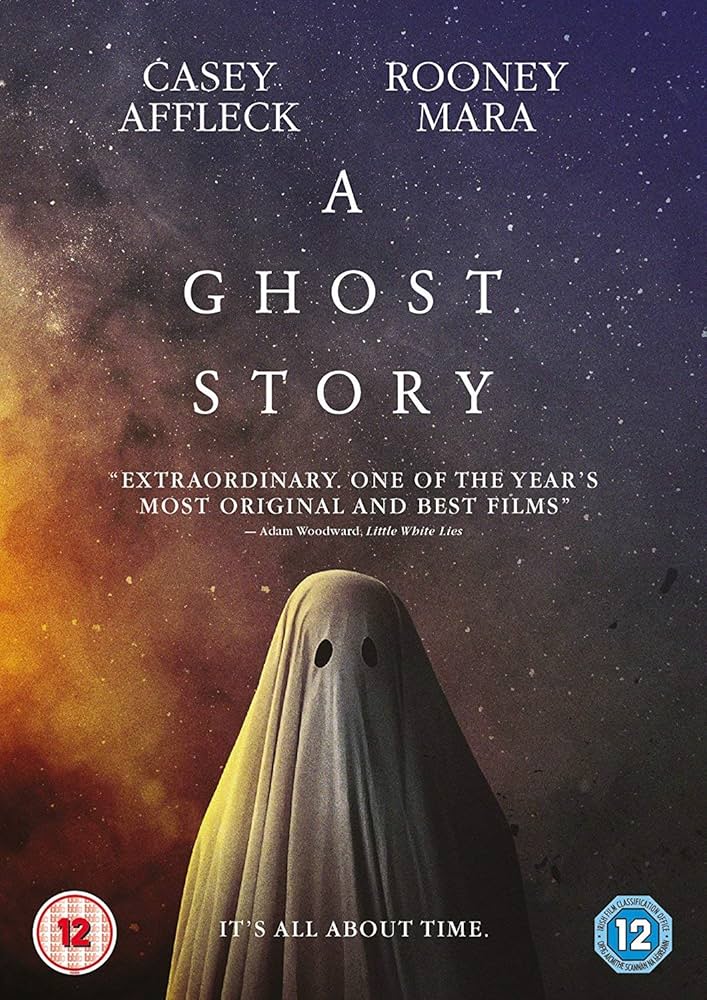
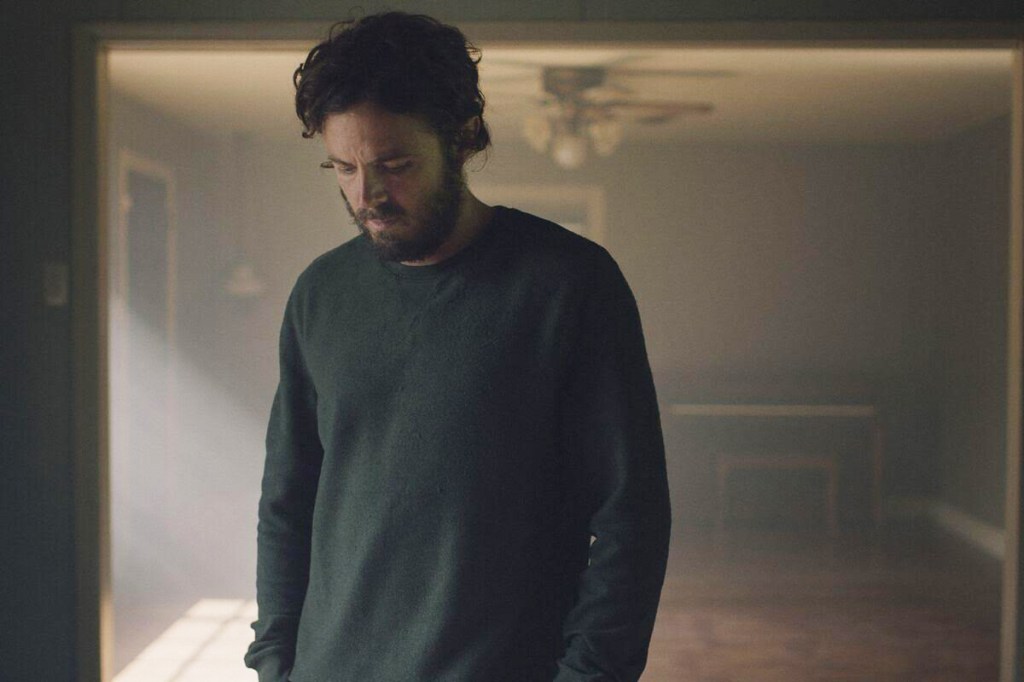
I thought of that while watching this haunted little movie. Apparently, Casey Affleck was always underneath the sheet in A Ghost Story—a lot more than he ever needed to be for the experience to be, I’d say. Sometimes, hiring a major actor for a role where you can’t see their face qualifies as stunt casting, especially when they are given so little to -do-.
.
The visuals are the primary draw here. Everything is impeccably framed, with a little bit of vignette on the outer corners of the frame. It’s as though a ghost is remembering their past as if they were watching a vintage home movie. There is a Tsai Ming-Liang level of action happening onscreen here. I feel like I need to research more about the house where this was shot. Whereas in Goodbye Dragon Inn, Tsai focused on a movie theater’s final days before it was shut down, focusing on all of the grody little details that still existed there: the leaky roof, the cruisiness of its usage by gay men. I felt like Tsai looked at the theater, saw it was going to be demolished, so he gave an assignment to himself. How can he capture the majesty of a theater, it’s downfall, and somehow preserve it. Goodbye Dragon Inn was a movie about the very worst days of a once majestic theater.
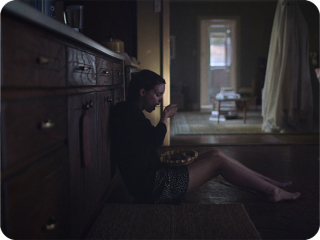
A Ghost Story’s backstory is a little less noble. Yes, the house was condemned, but the story came first. David Lowery found a house from a list of buildings that were to be torn down and used the film’s budget to fix it up to make it look more livable as a family home before its eventual destruction. Whereas in Goodbye Dragon Inn, Tsai incorporated a character who moved extremely slowly with one leg that couldn’t move so you could really take in the atmosphere of the theater, there are shots in A Ghost Story where nothing happens for almost no reason. The most memorable scene in A Ghost Story comes when Rooney Mara grabs a dish left for her on a table, sits at the wall for some reason, and pierces the fork right in the center of the tin. I thought “Are we going to watch her eat this entire pie in one shot?” There is nothing else to look at. There is a ghost and a piano. Old, undecorated suburban houses are not that interesting to look at, so we just watch her, chomping away.
I liked the pacing of A Ghost Story. It was like Tsai Ming Liang or Apichatpong Weerasethakul without the purpose. There is nothing that makes me roll my eyes as quickly as the idea that a ghost might be haunting an old house, but I do love the folklore tradition of ghost stories. There is truth in that aspect, that ghosts are more bound by a location than by time. I understood the main point of the movie: someone who believed in his own love so deeply that, once he died, he becomes his own self-fulfilling prophecy. “Wait… I have been haunting myself for years? Why?” Tsai makes slowness feel like observation; Lowery makes it feel a little like homework.
The idea behind this A–Z Film-a-thon is to find movies that seem underrated and that I might end up loving unequivocally. At this point, I would settle for a movie I think is even slightly underrated, as opposed to one that was already given every possible benefit of the doubt at the time of its release.
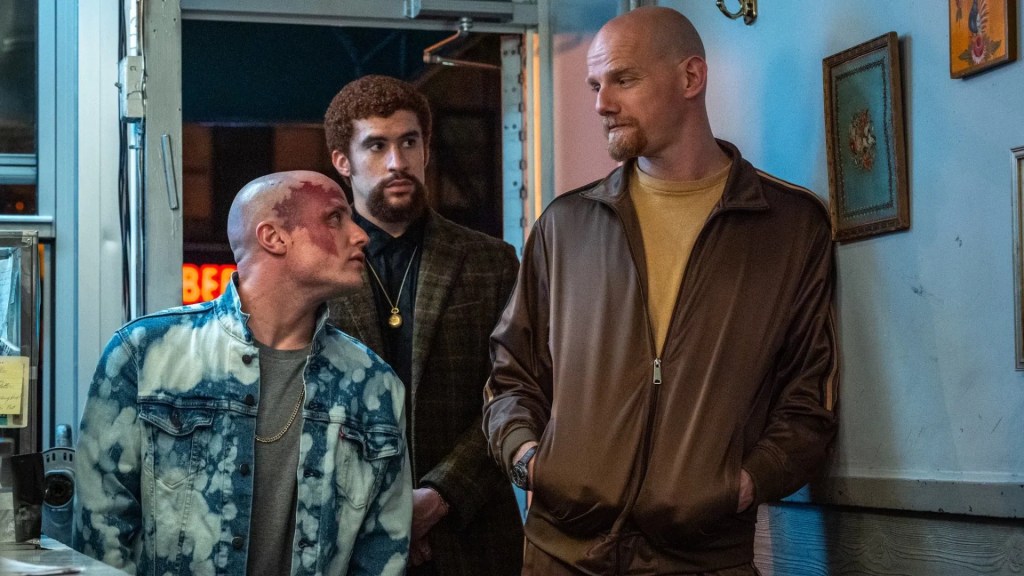
With Caught Stealing, I felt like I understood exactly what Darren Aronofsky was going for from the second I heard the premise: when his neighbor asks him to take care of his cat, a former baseball prodigy turned bartender finds himself in the middle of gangster chaos without knowing why. I read that and immediately thought: this sounds like After Hours.
Not because the stories or the characters are especially similar—they are not—but because it suggests a hard, gritty realist director trying to make a true comedy in the only way that would feel natural to him. In other words, by placing an ordinary man inside the absurdities of a criminal after-party that seems to have started slightly off camera and will continue whether he understands it or not.
“Without knowing why” is the key phrase. That is the feeling the movie is after. The criminal world in Caught Stealing is not presented as orderly enough to be fully explained. It has rules, grudges, alliances, and weird little side dramas that seem to have been in motion long before Hank Thompson stumbled into them. The movie trusts that this confusion can be funny, suspenseful, and strangely immersive all at once.
This may be the first outright “fun movie” Aronofsky has made. It is still a hard-R, very adult movie, one with shocking deaths, ugly violence, and an almost gleeful willingness to make the audience squirm, but its energy is playful in a way his films usually are not. The closest thing in his filmography might actually be mother!, which was “fun” only in the sense that its escalating insanity became perversely exhilarating. Caught Stealing is less subversive than that, but it has a similar confidence in its own nastiness.
What kept coming to mind while I watched it was how many movies rush emotional stakes in order to get the plot moving. Recent examples like Novocaine and Marty Supreme both revolve, in one way or another, around a man losing the woman who has suddenly become central to his life. Caught Stealing handles that much better. Hank Thompson, played by Austin Butler, does not lose someone he met yesterday after one especially magical night. He loses someone who has been in his orbit for years, someone who has quietly been on his side while he was too drunk, distracted, or self-involved to notice what was right in front of him.
That history matters. Even though Caught Stealing only unfolds over a couple of days, nothing feels expedited or emotionally synthetic. The movie is wall-to-wall incident, but it never feels like it is frantically skipping steps to get where it wants to go. The relationship at its center has weight, which gives the surrounding chaos something to push against.
It is also, simply, a fun and darkly funny movie. The Charlie Huston source material makes perfect sense as the basis for something like this. Huston has the look of an aging punk rocker—shaved head, tattooed sleeves, gender-non-specific clothes—and that sensibility comes through in the movie. Caught Stealing has the feel of a story written by someone who finds criminal stupidity, physical pain, and bad luck not merely dramatic, but fundamentally amusing.
(Bad Bunny is in this)
My partner pointed out that one reason the movie works as a period piece is that it has to exist in a version of New York just before airport security and modern surveillance would make parts of the plot harder to swallow. That sounds like a small point, but it matters. The movie needs the slightly grimier, looser feeling of the late 1990s to sustain its momentum. It wants a city where terrible decisions can still snowball in private for a little while before systems begin closing in.
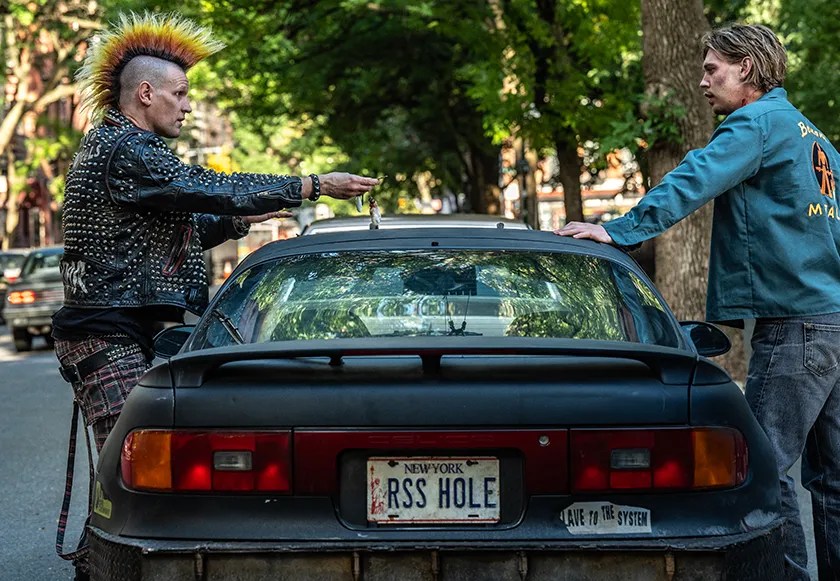
The soundtrack, by IDLES, is one of the movie’s stranger choices. Their sound is anachronistic for the setting, and the film more or less knows it. Matt Smith plays Russ, a mohawk-sporting punk whose taste in music one assumes must be excellent, and there is a sense throughout that if IDLES had somehow existed in 1998, he absolutely would have listened to them. The music mostly works, though it is used in a relatively muted way. That creates a strange tension: if the soundtrack is going to be this historically out of place and this subtle in the mix, one starts to wonder what the point of the anachronism really is. Still, it contributes to the film’s mood more than it hurts it.
Austin Butler is very good here. This is a role that understands what he is good at: looking beautiful, dazed, a little damaged, and not fully equipped for the world he has wandered into. Hank is decent to the point of near-sainthood by the standards of this movie, but he is still flawed in ways that matter. He is not a blank audience surrogate. He is a man whose passivity and self-medication have left him vulnerable to both bad people and missed chances. Butler gives him just enough sadness and self-disgust that the character remains interesting even when the plot is throwing new disasters at him every few minutes.
A movie like Caught Stealing—the kind willing to maim, torment, or metaphorically cut the fingers off all of its main characters just to keep the audience uncomfortable—lives or dies by the quality of its ending. This one has a great one. It delivers a kind of 1990s twist ending, the sort that makes everything rearrange itself without ever quite going where you think it will. Even if you have seen this kind of mechanism a hundred times before, Caught Stealing keeps finding ways to avoid the most obvious and irritating choices.
It does not add up to profound art. That is fine. Not every good movie needs to. What Caught Stealing does offer is the pleasure of watching a filmmaker and writer navigate a familiar kind of story while making a point of dodging cliché at every turn. It is the kind of movie that could be studied in a film class called “Avoid Cliché. Avoid Mistakes.”
When I turned it off, I felt a little more punk rock for having watched it.
“One day, when you are famous and everyone knows your name, people will see this and laugh at you.”
“Good. I hope they do. I am quite happy with how it turned out.”
That was an exchange I once had with my sister about one of my own early creative projects, the album Mad Cow Disease by my high school musical group, The Cadets of Temperance. My college-era zombie movie, Oh, No! Zombies!!!, inspired similar reactions from older relatives who seemed less charmed by my artistic instincts than I was. Other people involved had supportive families. Mine sometimes looked at what I was making with the expression of people being asked to admire a live electrical fire.
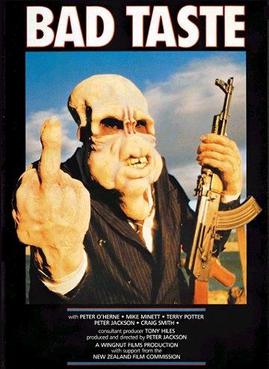
So I feel a certain kinship with Peter Jackson’s Bad Taste.
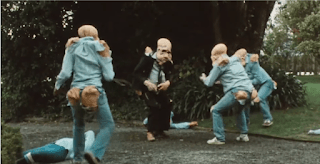
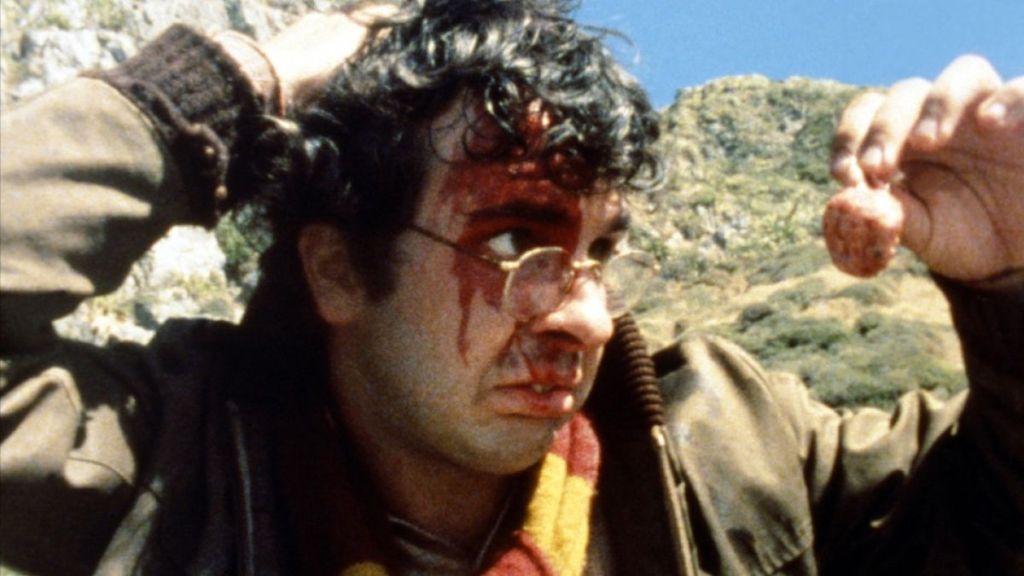
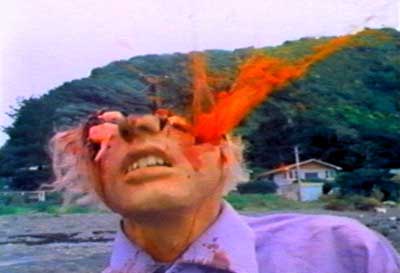
Watching it, I kept imagining Jackson showing this thing to his family at age twenty-four while they tried to process what exactly they were seeing. “What is this?” “Why do the aliens have human disguises that still leave their giant butt cheeks exposed?” “Why does the man with the head wound keep putting his brain back into his skull and carrying on?”
To my disappointment, Jackson never seems to have offered a great canonical explanation for the aliens’ protruding rear ends. But with a title like Bad Taste, perhaps he felt no obligation to. If anyone questioned the exposed buttocks, he could always point to the marquee and say: I warned you.
The plot, such as it is, concerns a group of men battling grotesque aliens in rural New Zealand. The creatures look a bit like something Jim Henson might have designed on weekend during a high degree fever. One character, Derek, suffers a catastrophic head wound early on and spends much of the film scooping fallen brain matter off the ground and stuffing it back into his skull. At one point, he even seems willing to supplement his own supply with alien brain. This is not a movie in which medical distinctions matter.
What struck me most was not the story, which barely qualifies as one, but the brute fact of the movie’s existence. I watched it on Plex without subtitles, which did it no favors. The accents are thick, the sound often resembles dialogue captured inside a coffee can, and the image has that faded, fragile look common to low-budget productions. And yet the camera, while shaky, is never hopelessly amateurish. The movie may not be polished, but it is recognizably a movie. That already puts it ahead of many ambitious homemade projects.
Bad Taste is less a world than a continuity exercise. Nothing in it feels fleshed out enough to support a larger mythology, and Jackson does not seem especially interested in coherence for its own sake. What he is interested in is getting the shot, finishing the effect, solving the problem in front of him. That is the real subject of the film.
Jackson plays Derek, the memorably concussed hero, but he also seems to play half the surrounding population. So many characters look suspiciously like Peter Jackson with slight variations in beard, wig, or voice that the film begins to feel like one man arguing with himself across New Zealand. From a strict continuity standpoint, it is not impressive. I noticed missing details, shifting visual elements, and the usual evidence of a production held together with stubborn improvisation. But Jackson was operating under absurd constraints, including the small matter of having to act in multiple roles while also making the movie.
And that is why Bad Taste matters.
Not because it is a great film on its own terms. It is not. The writing is thin, the world-building is nonexistent, and much of the humor depends on the audience finding sheer excess funny. But the movie proves that Jackson had the one quality no school can really teach: full commitment. He shot the thing over four years, beginning with a self-financed budget of 25,000 New Zealand dollars before receiving further support from the New Zealand Film Commission to complete it. He had no film-school polish because he had never gone to film school at all. He left school young (age 16), taught himself by doing, and turned this movie into his education.
In that sense, Bad Taste was his film school. Cheaper, too. The only thing he really missed were the writing classes.
I made Oh, No! Zombies!!! the summer before my senior year of college and used its music for my final project. My presentation got honors largely because the professors laughed constantly while I explained how the movie had been made and how all the pieces fit together. I had been inspired by Ed Wood and by the worst zombie films I could find. What inspired Jackson here is harder to pin down. Bad Taste does not feel fully enough formed to be parody, and it is too odd to read as straightforward homage. It feels instead like a prototype for the grotesque brilliance he would later achieve in Dead Alive/Braindead: the early, unstable version of a sensibility not yet fully invented.
I tried to watch Bad Taste when I was a junior in college and gave up. At that age, time felt too valuable to spend on something this ragged. I should have stuck with it. Watching it now is a little like seeing an early bicycle built by the Wright Brothers and asking why it does not fly. Of course it does not fly—that was never the point. The point is that it moves at all, that someone figured out how to make it work, and that they carried it across the finish line. Bad Taste is that kind of movie: less impressive for what it achieves on screen than for the fact that it exists, undeniable ragged—but overall complete.. Most movies, even now, never get that far.
I went through my giant 4,600-movie watchlist trying to find this week’s pick. I found three strong contenders: Atom Egoyan’s Ararat, one of the few narrative features about the Armenian Genocide ever to get any real attention; Sam Mendes’s Away We Go; and John Huston’s 1982 version of Annie. Ararat felt too heavy for the moment, and Away We Go seemed slight enough to ease into. My partner suggested the 1999 made-for-TV Annie with Kathy Bates, which is probably the “good” movie version anyway: closer to the Broadway tone, and without Carol Burnett seeming determined to prove how drunk a person can act on camera.
Since I had just watched a kids’ movie, 8-Bit Christmas, I decided to keep things relatively light. Better, I thought, to start with lighthearted fare than go straight to the Armenian Genocide. So, away we go to…
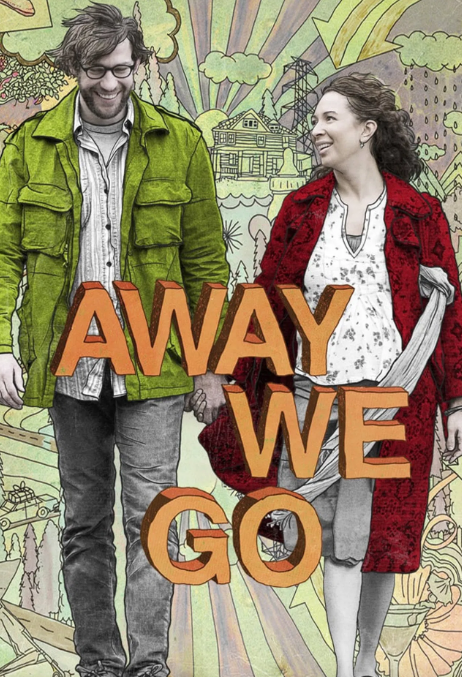
Away We Go (2009)
The theater where I used to work played Away We Go during my time there, which meant that for a few weeks I saw the end of it over and over while cleaning during the closing credits. The song over those credits, “Orange Sky” by Alexi Murdoch, is by far the best thing about the movie. It is so good, in fact, that I can almost imagine Sam Mendes hearing it and deciding he needed to build a film around the feeling it gave him.
That may sound flippant, but it gets at the problem. Away We Go feels less like a movie with something urgent to say than a movie assembled around a mood. Mendes, working from a script by Dave Eggers and Vendela Vida, seems to want to make a lightweight road movie about an expectant couple drifting through America in search of home. There is nothing wrong with that in theory. In fact, it sounds promising: a small, funny, observant movie about adulthood, parenthood, and the panic of trying to build a life before the baby arrives.
For a while, it almost works.
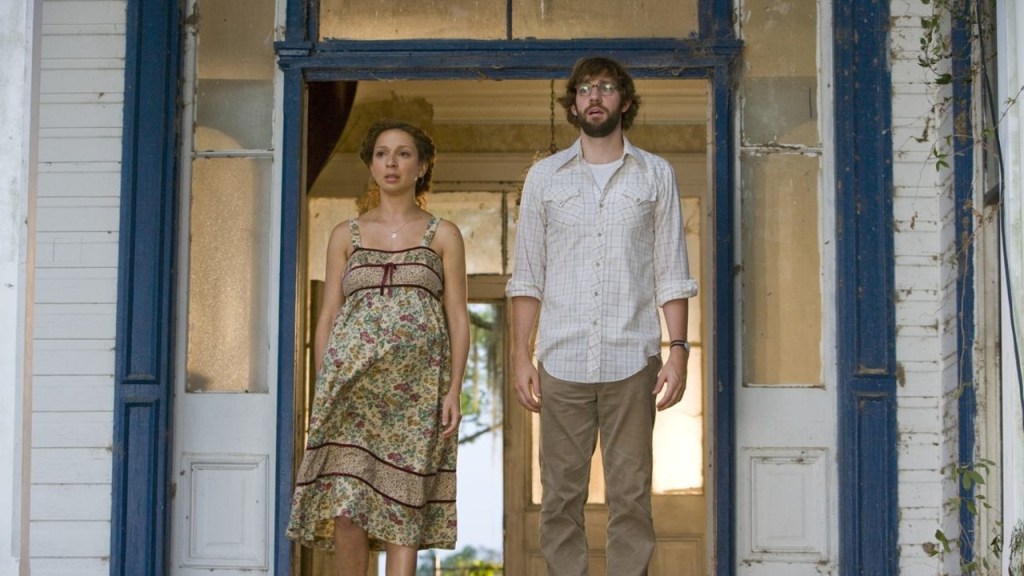
Burt and Veronica, played by John Krasinski and Maya Rudolph, learn that Burt’s parents are moving to Belgium just when the couple had apparently assumed they would have family nearby for support. That premise is good enough to launch a movie. The trouble is that the script never quite makes the couple’s situation cohere. Did they move to Denver specifically to be near his parents? Were they already there? Was the pregnancy planned, half-planned, or an accident they are calmly absorbing? The movie wants the looseness of real life, where people do not always explain themselves in neat dramatic terms, but it never finds the confidence to make that vagueness meaningful. Instead, it often just feels underwritten.
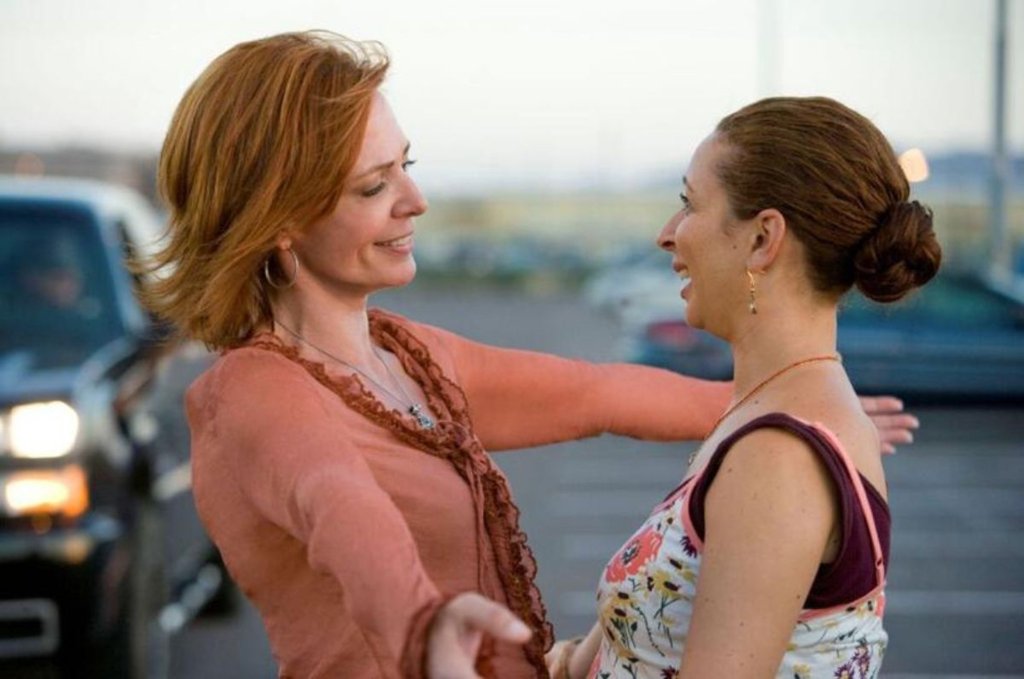
That becomes clearer as soon as the couple begins visiting the various people who are supposed to show them different models of adult life and parenthood. On paper, this is a strong structure. In practice, it produces a series of half-finished sketches. Catherine O’Hara and Jeff Daniels are amusing as Burt’s foolish, self-involved parents. Allison Janney, meanwhile, arrives like she has been dropped in from an entirely broader comedy. Her character Lily is one of the most obnoxious people I have seen in a movie in quite a while, which could have been funny if the film understood her as a grotesque. The problem is that it seems to want us to accept her as someone Veronica would plausibly choose to spend time with.
That is where Away We Go repeatedly loses me. The script wants characters to have relationships because the scene needs those relationships to exist, not because the story has made them believable. Veronica laughs with Lily, chats with her, and appears to enjoy her company. Fine. But why? What is the shared history there? What quality in Lily once made her seem worth keeping around? The movie never shows us. It simply assumes that because these two women are in the same room, we will accept that they are old friends. I did not.
The same problem applies elsewhere. Maggie Gyllenhaal’s LN is memorable, certainly, but she does not feel like a person so much as a satirical parenting exhibit. She breastfeeds older children, co-sleeps to an absurd degree, and generally behaves in a way that is plausible enough to be recognizable but so exaggerated that she stops being useful as observation. That is the movie in miniature: it wants the authority of realism and the comic payoff of caricature, and it keeps straining itself by trying to have both.
The first half of the film, at least, has enough oddity and momentum to keep a person engaged. The second half simply runs out of gas. The later stops on the road trip blur together, and the movie begins introducing dramatic material so abruptly that it feels less like life unfolding than screenwriters throwing fresh obstacles onto the road. Burt’s brother suddenly appears with a devastating marital crisis, and instead of deepening the movie, it feels imported from another draft. I do not object because bad things are unrealistic. I object because the screenplay has not earned this degree of melodrama. A movie about ordinary, mildly confused people can absolutely contain pain, but it has to arise from the emotional world the movie has built. Here it feels like the film panicked when it realized it had very little left to say.
That, more than anything, is the disappointment of Away We Go. It is filled with the appearance of insight. It has tasteful music, shaggy dialogue, quirky side characters, and the outline of a human-scale story. But it never cooks any of it through. It gestures toward conversational wisdom, emotional honesty, and slice-of-life ambiguity without ever turning those qualities into drama. By the last stretch, I was no longer annoyed so much as bored. The movie had spent so much time pretending to be observant that it forgot to actually observe.
The final emotional turn is where Away We Go really loses me. Veronica reveals that she never wants to have a wedding ceremony because her parents died when she was in college, and she cannot bear the idea of getting married without them there. Fine. That is sad. It is also, at some point, something a partner is allowed to find exasperating. The movie even gives Burt a scene where he is allowed to raise his voice, but he goes through the motions about something comparatively inane, as if the script wants credit for letting him yell without making him confront the one thing actually worth yelling about. Why is he not allowed to say the obvious? If Veronica does not want to get married, then she should admit she does not want to get married, instead of hiding behind the fact that her parents will always be dead and therefore can never attend the wedding. Veronica herself says they do not fight enough. Exactly. Happy couples fight. They especially fight about things this unreasonable. The movie’s refusal to let that argument happen is one of its most infuriating evasions.
I went in hoping that Dave Eggers’s involvement might lead to something sharp and emotionally cumulative, if not exactly heartbreaking. Instead, Away We Go feels half-raw: all premise, tone, and suggestion, with very little finished thought underneath. You can nibble at the crispy edges and survive. But as a meal, it is about as satisfying as reheated hamburger.
Nothing says “I might actually enjoy this movie” like watching a Christmas movie in March.
8-Bit Christmas (2021)
I am an 8-bit kid. I don’t really play NES games anymore, but I do fall asleep most nights to YouTube videos of young people playing video games that came out before they were born. So when I saw the title 8-Bit Christmas, I brought a lot of hope with me. I could easily imagine a version of this movie I would have loved. That is not this movie.
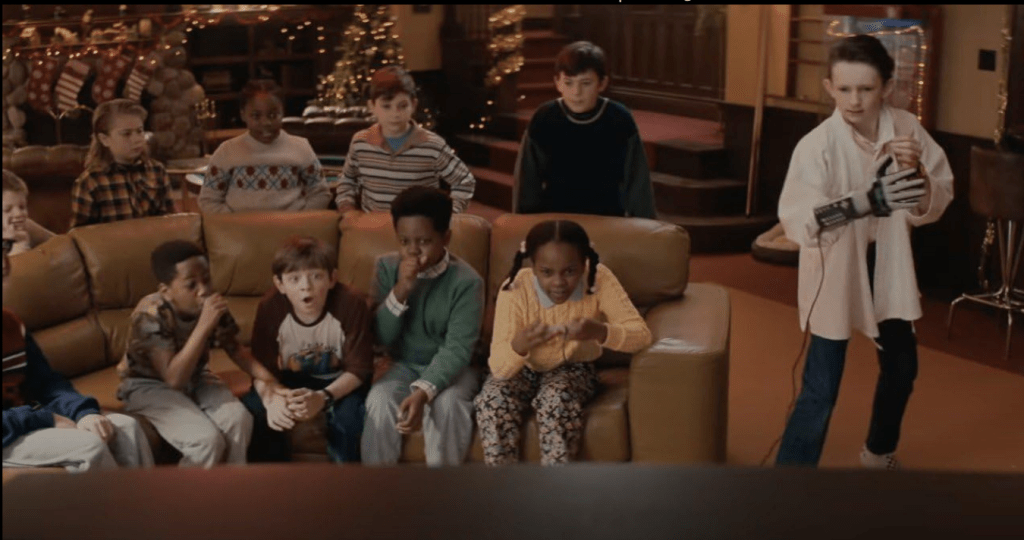
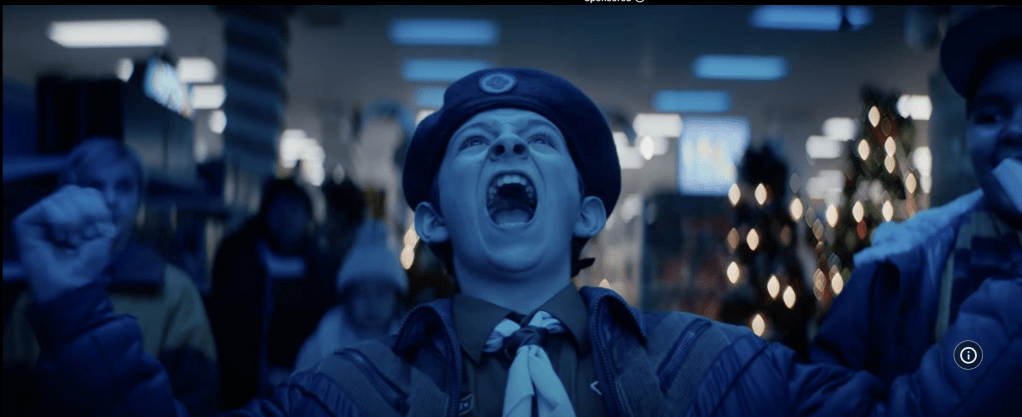
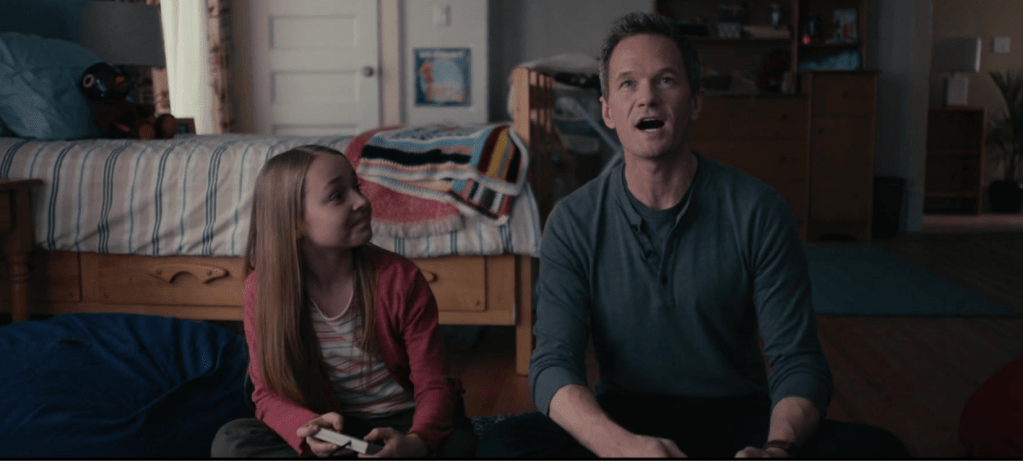
Instead, 8-Bit Christmas is basically a family-channel Christmas movie dressed up in Nintendo nostalgia. Neil Patrick Harris plays Jake Doyle, an adult reminiscing about how desperately he wanted an NES as a child in 1988. He tells the story to his daughter to explain why she cannot simply get everything she wants.
That setup could have worked. The problem is that the movie never seems to understand what made Nintendo feel magical in the first place. When Jake finally shows his daughter a game from his childhood, he picks Paperboy on NES—not Super Mario Bros., not Contra, not Bubble Bobble, or anything a normal child would use to explain why the system mattered. It is such a strange choice that it almost feels revealing. The movie is not interested in what kids actually loved about Nintendo. It is interested in using Nintendo as a generic symbol for “back then.”
And that leads to the movie’s real message, which turns out to be much drearier than the title suggests: You want a cell phone, kid? Get a job. For a Christmas movie about parents sharing the past with their children, that is a surprisingly joyless lesson. It is not even wrong, exactly. It is just hollow. The real issue with kids having cell phones was never simply that they were expensive.
The movie is basically A Christmas Story rewritten around an NES, but without the same specificity. That older film understood how completely a child could fixate on one object and make it feel mythic. 8-Bit Christmas keeps reaching for that feeling, but it does not seem to trust the reality of its own subject. The period details are shaky, the game choices are odd, and the whole thing feels assembled rather than remembered. For instance, the parents are up in arms over violence in video games. This did not happen in the 1980s. All that did not happen until the Clinton Administration in 1993. This aspect about the movie felt particularly false to me.
There are things I liked. I loved the costumes and casting all around. Everyone looked very stylish, though period appropriate. Jake winning an encyclopedia and then getting bookends for Christmas “because they have baseballs on them” is genuinely funny. Some of the parental details work too. But the spirit of the movie feels wrong. With a title like 8-Bit Christmas, this could have been several kinds of movie I would have happily embraced. The one it chose to be did not work for me.
27 days, 27 movies—one for every letter of the alphabet, all chosen because they might secretly be great.
Last year I attempted something maybe ridiculous: I watched 27 movies—one for every letter of the alphabet (with an extra number entry)—all pulled from my IMDb watchlist. The idea was simple: pick movies I had been meaning to see for years but probably wouldn’t get around to otherwise. These were all well reviewed movies, that had 80 or higher on Metacritic.
This year I’m trying a different angle. Instead of clearing out the backlog, I’m hunting for hidden gems: movies that the world seemed to ignore, dismiss, or misunderstand, but that might actually speak to me. Some will be under-appreciated oddities. Some will be cult favorites. Some might be fascinating disasters (think Showgirls, or Joker: Foie a Deux, maybe. The only rule is that they are movies I suspect I might genuinely enjoy—even if almost nobody else did.
For the next 27 days, I’ll watch one film for each letter of the alphabet and write about it here.
We begin with not A, but a numeral. The # 8, specifically.
The first film is one I know almost nothing about: 8-Bit Christmas. Yes, today is St. Patrick’s Day, and yes, it is definitely a Christmas movie. But the title alone is enough to intrigue me. I grew up in the NES era, and the idea of a movie about childhood Nintendo obsession has enormous potential.
What I’m hoping for, honestly, is something stranger than the trailer probably promises—maybe a world where Neil Patrick Harris and June Diane Raphael somehow get rendered into chunky 8-bit sprites and have to fight their way out of a video game.
Hopefully that’s what I am getting with this one. Fingers crossed. Wish me luck.
A buoyant and unpredictable film about wanting, above all else, to be the best at something.
I went into Marty Supreme assuming I was about to watch a straightforward, inspirational true story about a legendary ping-pong player. Which immediately raised a question: why had I never heard of this person?
That confusion never really goes away—and that’s the point. Whose story is this, exactly? And when is it being told? The film feels as if it has been assembled inside Marty’s own head, cut together from half-remembered movies, cultural artifacts, and emotional highlights. It’s as though Marty walked out of a theater in 1989 after seeing Look Who’s Talking, thought about his own life, and then edited the memories together with needle drops from Peter Gabriel, Alphaville, and Tears for Fears. The soundtrack is wall-to-wall ’80s pop for no obvious reason. That’s before you even get to the score by Oneohtrix Point Never, one of the most exhilarating film scores in years—so good that Pitchfork highlighted it in its Best New Music section.
Marty Mauser has one supreme goal: to prove he is the best at something. Unfortunately, he is only exceptionally good at two things—selling shoes and ping-pong. No one wins trophies or headlines for selling shoes, so ping-pong it is. He robs his own family’s cash register to fund a trip to an international tournament, because that’s what belief looks like when it borders on delusion.
The year is 1952, and the film mostly couldn’t care less about anything else happening in the world. Marty is Jewish, carrying the psychic weight of World War II while refusing to be seen as a victim. He disarms people by insulting Jews in public, then reassuring friends in private: “It’s fine—I’m Jewish.” It’s ugly, funny, defensive, and very human.
Marty Supreme is buoyant and exciting. Marty is an archetype—the Rocky Balboa fantasy most of us secretly entertain. We may never be Michael Jordan or Babe Ruth, but maybe, if we really applied ourselves, we could become the world’s greatest pickleball champion. The movie understands that hunger perfectly.
This is one of the most exhilarating collections of well-written scenes I’ve seen in years. Timothée Chalamet produced the film, the first from the Safdie brothers since Uncut Gems—to the eternal disappointment of Adam Sandler’s Netflix fans. Compare it to something broadly beloved like Forrest Gump and you can feel how unsure audiences might be. Is it a tragedy? A comic romp? A true story? It’s all of those things, but never long enough to be comfortable.
Like Marty himself, the film wants to prove it is extraordinary, hilarious, and capable of shocking you at any moment. It brushes up against crime-movie territory—poverty, desperation, proximity to ruin—without ever collapsing into cliché. It’s a genuine delight.
A minor masterpiece of stress, shame, and the feeling that reality is beginning to warp.
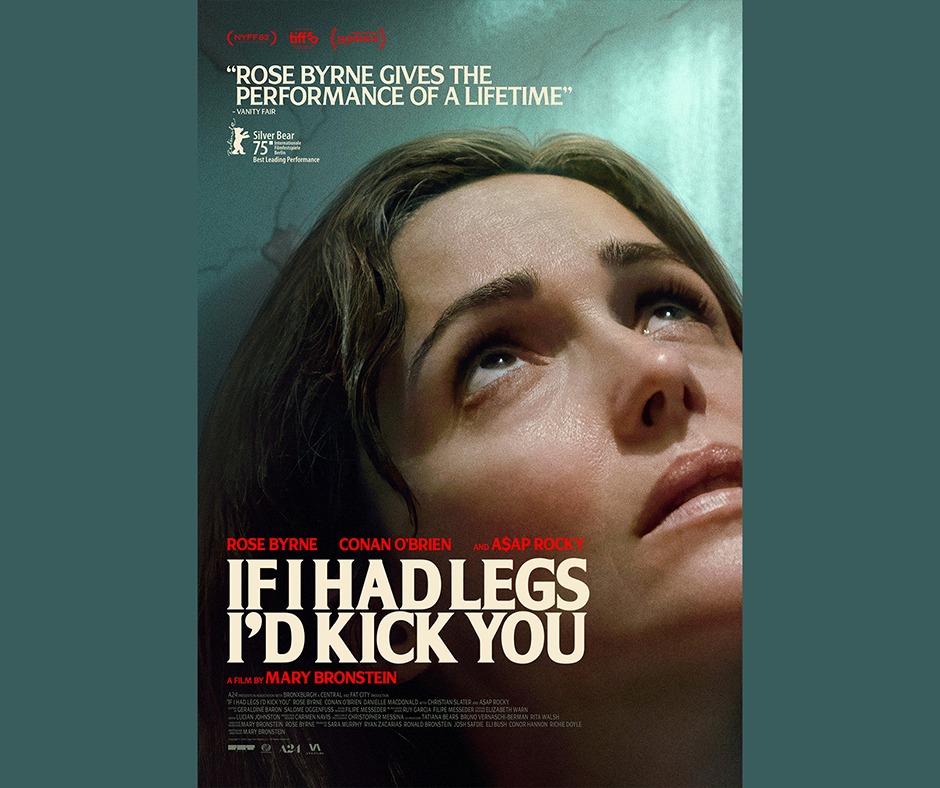
The way Rose Byrne is shot and edited in If I Had Legs I’d Kick You makes her feel like an uncredited fifth character in Requiem for a Dream. If she were in that movie, audiences would be asking where her drugs are—but here, she needs none. Her mental illness behaves like a drug anyway, distorting time and flattening reality. She sees a therapist, though she is one herself. It makes you wonder: is this what my therapist is like when they’re not talking to me?
Linda’s life collapses quite literally when a hole opens in her apartment ceiling—possibly from flooding, faulty plumbing, or maybe an alien in the walls. The film never clarifies, because Linda can’t. Her grip on cause and effect is slipping. At the same time, she is responsible for caring for her daughter, who can technically eat but refuses food because it feels “squishy,” and who is graded daily on how much she consumes. The entire household revolves around a single goal: getting her weight up to fifty pounds. Linda is never alone, yet utterly abandoned.
Byrne carries the entire film, delivering a performance built on quiet humiliation and sustained dread. Linda isn’t heroic or admirable; she’s exhausted, brittle, and increasingly convinced she is failing at everything she is supposed to do well. Everyone else feels like a walk-on cameo. Conan O’Brien actually acts, briefly, and his presence reminded me of Dylan Baker in Requiem for a Dream: when someone is unraveling, the most others will do for them is ask a few questions and then discreetly step away.
For a first feature, director Mary Bronstein shows impressive control. This could easily have been an amateurish mess—a pile of anxiety with no shape—but instead it becomes a low-budget, quietly devastating minor masterpiece. Byrne somehow landed a role most actresses would have killed for, had they known what Bronstein was after. Onscreen, it feels uncomfortably familiar.
The bees are dying, the executives are talking, and the joke may be on us.
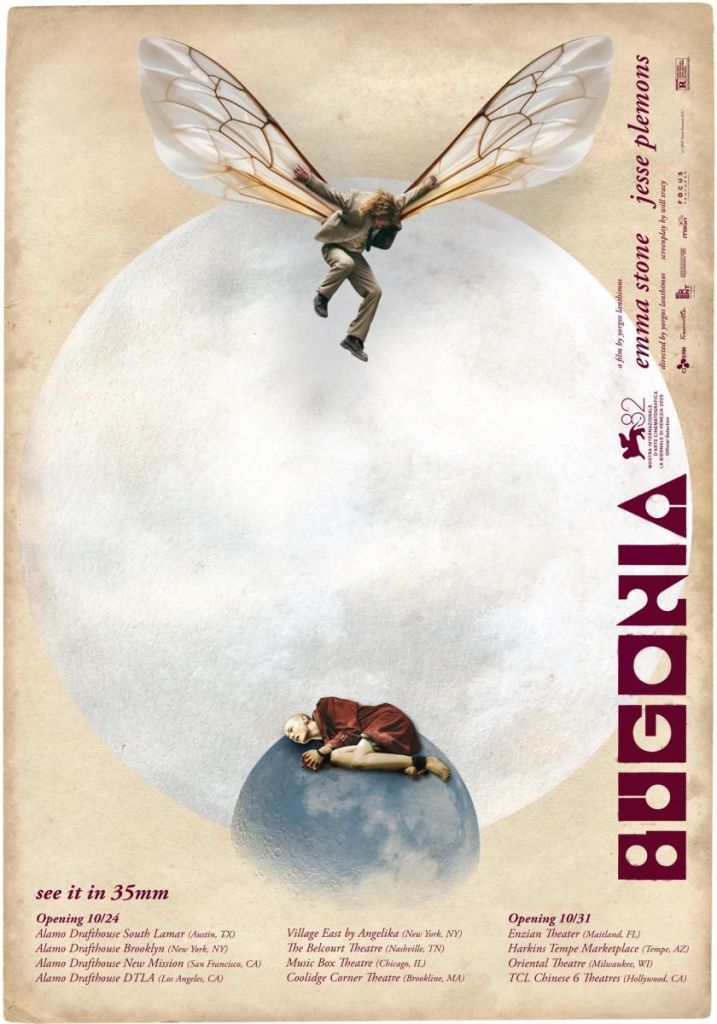
Is Bugonia a place? A character’s name? Apparently it has something to do with Greek mythology and bees. I’ve always thought that if the human race died out, it would have something to do with colony collapse disorder. I just never imagined it could happen—or look quite like this.
Emma Stone plays Michelle, an executive at a vast, vaguely defined conglomerate—something like Amazon filtered through the pharmaceutical industry. She delivers corporate edicts that sound humane while being quietly coercive, the kind of language designed to make people work harder for less while thanking management for the privilege. Stress is treated as a given. Burnout is reframed as responsibility. Somewhere in the background, the bees are dying.
There’s enough good in Bugonia to almost compensate for Yorgos Lanthimos’s increasingly questionable sense of humor. The film has the shape and texture of something very familiar—procedural, paranoid, vicious. With only minor adjustments, it could easily pass for a season of Fargo. The score and cinematography are immaculate, and the performances are absurd in ways that still feel recognizable. Everything seems carefully built. It might even feel like a masterpiece—right up until it decides not to be one. But what’s the fun in that?
The Oscar buzz around Stone feels less about nuance than about her continued commitment to being Lanthimos’s most pliable collaborator. Yes, she really shaved her head for this. The film flirts with weighty ideas—mental illness, institutional power, corporate systems managing human behavior—in ways that feel unnerving and recognizable. But it keeps shifting, nudging, testing how much disbelief the audience is willing to suspend.
The whole thing plays like a meticulously structured Upright Citizens Brigade sketch that refuses to announce where the joke is—or when it’s over. I understood what it was doing. I admired the confidence. This could have been No Country for Old Men or The Silence of the Lambs. I just couldn’t shake the feeling that it was laughing at a version of the movie I would have liked better.
Bugonia is handsome and deeply committed to its own logic. In real life, we probably already know these characters. Whether we recognize them as such is another matter.
A thoughtful elegy that ends as a plea for significance.
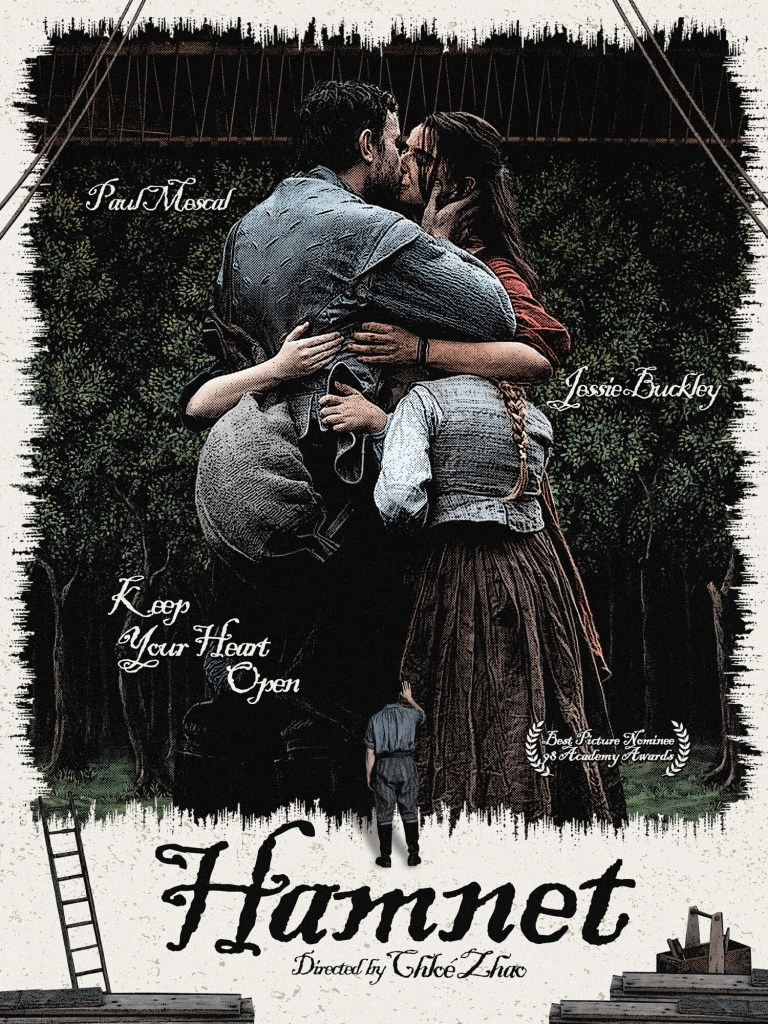
Hamnet is intermittently compelling while you’re watching it, but I don’t think the world will ultimately care very much. The first half works surprisingly well, unfolding with a meditative patience that recalls the style of Chloé Zhao—a comparison that will excite the half of the audience that tolerated Nomadland and bore everyone else senseless. There’s a quiet confidence early on, an observational calm that treats grief as a lived condition rather than a dramatic event. For a while, Hamnet feels like it knows exactly what kind of movie it wants to be.
That confidence collapses by the end. Some have positioned Hamnet as the “real” Shakespeare in Love, but that comparison only highlights how much that film got right. Hamnet can’t decide how its characters are supposed to exist: they often speak like modern people who binge Outlander, then suddenly shift into scenes written in full Shakespearean verse. The tonal whiplash is baffling. Are we meant to believe the audience can’t handle period language—except when it’s convenient?
The final act fails outright. Leaning on Adagio for Strings—arguably the most famously depressing piece of music ever written—to sell Shakespearean tragedy feels desperate, not profound. The camera lingers on Jessie Buckley’s face for so long that people around me literally fell asleep, and the staging of the finale makes entering the center of the Globe Theatre feel about as casual as finding a spot near the stage at a rock concert. I liked too much of Hamnet to recommend against seeing it, but I give a thumbs down to the very elements most people seem to admire.







 Avidavr: Media Reviews