Talking Animals, Shakespeare, and Amazonian Aliens.
At some point these stopped being short reviews and started turning into whatever this is. I’m fine with that. Here are the next three movies, in the order I watched them.
Here you go:
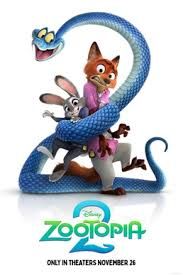
Zootopia 2
Zootopia 2 benefits enormously from revisiting Zootopia, which has aged surprisingly well—far better than Moana, which now feels small and oddly muted, like a wannabe epic propped up by great songs. The problem with Moana as a franchise is structural: it barely has characters. There’s Moana, her stern father, her dead grandmother, Maui, a chicken, and the ocean. That’s not a world; it’s a fable. Moana 2 clearly didn’t know where to take those pieces next, and the result felt pointless. (Also: why did no one ever eat the chicken?) Disney’s recent sequel strategy has been so uninspired that it briefly makes you wonder whether they should just stay out of theatrical sequels altogether.
Or maybe not. Zootopia 2 is fun, clever, and densely packed with jokes. The original film had a deceptively simple premise that left room to grow, and this sequel smartly picks up only a week after the first movie ends. It initially feels odd, but it works—the film plays like episode two of a throwaway detective TV show that accidentally became excellent. Unlike Moana 2, which lists four credited screenwriters, Zootopia 2 is written by a single voice: Jared Bush, who also co-directs. That cohesion matters. Even when the movie leans into procedural rhythms, it feels confident—like an artist cracking jokes, experimenting and laughing at his own instincts. It’s lighter than the original, but boldly understands its own strengths.
8/10.
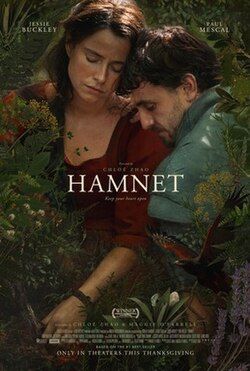
Hamnet
Hamnet is intermittently compelling while you’re watching it, but I don’t think the world will ultimately care very much. The first half works surprisingly well, unfolding with a meditative patience that recalls the style of Chloé Zhao—a comparison that will excite the half of the audience that tolerated Nomadland and bore everyone else senseless. There’s a quiet confidence early on, an observational calm that suggests grief as a lived condition rather than a dramatic event. For a while, Hamnet feels like it knows exactly what kind of movie it wants to be.
That confidence collapses by the end. Some have positioned Hamnet as the “real” Shakespeare in Love, but that comparison only highlights how much that film got right. Hamnet can’t decide how its characters should exist: they often speak like modern people who binge Outlander, then suddenly shift into scenes written in full Shakespearean verse. The tonal whiplash is baffling. Are we meant to believe the audience can’t handle period language—except when it’s convenient? The final act fails outright. Leaning on Adagio for Strings—arguably the most famously depressing piece of music ever written—to sell Shakespearean tragedy feels desperate, not profound. The camera lingers on Jessie Buckley’s face for so long that people around me literally fell asleep, and the staging of the finale makes entering the center of the Globe Theatre feel about as casual as finding a spot near the stage at a rock concert. I liked too much of Hamnet to recommend against seeing it—but I give a thumbs down to the very elements most people seem to praise. 6/10.
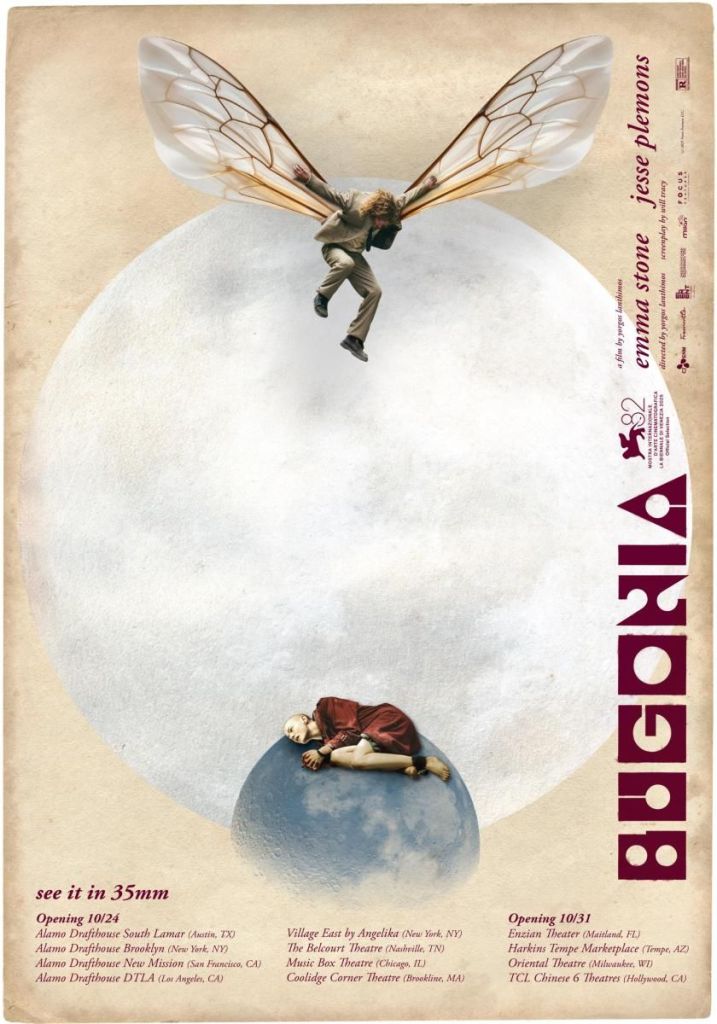
Bugonia
Is Bugonia a place? A character’s name? Apparently, it has something to do with Greek mythology and bees. I’ve always thought that if the human race died, it would have something to do with colony collapse disorder. I just never imagined it could really happen—or look quite like this.
Emma Stone plays Michelle, an executive at a vast, vaguely defined conglomerate—something like Amazon filtered through the pharmaceutical industry. She delivers corporate edicts that sound humane while being quietly coercive, the kind of language designed to make people work harder for less while thanking management for the privilege. Stress is treated as a given. Burnout is reframed as responsibility. Somewhere in the background, the bees are dying.
There’s enough good in Bugonia to almost compensate for Yorgos Lanthimos’s increasingly questionable sense of humor. The film has the shape and texture of something very familiar—procedural, paranoid, vicious. With only minor adjustments, it could easily pass for a season of Fargo. The score and cinematography are immaculate, the performances relatably absurd. Everything feels carefully built. It might even feel like a masterpiece—right up until it decides not to be one. But what’s the fun in that?
The Oscar buzz around Stone feels less about nuance than about her continued commitment to being Lanthimos’s most pliable collaborator (yes, she really shaved her head for this). The film flirts with weighty ideas—mental illness, institutional power, corporate systems managing human behavior—in ways that feel unnerving and recognizable. But it keeps shifting, nudging, testing how much disbelief the audience is willing to suspend.
The whole thing plays like a meticulously structured Upright Citizens Brigade sketch that refuses to announce where the joke is—or when it’s over. I understood what it was doing. I admired the confidence. This could have been No Country for Old Men or The Silence of the Lambs. I just couldn’t shake the feeling that it was laughing at a version of the movie I would have liked better.
Bugonia is handsome and deeply committed to its own logic. In real life, we probably already know these characters. Whether we recognize them as such is another matter.
7.5/10
This will all continue in a third and final-ish part.
 Avidavr: Media Reviews
Leave a comment