My 27 Movie A-Z Film-a-thon: Day 27.
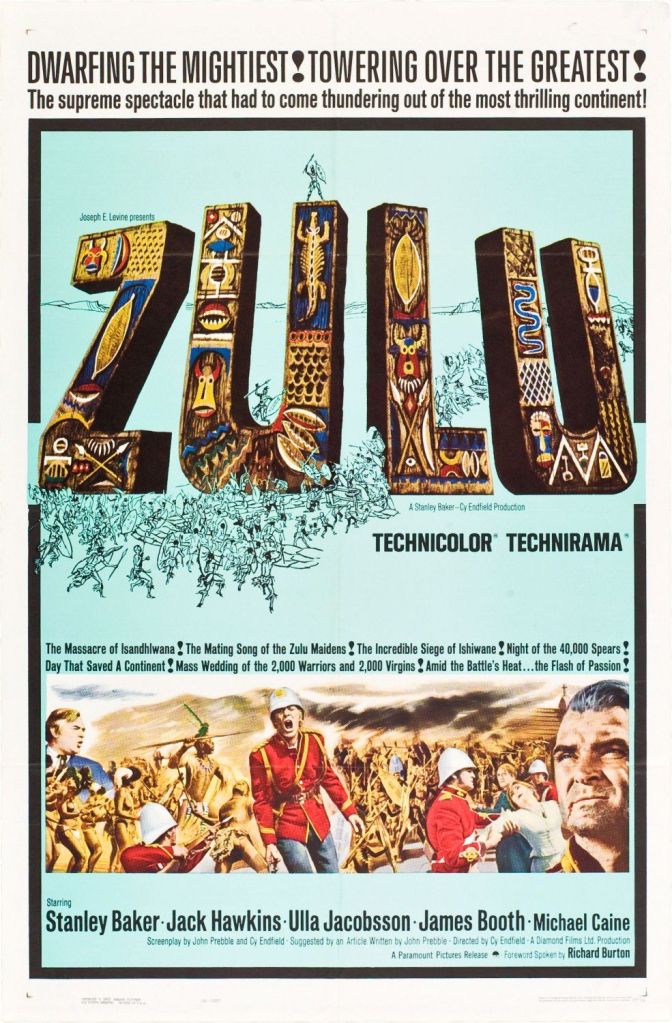
Zulu (1964)
I’d like to think a great war movie could be made about the Battle of Rorke’s Drift—but Zulu (1964) isn’t it.
In history videos on YouTube, Zulu warriors are always portrayed as one of the most fearsome and disturbingly ferocious forces you’d never want to find yourself at odds with. I was hoping to see a good reason here for why that is. Why wasn’t I shown that?
Almost nothing in Zulu is realistic or historically accurate. The filmmakers present a sanitized and implausible depiction of what actually happened. The movie tries to romanticize Zulu culture as being more about art and admiration than actual victory in war. There are large dance and singing sequences that seem really cool to see on film—until you find out they were written by composers for the movie. I studied primitive cultures’ music in college (my degree is in music), and I don’t know why Western filmmakers feel the need to evolve or improve what actually existed. For instance, modern takes on Native American tribal music always wind up sounding like 20th-century Japan to me.
I’m not going to say Zulu is historically useless—it does a few things right, mostly just by existing at all. You get to see thousands of modern Zulu extras dressed like their great-great-grandfathers and wielding accurate-looking spears and shields. A lot of it just looks cool, and you do learn a few surprising details. For instance, the Zulu brought many guns to the battle, but they were outdated and the warriors were poorly trained in their use. The reality is they only might have hit a few British soldiers—almost by accident. In the movie, it seems like dozens of British soldiers are constantly dying and falling on top of each other.
The movie opens with a real head-scratcher of a sequence. A British missionary and his daughter observe a Zulu wedding ceremony. The daughter keeps asking questions: Why would a young woman marry an older man? The answer: in Britain, younger women marry rich older men all the time. Maybe a Zulu woman wants a brave older man. Isn’t it awful that they don’t wear clothes? Her father responds with one of the best lines in the movie:
> “The Book says, ‘What went ye out into the wilderness to see? A man clothed in soft raiment?’ You must understand these things if you’re going to stay in Africa. That’s why I brought you here. They are a great people, daughter.”
Then the scene ends… absurdly. The daughter suddenly freaks out, rushes back to the carriage, and starts screaming like she’s being chased—even though no one’s threatening her. A man stands at the door. She continues to scream while getting inside. He says something in Zulu to the other warriors. Then—seemingly out of nowhere—another Zulu warrior stabs the man at the door. The carriage rides away and a hundred Zulu give chase for about 50 feet. This is never brought up again.
This didn’t really happen. It seems to serve no narrative purpose except to suggest that a British woman couldn’t handle being around non-white people and would get hysterical on a whim. Then a Zulu warrior stabs one of his own, seemingly out of confusion. So in one swift scene, the movie manages to be both racist and misogynistic—all for the apparent logic of “you can’t open a movie with just an hour of dialogue where nothing happens. Kill someone!” “Okay, Mr. Producer.”
It’s a real flaw that the movie is only told from the British perspective. There’s no context for why the Zulu were fighting the British at all. The setup is basically: “We were just living here, minding our own business, when thousands of Zulu came up to our door and started threatening us.” The truth is, colonial Britain was one of the most evil regimes in history—and we don’t get to see even a moment of what the Zulu were fighting for.
The film tries to balance out that lack of perspective by framing the battle as one of mutual admiration and respect. But in truth, the British actually won this battle—and it took a lot of effort and smart fighting to do it. In the movie, the Zulu suddenly retreat for no good reason. They then linger to perform a fabricated “salute song” that seems to say, “We respect you. We have proven ourselves. Now we’ll leave you be.” So… the Zulu actually won the battle and then chose to walk away? Absolute hogwash. Not only does it make no sense, it makes the ending feel so anticlimactic it’s hard to understand why the film was made at all.
And yet—I can’t hate this. It looks great. It’s about a period of history we almost never see on screen. That’s likely because you can’t make a movie about 1800s colonial Britain without making them look like the bad guys—because they were the bad guys. But Britain today is too cuddly to confront on screen, and no country really has the cultural appetite to take them on now.
Germany, maybe:
> “Wanted: hundreds of British actors for a movie that will show how terrible you all are.”
I’d buy a ticket.
6/10
 Avidavr: Media Reviews