My 27 Movie A-Z Film-a-thon: Day 21.
“Aye aye, matey.”
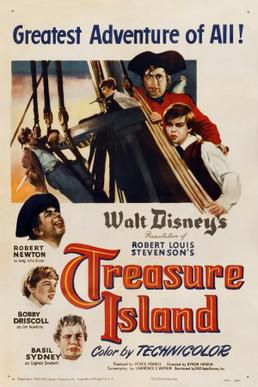
Why do people think this is what pirates sound like? That phrase pops up in Disney’s Pirates of the Caribbean ride, but it actually traces back to Treasure Island—specifically this 1950 Disney movie. No one says “matey” in the original book.
Young Jim is swept into an expedition with a doctor and a squire (where is Jim’s mother?) after a mysterious stranger gives him a treasure map. They bring along the doctor’s cook—Long John Silver—who just so happens to be the most obviously suspicious man imaginable. Silver stages a mutiny, takes over the ship, and reveals himself to be a pirate.
The film oozes with stylized lore. Its success hinges on selling the mythos of piracy, and Robert Newton couldn’t be better. He drips pirate swagger—almost too much. Why would a respectable doctor hire such an obvious pirate as his cook?
The movie seems to imply Silver was planning this all along. But if he was already a pirate, why was he working for the doctor before the map ever appeared? His presence aboard the ship only makes sense if the doctor was recruiting a crew after the map, as in the book. But this version rearranges events in a way that creates plot holes rather than clarifying anything.
Also: Silver is already missing a leg at the start, but the film never tells us why. It’s a missed opportunity—there’s no story behind it, not even a throwaway line. Did he lose it to gangrene? Did the doctor never ask? It’s one of many curious narrative gaps.
Treasure Island is good, not great. It’s historically significant and offers one of cinema’s most iconic pirate performances, but it doesn’t add much to the source material or the pirate genre overall. It leans heavily on atmosphere, production design, and Newton’s performance, while glossing over character logic and story coherence. Still, it’s a film I wouldn’t mind revisiting—if I were marooned on a desert island and had nothing better to do.
7/10
 Avidavr: Media Reviews