My 27 movie A-Z film-a-thon’: day 16.
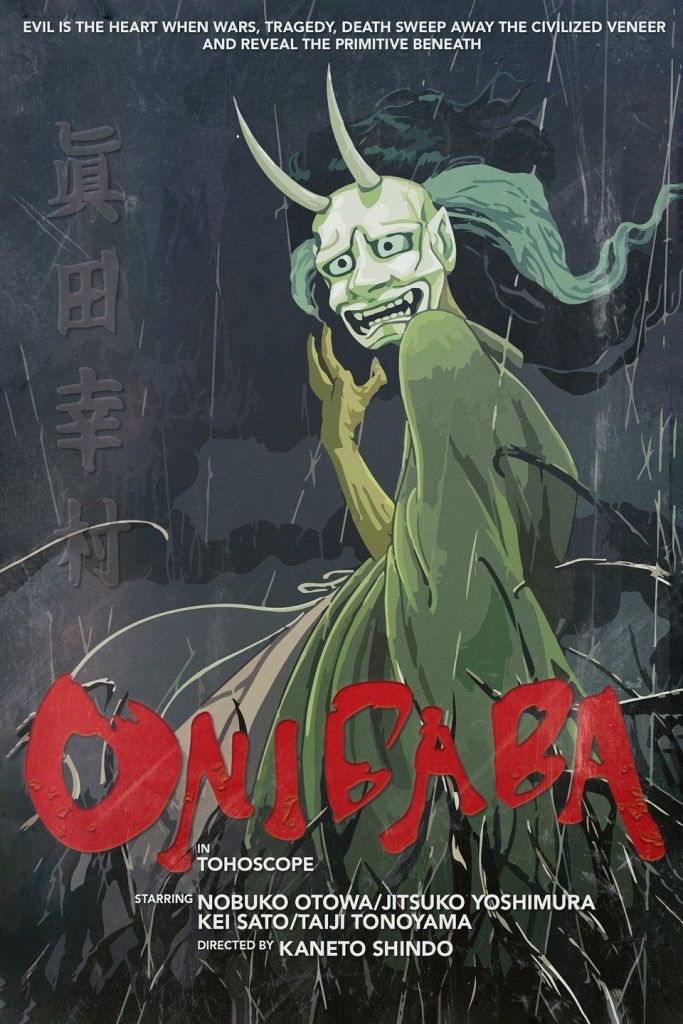
Onibaba (1964)
Onibaba: Demon Woman feels like a 1970s grindhouse movie — except it came out of Japan in 1964. Though “pink films” and exploitation movies had already been made since 1959, Onibaba isn’t a sex picture. It’s a folk-horror art film, and it features some of the best black-and-white cinematography of all time. It looks like Seven Samurai in its craftsmanship. That much effort was put into it.
The plot is slight and semi-ludicrous. Two women, a mother and daughter-in-law, have no way to fend for themselves while the son is off fighting a war. They kill wandering samurai and sell their belongings. I expected them to lure men and poison them, or attack them in their sleep — something two normal women could plausibly do. Nope. When a samurai happens to wander near, they stab him with a spear or bludgeon him with a rock. Killing a fully armored samurai with a single spear thrust seems as far-fetched as saying: Hungry? Just bend this crowbar with your bare hands!
The story centers on Hachi, a soldier who returns home without the son. He claims the son was killed, but the mother suspects Hachi may have murdered him. Hachi quickly discovers the women’s killing scheme and demands a share of the spoils. “Mind your own business,” the mother tells him.
Tension builds as Hachi becomes attracted to the daughter-in-law, now a widow, much to the mother’s horror. She fears losing her killing partner — and maybe something more. She tries to drive a wedge between them, but her interference only fuels their desire.
Tarantino has never explicitly cited Onibaba, but it’s hard to believe he hasn’t seen it. He loves both Japanese art films and pink films from this era, and the ending here feels very Death Proof-esque. The movie wrings everything it can from its setting: a well-scouted marsh, a fearsome demon mask, and immaculate framing. It is unforgettable visually — any frame could be hung in a gallery. It looks exquisite.
The movie has atmosphere, but not necessarily much content. About 30% of the dialogue is filler, with characters repeating key lines three or four times. Still, it is never boring, which is a rare thing for me to say about a 1960s film. Onibaba is rich with emotion, captured against the wild beauty of nature. It’s a rare hybrid: an exploitation film with real artistry, and an art film that embraces sex and nudity with surprising frankness for its time.
If you’re a fan of cult cinema, Japanese film, old horror, or any combination thereof, Onibaba is a relic worth unearthing.
8/10
 Avidavr: Media Reviews