My 27 Movie A-Z Film-a-thon: Day 15.
Day 15: N
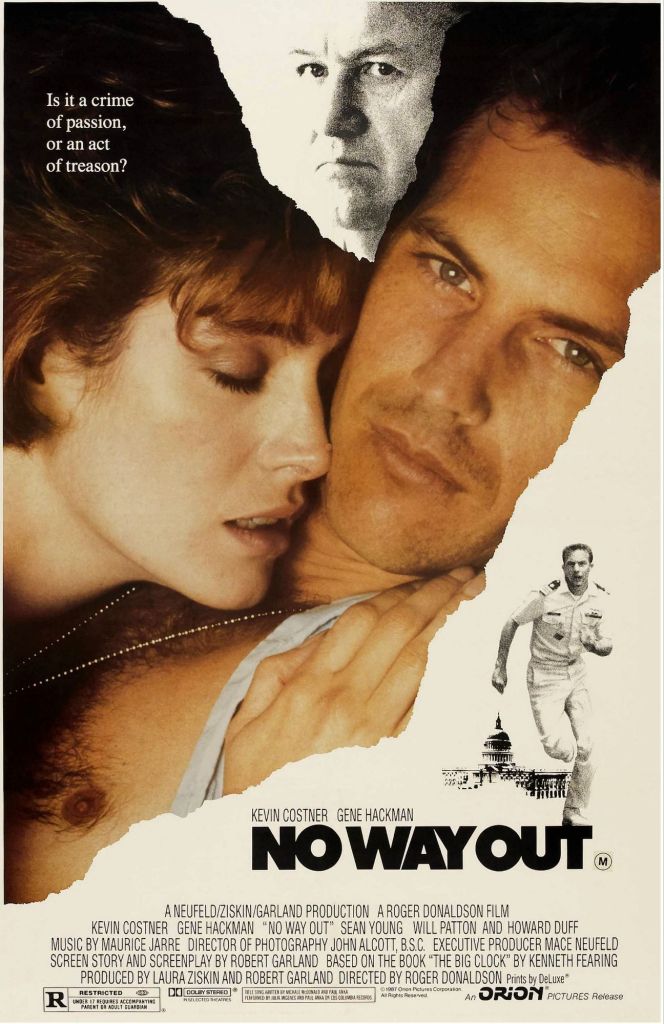
No Way Out (1987)
Let’s get the elephant in the room out of the way: it is absolutely ridiculous that Kevin Costner walks around in a Navy uniform the entire movie. Yes, he’s a high-ranking officer, and Gene Hackman’s Secretary of Defense would likely want a military figure nearby to lend credibility to his authority. But for Costner to walk around in uniform all the time feels like a producer’s decision, not the director’s. (“Just have him in uniform every scene — otherwise how will people understand the trailer?”)
The direction is a little shaky. During the love scene, the characters listen to a song on the radio where the lyrics literally say, “No way out. None whatsoever.” It’s not just a musical cue for the audience — it’s actually playing inside the scene. So, which is it? Is the movie called No Way Out because there’s no way out, or because there’s a song called “No Way Out”? If it’s both… wow. Super cheesy.
The ‘80s really didn’t understand technology, at least not in movies. In Blow Out, it was somehow plausible for John Travolta to turn magazine photos into a moving film. Here, the characters scan a Polaroid negative into a computer to “enhance the pixels.” Of course, Polaroids don’t have pixels — they have pigments — and even today, you can’t magically clarify a bad analog photo with a few keystrokes. And if you somehow could, it wouldn’t take days to do it.
The plot’s logic is generally flawed — because it has to be. Not just the technology, but the basic chain of clues. She only takes one Polaroid? She only leaves behind one negative? If the image enhancement process is so painstaking, they’re awfully lucky there’s just one photo to worry about.
Good things:
I really loved the music. The synth score was probably seen as cheesy at the time, but it has aged surprisingly well. It’s smooth when it needs to be, exciting when the action picks up — the kind of distinctively polished sound that could only have existed a few years after Vangelis’s work on Chariots of Fire. I’m glad movies don’t sound like this anymore, but the ones that do each have a unique charm that adds something you can’t fake.
The actors make the most of what they’re given. The characterizations are astute: both Costner and Sean Young’s characters recognize the practical realities of their situation. Susan (Young) accepts her arrangement, and David (Costner) resigns himself to it. It’s practical and matter-of-fact, up to a point — and relationships portrayed this way are rare. The only other film that comes to mind is The Servant (1963).
Costner is serviceable. Sean Young is great — I honestly don’t know why she didn’t become a bigger star. Gene Hackman has a rather thankless part but, as usual, he makes the most of it. He cuts right to the heart of the power and authority his role demands, without any wasted motion.
This moves briskly, hits its marks, and has some interesting plot turns. It’s not a great story: there are plot holes, no truly standout scenes, and it could have used a sharper director. Costner’s suit stays perfectly clean all the way through, even when he gashes his hand — until the very last scene, where a single drop of blood is ceremonially smeared on the jacket. Wouldn’t it have been better storytelling to have the uniform gradually degrade alongside the rising tension?
Still, No Way Out is a smartly written thriller, one of the better political thrillers of its era. It’s worth checking out — if only to watch Gene Hackman quietly nail yet another role.
7/10
 Avidavr: Media Reviews