My 27 movies A-Z film-a-thon day 9.
I am choosing a movie for each letter of the alphabet that I want to see but likely would not get to in years. So far, I have seen:
_ 13 Assassins (Takashi Miike, 2010) – 9/10
_All Dirt Roads Taste of Salt (Raven Jackson, 2023) – 7.5
_Blow Out (Brian De Palma, 1981) – 8.5
_Cold War (Pawel Pawlikowski, 2018) – 6.5
_Darby O’Gill and the Little People (Robert Stevenson, 1959) – 9
_EO (Jerzy Skolinowski, 2022) – 5
_Fat City (John Huston, 1972) – 9
_Gomorrah (Matteo Garrone, 2008) – 8.5
Maybe I should stick to films at least 10 years old. I feel like a fogey, but I wonder if I have seen all of the most necessary films of recent years. I feel like the trend may be that some of these highly acclaimed movies have so much critical support because they have to like *something*. Every film since 2018. I think are graded on a curve. “Shows promise”, should be attached to the report card.
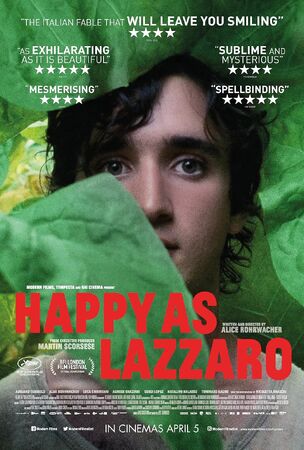
Happy as Lazzaro (2018)
Mixed metaphor city.
This is an allegorical reference to Lazarus in the Bible. But which Lazarus, you ask—Lazarus of Bethany or the beggar Lazarus? The answer is both. Lazarus of Bethany was raised from the dead by Jesus. His story is about miraculous resurrection and faith. The beggar Lazarus, on the other hand, was denied entrance at the gates of a rich man’s home, only to be accepted into Heaven while the rich man suffers in Hell.
I’m not a religious man. I don’t like stories from the Bible—especially not ones that end with someone suffering for eternity in Hell. So this story didn’t really work for me.
Lazzaro is a “blank canvas” character. But in this case, he’s a total blank. He has no discernible traits beyond being passive and agreeable. He makes no major sacrifices and undergoes no deep suffering. At most, he’s overworked. Someone asks him to cover their post—he agrees. They never return. Grueling stuff.
And yet, I might’ve found that charming: the idea of a pure-hearted man quietly enduring a lower-class life while being used by those above him. It has the ingredients of a good Renoir film, exploring class divisions and how each side protects its own. But it didn’t need to reference such dramatic, life-or-death biblical stories to tell that tale.
Did I mention the wolves? This is where the metaphors start stacking up to the point of collapse. A mystical wolf appears, seemingly tied to Lazzaro’s nature or fate. Another character teaches him to howl back, and a narrator even tells a story about a wolf that may, in fact, be about Lazzaro himself. It’s all very… much.
That said, Happy as Lazzaro is gorgeously directed and features a few genuinely inspired moments. The story of the rich exploiting the poor certainly has cultural resonance. Lazzaro is a nice idea for a character, and the message has value. But the rich don’t seem quite rich enough, and the poor don’t seem quite poor enough.
Mostly, there are too many moments of allegory that feel forced or unnecessary. I won’t spoil them here—this deserves to be seen, and some viewers will walk away feeling deeply satisfied.
For me, Alice Rohrwacher would go on to do a much better version of these themes in La Chimera—a film that feels deeper, more believable, and uniquely necessary.
7/10
 Avidavr: Media Reviews
Leave a comment